Amsterdam [Netherlands], September 14 (ANI): India could emerge as the key market for building a global Direct-to-Mobile (D2M) ecosystem, with broadcasters and technology leaders from the US and Brazil looking to the country’s scale, semiconductor ambitions and device-manufacturing capabilities to accelerate adoption of broadcast-to-mobile services.
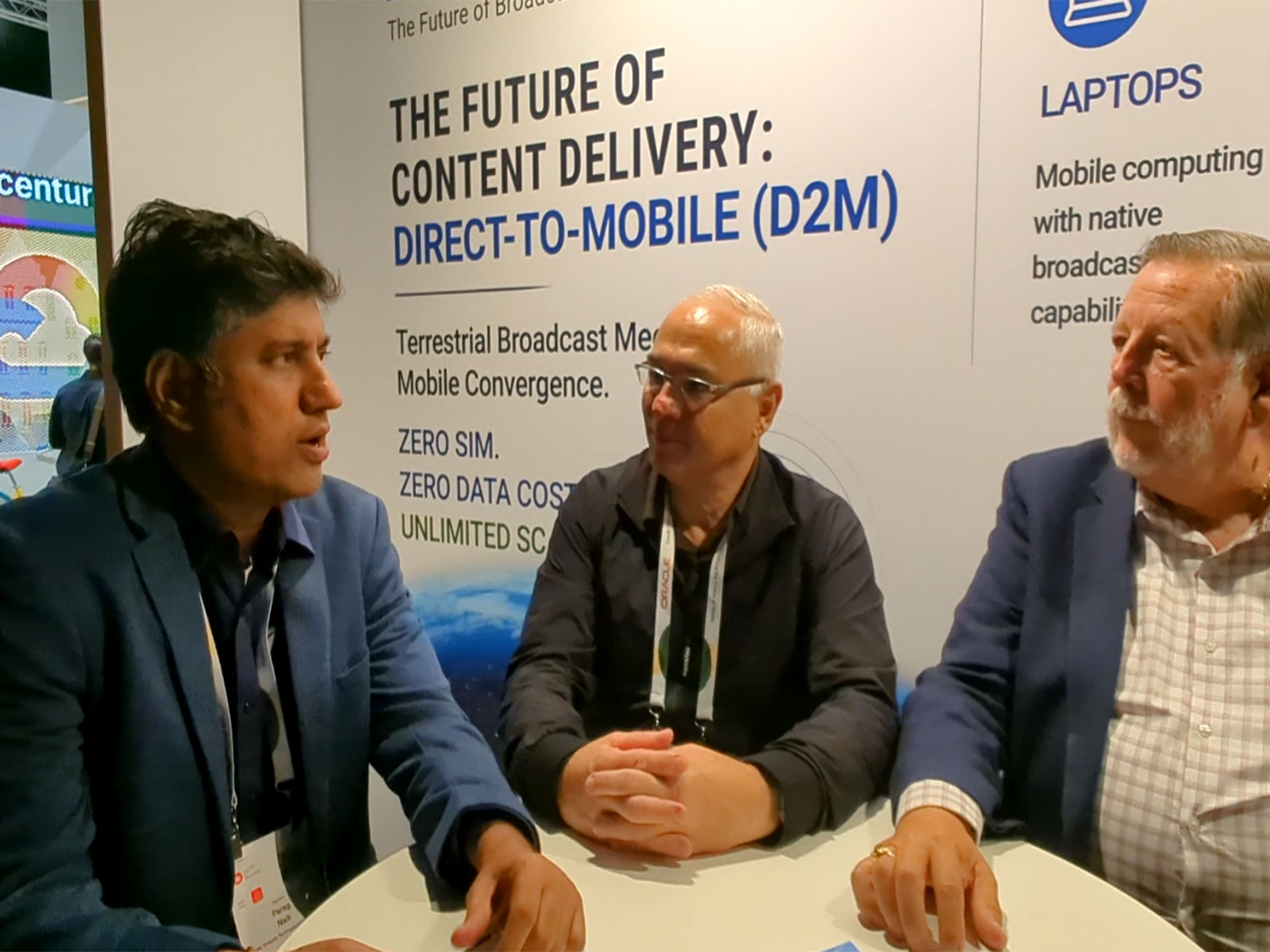
Speaking at the International Broadcasting Convention (IBC) 2026 in Amsterdam, Raymundo Barros, Chief Technology Officer of Brazilian media major Globo and chairman of the Brazilian Digital Television Forum, said the convergence of India, the US, South Korea and Brazil around compatible broadcast technologies could create the scale needed to make D2M commercially viable.
“When we have India having adopted the same technology, US, Korea and Brazil, we have a huge market,” Barros said. “If we collaborate, we can make the ecosystem happen in such a way that devices, telcos, government and broadcasters can work together to provide consumers free access to our content on their mobile phones.”
Barros said Brazil’s experience with its next-generation digital television platform had demonstrated the potential of the technology for both fixed and mobile reception. Brazil selected ATSC 3.0 as the basis for its next-generation television system, while adding innovations in areas such as codecs and MIMO transmission.
According to Barros, Brazil began planning the evolution of its broadcast ecosystem in 2020, recognising the continued importance of free-to-air television in the country. The country has already begun deploying its new DTV+ service, with further expansion planned over the coming years.
For India, however, the larger opportunity may lie beyond television sets. The country’s enormous consumer market could provide the scale required to persuade global device manufacturers to incorporate D2M capabilities into phones, tablets, notebooks and other connected devices.
Barros said the approach used in Brazil to establish standards for television manufacturing could offer a model for India’s mobile-device ecosystem.
“I think the same principles can be applied for the mobile phones as well,” he said. “If in India, if that’s such a huge market, you can have those global manufacturers engage on the D2M programme in India. I really think the ecosystem problem is going to be solved.”
Mark Aitken, President/SVP of ONE Media/Sinclair in the US, echoed that view, arguing that India’s market size could provide the missing catalyst for D2M.
“The marketplace is missing that one little element, the catalyst, which is commitment,” Aitken said. “Markets need certainty.”
He added that India’s scale could fundamentally change the economics of the device ecosystem.
“When you see a market like India opening up to D2M, suddenly, you’ve got everybody going to want to be part of a 1.4-billion-person marketplace,” Aitken said.
Aitken, who said his organisation has worked in India for years on chipsets and devices for mobile television, said D2M could extend across an entire range of consumer electronics, rather than being limited to conventional television.
“This technology isn’t just about television sets. It’s about tablets. It’s about notebooks. It’s about feature phones,” he said.
The attraction for consumers, he argued, is equally straightforward: D2M can deliver free-to-air television without requiring a mobile data connection or SIM card.
“The idea that I don’t need a data plan, I don’t need a SIM card, that in fact, this is free-to-air television,” Aitken said, could become a compelling proposition for consumers across different classes of devices.
This is particularly significant for India, where affordability and access remain important considerations in the expansion of digital services. A D2M-enabled device could allow users to access broadcast content without consuming mobile data, potentially creating a new distribution channel for broadcasters.
Aitken also pointed to India’s semiconductor and electronics-manufacturing policies as an important potential catalyst. A clear policy commitment, he suggested, could give device makers and component manufacturers the certainty required to invest in D2M-compatible products.
The discussion also highlighted the strategic dimension of terrestrial broadcasting. Aitken argued that terrestrial networks offer countries a degree of technological sovereignty because they provide an alternative distribution infrastructure outside commercial mobile networks.
“Only terrestrial television offers that level of sovereignty to those nations that deploy,” he said. “So, you’re putting sovereignty into the hands of the people.”
For India, the message from the US and Brazil is therefore broader than simply adopting another broadcast technology. Its large consumer base, growing semiconductor ecosystem and ambitions in electronics manufacturing could make the country a critical market for establishing the device scale required to take D2M beyond individual national deployments.
The central challenge now is moving from technology demonstrations and standards alignment to a coordinated ecosystem involving broadcasters, device manufacturers, chipset companies, telcos and policymakers.
As Aitken put it, “The technology is solved. The business proposition is largely solved.” The remaining question, he suggested, is whether the industry can create the devices and deployment certainty needed to put that technology into consumers’ hands.
With India potentially connecting the D2M ambitions of some of the world’s largest broadcast markets, the country could become not just a participant in the next phase of broadcast technology, but one of its most important catalysts. (ANI)