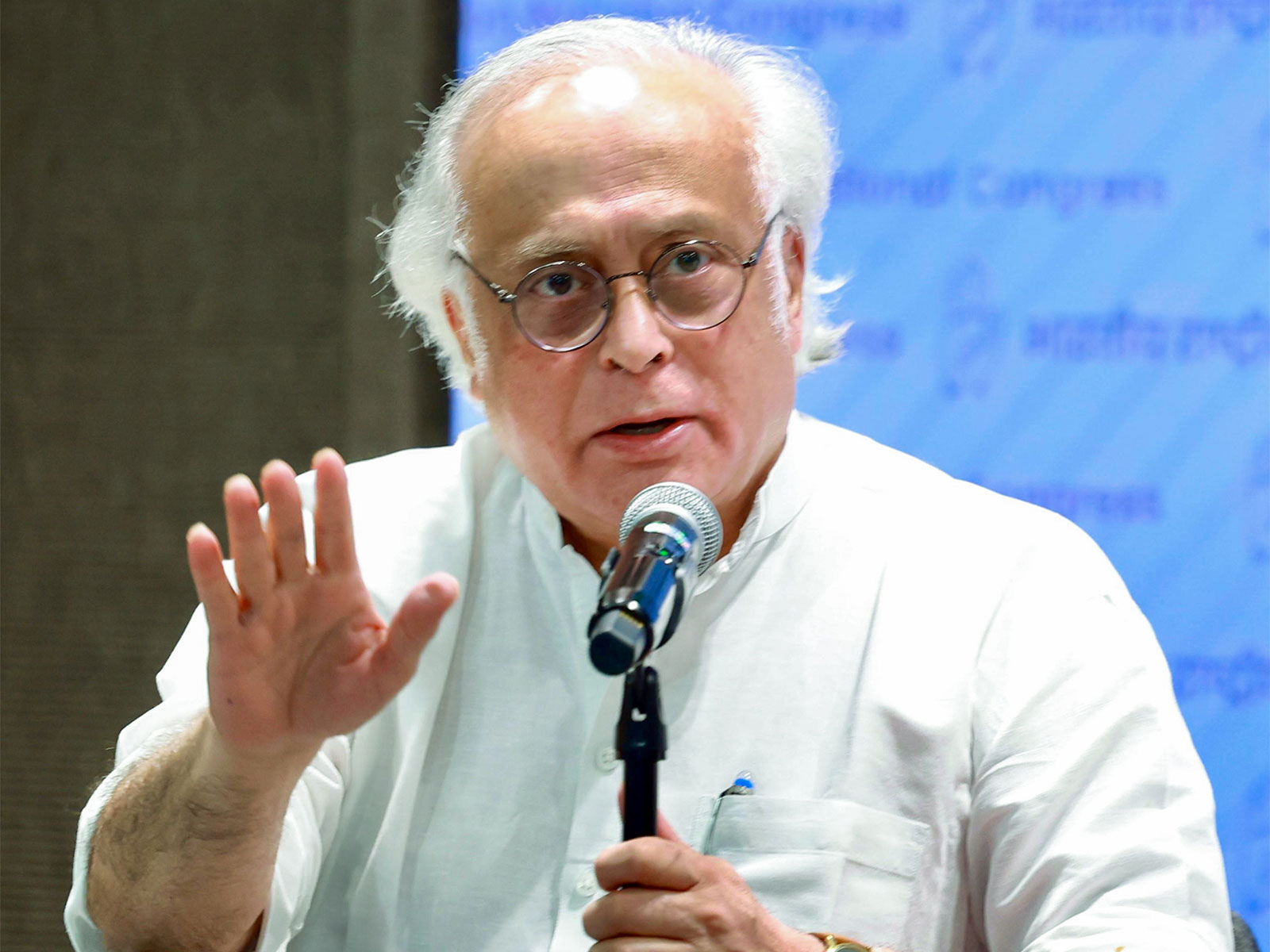
New Delhi [India], August 22 (ANI): Senior Congress leader Jairam Ramesh on Saturday raised concerns over a split decision by the Supreme Court of India, warning that the ruling risks diluting crucial worker safeguards and creating widespread legal ambiguity.
In a post on X, Ramesh stated that leaving this “hypothesis” on record creates an “interpretive vacuum that could open a Pandora’s box of litigation and uncertainty, particularly before Labour Courts and Industrial Tribunals.”
“The Supreme Court has clarified that this reformulation will not disturb concluded or pending proceedings under the erstwhile Industrial Disputes Act as amended from time to time and will not govern interpretation of the new Industrial Relations Code. But leaving this “hypothesis” on the record creates an interpretive vacuum that could open a Pandora’s box of litigation and uncertainty, particularly before Labour Courts and Industrial Tribunals. This leaves space for a narrower definition to take hold in practice, especially when the Industrial Relations Code already empowers the Central Government to exclude further categories of establishments from its ambit,” he said.
He cautioned that narrowing the definition of an “industry” alongside the Central Government’s powers under the new Industrial Relations Code (IRC) risks “weakening worker safeguards precisely when they are needed most.”
“The Aug 2026 majority judgment is concerning because it injects uncertainty into labour relations at a time when clarity is essential for industrial peace. In an open economy with increasing private delivery of services, any move to narrow or distance the law from the broad definition of “industry” risks weakening worker safeguards precisely when they are needed most,” added Ramesh.
He alleged that the Modi Government’s Industrial Relations Code, 2020 is significantly weakening essential safeguards for workers. The triple test broadly asks whether an activity involves systematic activity, cooperation between employer and employee, and production or distribution of goods or services to satisfy human wants and wishes.
“Against this backdrop, a narrow 5:4 majority of the Supreme Court, in State of Uttar Pradesh v. Jai Bir Singh delivered on 20 August 2026, has “hypothesised” a reformulation of the Triple Test laid down in its earlier landmark Feb 1978 verdict in the Bangalore Water Supply & Sewerage Board v. A. Rajappa case,” said the Congress leader.
On August 20, 2026, a nine-judge Constitution Bench led by Chief Justice Surya Kant delivered a majority verdict in State of Uttar Pradesh v. Jai Bir Singh. The decision reformulated the long-standing 1978 “Triple Test” from Bangalore Water Supply & Sewerage Board v. A. Rajappa. For nearly five decades, the 1978 benchmark broadly brought non-profit, public, and charitable entities under the protective ambit of the Industrial Disputes Act, 1947.
“The 2026 majority judgment narrows this approach in two important ways: (i) by requiring an activity to have a “discernible commercial character” resembling trade or business–an additional requirement not found in the earlier test; and (ii) by broadening the scope of the sovereign-function exemption, potentially placing a wider range of government activities outside the definition of ‘industry'”, said Ramesh.
The 2026 bench held by a 6:3 majority that while the core framework of the 1978 judgment had stood the test of time, aspects of its “triple test” required refinement.
CJI Surya Kant, joined by Justices PS Narasimha, Satish Chandra Sharma, Joymalya Bagchi, Alok Aradhe, and Vipul M. Pancholi, held that statutory definitions under the 2020 Code must be interpreted independently on their own text and context rather than past precedent. Justices BV Nagarathna, Dipankar Datta, and Ujjal Bhuyan dissented.
“The importance of how “industry” is interpreted lies in the legal reality of who qualifies as a workman and, consequently, who receives the protections of labour law. In the 1978 Bangalore Water Supply case, the Supreme Court identified three elements that ordinarily characterise an industry: a systematic activity; cooperation between employer and employee; and •production or distribution of goods or services calculated to satisfy human wants and wishes, excluding purely spiritual or religious services,” said Ramesh.
The August 2026 majority judgment restricts this framework by requiring activities to possess a “discernible commercial character” and expanding the scope of sovereign function exemptions. While the Court ruled that the reformulated test will operate prospectively–leaving pending matters under the 1947 Act undisturbed and establishing that the 1978 ruling will not act as a “sheet anchor” for the new Industrial Relations Code (IRC), 2020–critics argue the move undermines labour stability.
“It also held that the absence of profit motive is irrelevant, and activities carried out by charitable institutions or public bodies may still fall within the definition. The only exemption was core sovereign activities — such as the judiciary, law and order, and defence. For nearly five decades, this Triple Test provided a broad and settled framework for determining what constitutes an “industry” under the erstwhile Industrial Disputes Act, 1947 as amended from time to time, bringing a wide range of workers within the protection of labour law,” said Ramesh. (ANI)
Related reading