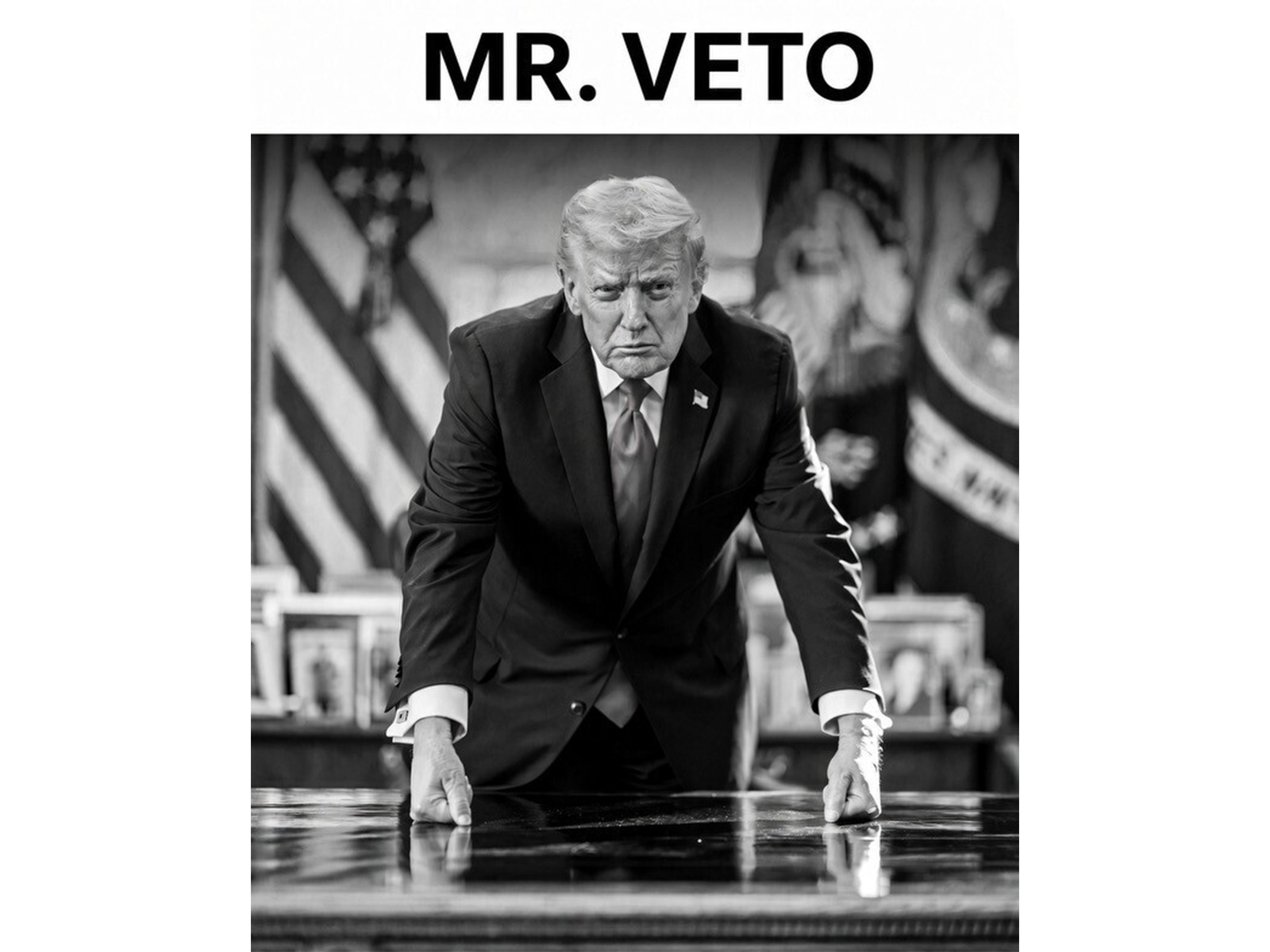
Washington, DC [US], November 7 (ANI): Unfazed by the shifting political terrain following a punishing electoral cycle, United States President Donald Trump has once again taken to social media, sharing a striking black-and-white portrait of himself leaning over a desk, captioned “MR. VETO” on Truth Social.
This defiant digital statement arrives directly in the wake of the 2026 US midterm elections, which delivered a resounding victory for the Democratic Party.
With Democrats sweeping back into commanding control of both the House of Representatives and the Senate in what has been widely characterised as a historic “blue wave”, the legislative balance of power has fundamentally shifted.
These damaging losses pose a formidable obstacle for the remainder of Trump’s presidential term, leaving a fully Democratic-controlled Congress poised to challenge the executive branch.
With Republicans suffering severe electoral losses, congressional Democrats are gearing up to advance ambitious policy proposals, unwind past executive actions and launch rigorous oversight investigations into the administration.
Nevertheless, their newfound majorities do not grant them unhindered legislative control, as the president retains a formidable constitutional safeguard: the power to veto legislation.
Demonstrating his readiness to deploy this mechanism, Trump signalled his intent to check opposition-led bills. Reflecting on the constitutional instrument following the electoral rout, Trump asserted, “It’s the power of veto. It’s one of the stronger powers that a president has.”
Despite drawing a line in the sand, the president indicated a preference for broader governance rather than endless legislative gridlock.
Explaining his stance to Politico, Trump remarked, “I don’t want to be just sitting there for two years vetoing everything.”
Under Article I, Section 7 of the United States Constitution, every legislative measure cleared by the House of Representatives and the Senate must reach the president’s desk before enactment.
The executive branch has a ten-day window, excluding Sundays, to sign a bill, return it with formal objections or permit enactment without a signature.
Should a regular veto be issued, the contested bill returns to its chamber of origin alongside presidential objections.
While Congress retains the constitutional authority to override such blocks, doing so demands a two-thirds supermajority in both the House and Senate, a threshold well beyond the simple majorities Democrats currently command and significantly higher than the standard passage requirement.
Historically, overrides remain rare, cementing the veto as a formidable institutional roadblock.
In addition to regular vetoes, the executive branch maintains the option of a pocket veto.
If a bill remains unsigned for the statutory ten-day period while Congress is adjourned, the measure automatically lapses without taking effect.
Unlike standard vetoes, pocket vetoes cannot be overridden by lawmakers, forcing proponents to restart the legislative process from the beginning.
Beyond direct legislative rejections, the White House can exert influence proactively through explicit veto threats or by issuing formal Statements of Administration Policy (SAPs) to signal executive opposition before bills reach the president’s desk.
Even as the legislative battle lines are drawn, Democratic majorities are expected to utilise congressional oversight tools, including committee hearings, subpoena issuances and inquiries into federal spending, to challenge the administration independently of passing legislation. (ANI)
Related reading