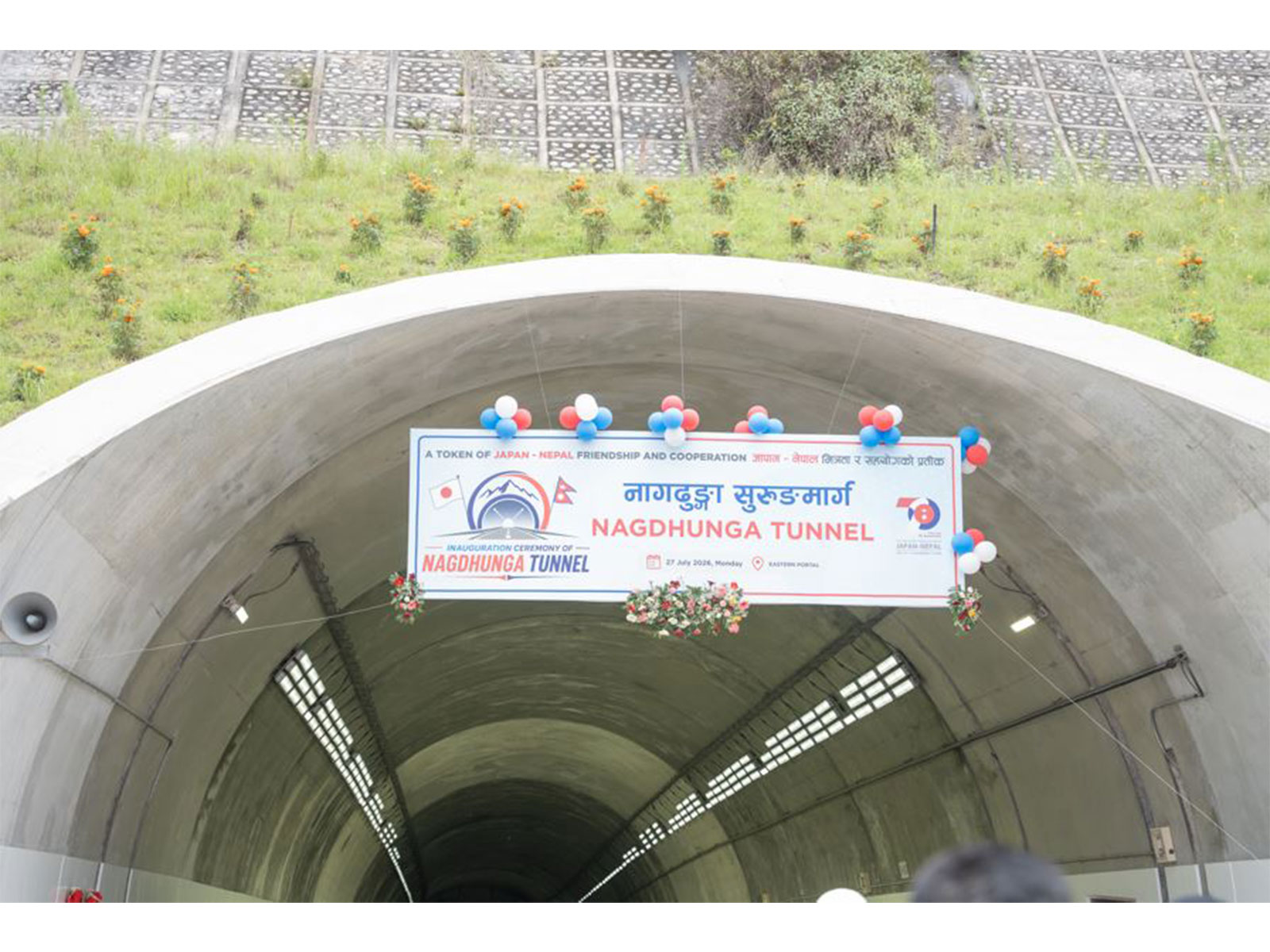
Dhading [Nepal], July 27 (ANI): Nepal’s first road tunnel, the 2.688-kilometre Nagdhunga-Sisnekhola Tunnel, was officially inaugurated on Monday after completing construction over a period of 80 months, marking a major milestone in the country’s transport infrastructure development.
The tunnel was jointly inaugurated by Nepal’s Minister for Physical Infrastructure and Transport Sunil Lamsal, Japanese Ambassador to Nepal Toru Maeda, and Japan International Cooperation Agency (JICA) President Akihiko Tanaka.
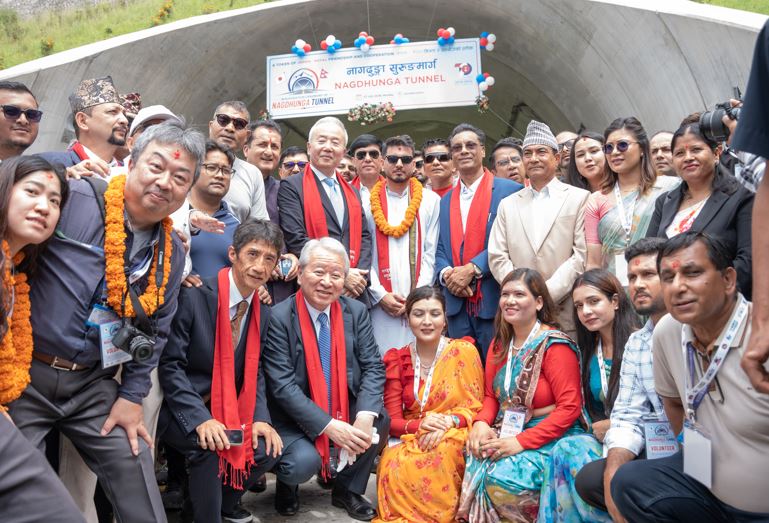
Speaking at the inauguration ceremony, JICA President Akihiko Tanaka said the Nagdhunga Tunnel represents the aspirations of the Nepali people by improving connectivity, enhancing safety and strengthening resilience against natural disasters.
“In many ways, the Nagdhunga Tunnel embodies the aspirations of the Nepali people. It improves connectivity, enhances safety and strengthens resilience against natural disasters. In this respect, the project reflects the principles of human security to ensure safer mobility, maintain connectivity during emergencies and expand access to economic opportunity and essential services,” Tanaka said.
Highlighting the significance of the project, Tanaka said the tunnel fulfils a long-standing aspiration of Nepal and will serve as an important gateway connecting Kathmandu with western Nepal and India.
“The Nagdhunga tunnel is a project of historic significance. For many years, the construction of a road tunnel was a shared aspiration among the people of Nepal. Today that aspiration has been realised as Nepal’s first roadway tunnel; it serves as a vital gateway connecting Kathmandu with Western Nepal and India,” he said.
“Approximately 9000 vehicles pass through the Nagdhunga corridor each day. In the past, the journey could take more than an hour during peak congestion; with the opening of the tunnel, it will now only take five to seven minutes,” Tanaka added.
The tunnel connects Sisnekhola of Dhading with Totipakha of Chandragiri Municipality-1 in Kathmandu. The project includes a 2.68-kilometre main tunnel and a 2.56-kilometre emergency rescue tunnel, equipped with modern safety systems such as CCTV cameras, fire-fighting facilities, emergency communication systems, ventilation and other safety features.
The construction contract for the project was signed on November 14, 2019, with the work originally scheduled for completion by April 26, 2023.
However, the project faced delays due to the COVID-19 pandemic, contractor-related issues and local disruptions, leading to an extension of the deadline until October 25, 2025.
The project has been funded through Official Development Assistance (ODA) from the Government of Japan via JICA, along with contributions from the Nepal government. The initial estimated cost of the project was NPR 22.14 billion, with Nepal contributing NPR 5.85 billion and JICA providing a loan of NPR 16.5 billion (up to JPY 16.636 billion).
Under ODA assistance, JICA provides loan support to low-income and least developed countries at an interest rate of 0.01 per cent for 40 years, including a 10-year grace period during which no interest or instalments are required.
The total project cost has since increased to around NPR 29 billion after additional funding was provided during construction.
The construction consultancy was carried out by a joint venture comprising Nippon Koei, Eight Japan Engineering Consultants, Nippon Civic Consulting Engineer, in association with GEOCE Consultants and ITECO-NEPAL.
Japanese construction company Hazama Ando Corporation was responsible for executing the construction work.
Japanese Ambassador to Nepal Toru Maeda highlighted the importance of the project as Nepal and Japan mark the 70th anniversary of diplomatic relations.
“This inauguration is more meaningful as it falls in the year Japan and Nepal celebrate the 70th anniversary of their diplomatic relations. This tunnel was constructed with Japanese Official Development Assistance (ODA) in the form of a loan totalling approximately JPY 22.3 billion or around NPR 21.2 billion and stands as a testament to the close and enduring partnership between our two countries,” Maeda said.
Nepali authorities said the tunnel will undergo a three-month testing phase before public transport vehicles are allowed to use it. Following the initial trial period, the tunnel will gradually be opened for private vehicles.
During the initial operational phase, traffic will be allowed in only one direction to familiarise drivers with the new facility before two-way movement begins. However, motorcycles, scooters and other two-wheeled vehicles will not be permitted inside the tunnel.
Although construction was completed around six months ago, the opening was delayed due to several issues, including the appointment of a separate company for tunnel management and operations.
Nepal has signed an agreement with the Yusin-ART Joint Venture (JV) to operate and maintain the tunnel, including the collection of toll fees from vehicles using the facility.
The service provider has completed preparations for emergency response, rescue operations, emergency protocols, lighting, ventilation and other safety systems. Around 150 employees have been recruited to ensure round-the-clock operations, with staff working in shifts.
The company has received a five-year contract following a competitive bidding process involving ten firms. It will be responsible for routine inspection and maintenance of the tunnel’s civil structures, mechanical and electrical systems, and internal safety infrastructure.
The tunnel is expected to handle around 8,000 vehicles per day once it reaches full capacity. If the projected traffic volume is achieved, it could generate approximately NPR 350 million annually in toll revenue.
Of this amount, around NPR 220 million annually will be paid to the operating company under the five-year agreement, taking the total contract value to NPR 1.10 billion.
The project will also introduce Nepal’s first electronic toll collection system, offering three payment options: cash payment at toll booths, QR code payments, and automatic electronic payments through vehicle-mounted electronic stickers read by high-capacity cameras.
Toll revenues will be deposited into the account of Road Board Nepal, while payments to the operating company will be made by the government.
According to a notice published in the Nepal Gazette on April 9, 2026, cars, vans, pick-up trucks, tractors, microbuses and other light vehicles will be charged NPR 65 while entering Kathmandu and NPR 60 while travelling out.
Minibuses, minitaxis and trucks will pay NPR 125 when entering the capital and NPR 80 when exiting.
Buses and trucks with a single rear axle will be charged NPR 260 when entering Kathmandu and NPR 200 when leaving, while multi-axle trucks and heavy equipment vehicles will pay NPR 600 when entering the capital and NPR 250 when travelling out. (ANI)
Related reading