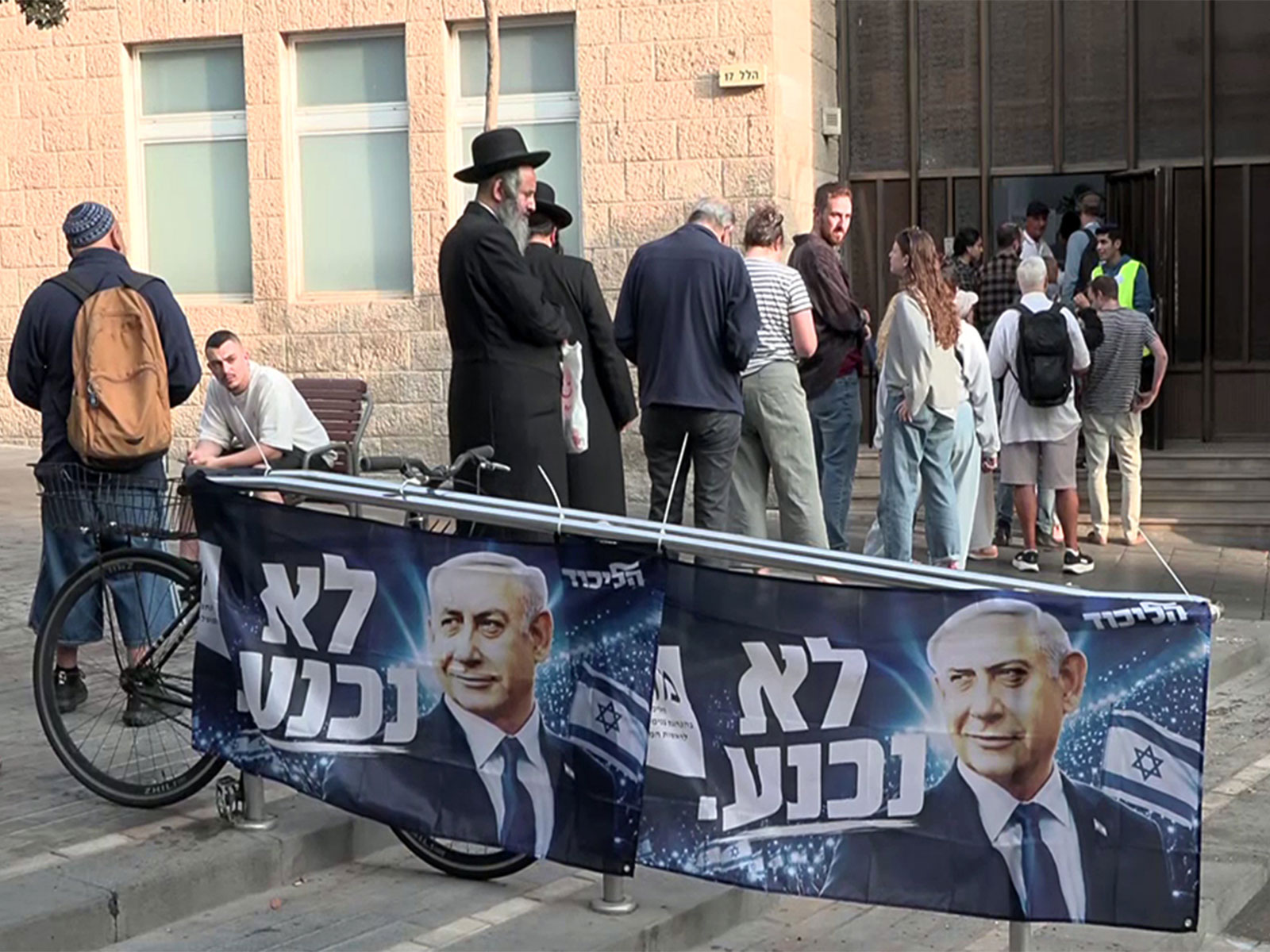

Jerusalem [Israel], October 30 (ANI): Amid growing political tensions surrounding potential external meddling in the electoral process in Israel, Gadi Eisenkot, leader of the opposition Yashar party, launched a scathing attack against Prime Minister Benjamin Netanyahu. According to The Times of Israel, Eisenkot accused the premier of running an organised campaign to undermine the election outcome based on unverified claims, vowing that the scheduled opening of parliament would proceed without delay.
Addressing the nation following briefings with security and electoral chiefs, Eisenkot detailed his discussions regarding the unfolding situation.
“I met earlier with the Shin Bet chief and the head of the Central Elections Committee. I was updated by them on the situation. It is too early to understand what happened and if it happened at all. We must allow the relevant professionals to complete their investigation without any political interference,” he said.
The opposition leader raised serious concerns regarding external actions, particularly pointing fingers at Doha.
“Foreign interference in Israel is unacceptable and grave, all the more so when it involves a state that funds terrorism and supports the terrorist organisation Hamas, and which has managed, in recent years, to infiltrate the office of the Prime Minister of Israel,” he said, in reference to Qatar.
“It is essential to investigate whether they tried to exert influence, and through whom they sought to do so,” he added.
Shifting his focus to domestic political manoeuvres, Eisenkot alleged that the ruling faction was attempting to manipulate the outcome due to a lack of parliamentary backing.
“What is already clear is that Likud and Netanyahu have embarked on an orchestrated and organised campaign to delegitimise the election results,” Eisenkot charged.
“Their statements and talking points were ready. They are doing this because they lost. They do not have a majority. The State of Israel is governed by the rule of law. I will not allow even a centimetre’s deviation from the swearing-in of the Knesset as planned,” Eisenkot declared.
Reaching out to the working public and security personnel, the opposition figure outlined upcoming legislative priorities intended to reshape governance and accountability.
“From here, I wish to address the public that serves in the military and works, those determined to live in the State of Israel as a Jewish and democratic, liberal, strong, and secure state,” he continued.
“In the offices here, next to me, teams are already at work finalising preparations for a law on conscription and service for all Israeli citizens, the establishment of a State Commission of Inquiry into the October 7 massacre, legislation to reform the budgetary mechanism, measures to prioritise those who serve, and more,” Eisenkot said.
“The programmes are ready, and in coordination with my partners, we will work to bring them to a vote at the opening of the Knesset. It is my intention to work to fortify and defend the interests of those who work, those who enlist, and those who are committed to the values of the Declaration of Independence,” he added.
Emphasising a definitive break from past administrative policies, Eisenkot’s promise highlighted the intent to redirect state institutions towards public welfare rather than political preservation.
“I am here to fight for you. And I am determined to fight for your interests. Citizens of Israel, one thing is for sure: the days in which Netanyahu uses government institutions against Israeli interests for his personal interests are over,” he said.
Eisenkot asserted that rhetorical distractions would fail to alter the democratic verdict delivered by the electorate.
“Israel is in a complicated political situation. It is my intention to act as I have always acted, with composure and determination. I call upon everyone to likewise show composure and restraint. Remain patient; there is hope. We will bring it about. I give you my word,” he said.
In response to these unfolding events, Israel’s internal security and counterintelligence service Shin Bet stated that information regarding alleged voter fraud in the recent election stems entirely from internal intelligence on foreign influence campaigns, rather than “any political party or political actor on either side of the political map.”
The agency emphasised that access to the intelligence remained strictly restricted to internal security personnel and Central Elections Committee (CEC) chair Justice Noam Sohlberg until polls closed.
Addressing ongoing inquiries, the Shin Bet noted that its investigation remains active, cautioning that “any statements concerning the content or nature of the suspicions do not reflect the agency’s position.” Once finished, the agency stated it will submit its final findings directly to Sohlberg, “who is the authorised decision-maker on this matter.”
Reaffirming its commitment to statutory boundaries, the Shin Bet stressed that it is operating exclusively under its legal mandate, with all measures being executed by professional staff and internal legal counsel.
Addressing allegations surrounding substantial Qatari funding intended to sway Arab turnout—which reached high levels during Tuesday’s vote—the agency clarified that its inquiry is “focused and limited in scope, and does not cast aspersions on or accuse an entire sector that went out to vote democratically and legally.”
“Only those who acted in violation of the law will be dealt with,” the agency stated.
Additionally, the Shin Bet confirmed that its chief, David Zini, held high-level briefings over the past day with Prime Minister Benjamin Netanyahu, Yashar party leader Gadi Eisenkot, and opposition leader Yair Lapid to outline the core suspicions currently under review. The agency noted that these briefings were conducted with the authorisation and at the explicit request of Sohlberg.
Earlier in the day, Acting Central Elections Committee Director General Dean Livne firmly rejected allegations of widespread election fraud as baseless, insisting that Tuesday’s Knesset vote was conducted lawfully.
Livne dismissed the claims, confirming that no evidence supports allegations of systemic irregularities. “The Knesset elections were conducted lawfully. The integrity of the elections at polling stations was rigorously safeguarded, and to the best of our knowledge, there is no basis for allegations of systematic violations of election integrity,” Livne wrote in a letter addressed to Yesh Atid Knesset Member Vladimir Beliak, who serves on the committee.
Livne clarified that the inquiry requested by CEC Chairman Justice Noam Sohlberg involves classified intelligence requiring additional review, adding that the material has not been substantiated.
The statement comes amid heightened political scrutiny following demands for inquiries into alleged voting irregularities and foreign interference surrounding the election.
Israel’s Central Elections Committee chair, Justice Noam Sohlberg, directed Shin Bet chief David Zini to investigate suspicions of improper foreign influence through funding allegedly provided by entities acting against Israeli interests. Sohlberg has asked the agency to submit its findings within a week.
The order follows incumbent Prime Minister and Likud boss Benjamin Netanyahu alleging that the Arab parties had ‘stolen’ the election using bribery and threats.
Netanyahu described the controversy as an “earthquake”, alleging that foreign entities had interfered in the elections in favour of Arab parties. He called on Zionist parties to reject cooperation with Ra’am and the Joint List.
Incumbent Minister of National Security and Chairman of Otzma Yehudit, Itamar Ben Gvir, called for the arrest of the Arab party bosses and alleged the involvement of money from Qatar.
However, Qatar has strongly denied claims that it interfered in Israel’s elections, accusing “certain Israeli politicians” of exploiting its name to serve domestic political interests and cover up their own failures.
In an official statement published on X, Qatari Foreign Ministry spokesman Majed Al Ansari rejected allegations of funding activities aimed at influencing the vote, warning that Doha will not stay silent while being dragged into Israel’s internal politics.
“We categorically deny allegations that Qatar has interfered in Israeli elections or funded any activities intended to influence their outcome,” Al Ansari stated. “We reject the accusations made by certain Israeli politicians and their contacts in the media, who have launched yet another disinformation campaign aiming to drag Qatar into Israeli political disputes following this week’s elections.”
Similarly, Arab political parties in Israel have rejected allegations linking them to suspected foreign funding and interference in the Tuesday polls.
Mansour Abbas, chairman of the United Arab List (Ra’am), welcomed the decision to investigate the allegations but asserted that his party had no connection to the affair, pledging full cooperation with law enforcement authorities.
Balad chairman Sami Abou Shahadeh also rejected the allegations, accusing Prime Minister Benjamin Netanyahu and his allies of escalating political hostility towards Arab parties and the Arab public.
Israel’s opposition leader and former military chief Gadi Eisenkot has also called for a thorough investigation while warning against using unverified suspicions to undermine the election results or delay the inauguration of the 26th Knesset.
Meanwhile, Israeli President Isaac Herzog held discussions with Central Elections Committee chief Noam Sohlberg and Shin Bet chief David Zini following Sohlberg’s request to probe allegations of external interference in Tuesday’s election.
Speaking from the President’s Residence, Herzog emphasised the necessity of a rigorous review while warning against unfairly maligning the broader Arab populace.
“I am closely following developments in the investigation into the suspicions reported this morning. The integrity of elections is a paramount value in a democracy. The evidence and suspicions must be thoroughly investigated, and the offenders must be investigated and punished to the fullest extent of the law,” the President stated.
“But even at a moment like this, we must avoid tarnishing an entire community that sought to exercise its right to vote and take an active part in democracy,” he cautioned.
Additionally, Israel Police has pledged to investigate all complaints concerning electoral integrity without bias. Authorities have also announced arrests in connection with a suspected election bribery investigation.
The order to investigate allegations of foreign funding with links to Arab parties is likely to strike a body blow to a possibility of them joining hands with the Eisenkot-led bloc to form a government. What that means is that government formation is now poised on a knife’s edge, and whoever President Herzog invites to form the government will have his hands full.
The majority continues to evade any of the coalition blocs. As of now, incumbent PM Benjamin Netanyahu’s Likud is projected to have 26 seats, making it the largest party in the Knesset. Along with his coalition allies like United Torah Judaism, Shas, and Otzma Yehudit, the Likud-led bloc is projected to win 53 seats, which is short of the 61 needed for a majority.
The opposition bloc, comprising Gadi Eisenkot’s Yashar, Naftali Bennett’s B’Yachad, Avigdor Liberman’s Yisrael Beytenu, and Yair Golan’s The Democrats, was projected to win 48 seats. The Arab parties, which include the Joint List and Ra’am, are projected to win 19 seats. (ANI)
Related reading