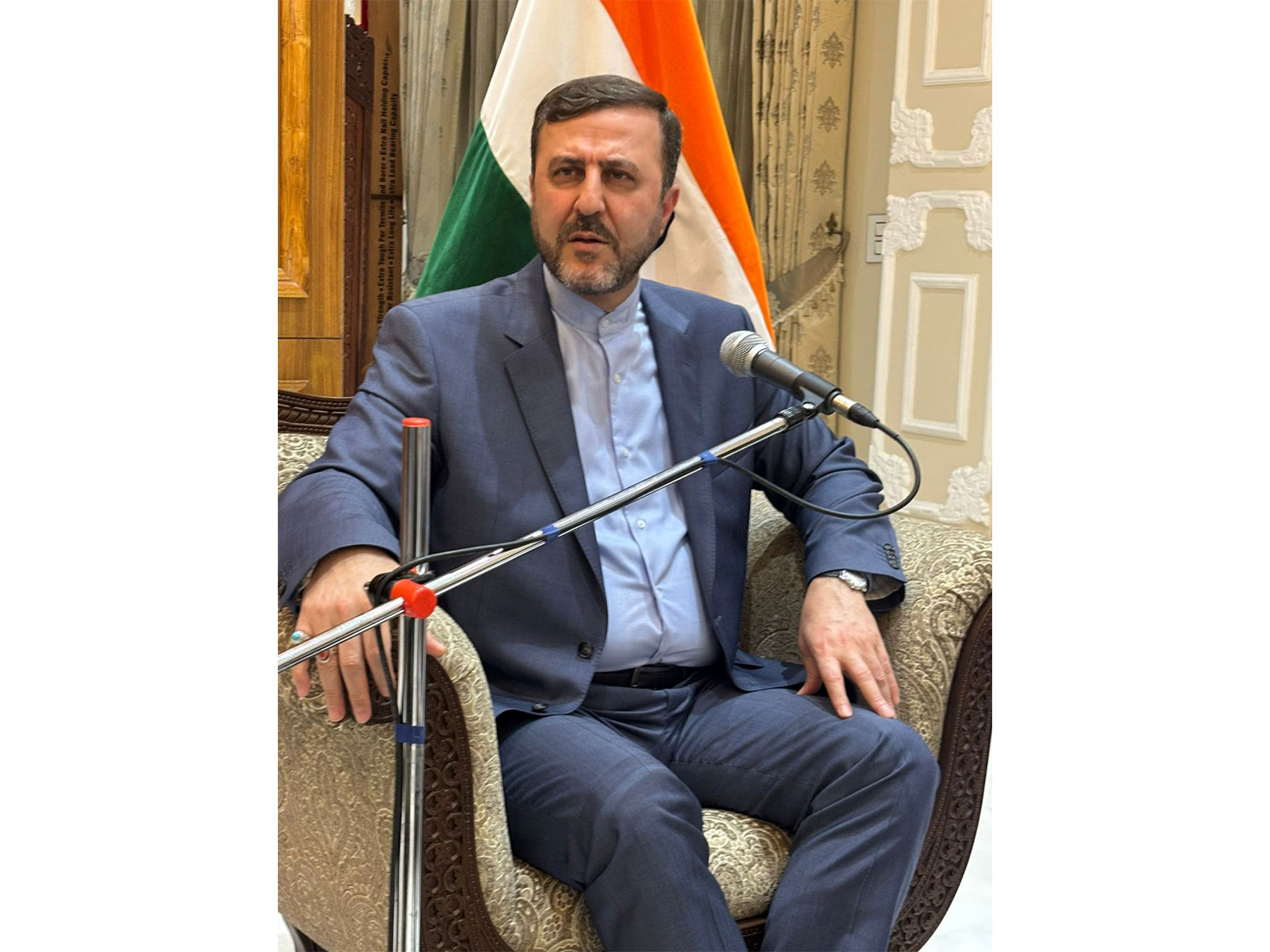
New Delhi [India], May 13 (ANI): Iran on Tuesday said it would welcome any initiative by India to help defuse tensions in West Asia, with Iranian Deputy Foreign Minister for Legal and International Affairs Kazem Gharibabadi praising New Delhi’s “impartial” approach ahead of the BRICS Foreign Ministers’ meeting in New Delhi.
“India has always supported peace and is always in favour of peace,” Gharibabadi said while briefing reporters in the national capital.
Highlighting the close ties between the two countries, Gharibabadi described India and Iran as “two nations with one culture.”
“Both countries are proud of their culture. There are many commonalities and we attach great importance to people-to-people contacts between India and Iran,” he said.
The Iranian Deputy Foreign Minister added that Tehran would welcome any diplomatic initiative from New Delhi aimed at reducing tensions in the region.
“Any initiative coming from India will be welcomed,” he said during interactions ahead of the BRICS meeting.
On the strategically important Chabahar Port project, Gharibabadi said the port remains a major priority for Tehran and acknowledged India’s strong interest in expanding cooperation.
“Chabahar Port is very important. India is very keen to work on this. It largely depends on India how it takes it forward,” he said.
The Iranian Deputy Foreign Minister also praised India’s role within BRICS and said Tehran hopes the grouping will issue a joint declaration after the meeting.
Without naming any country directly, he indicated that one Arab country within BRICS was pushing for language condemning Iran over attacks on neighbouring countries.
On the ongoing tensions around the Strait of Hormuz, Gharibabadi said Iran was prepared to ensure maritime access if the United States removes sanctions, lifts what Tehran describes as a naval blockade, releases Iranian funds and works towards ending the conflict.
“Iran is ready to open Hormuz if the US ends the naval blockade, lifts sanctions, releases Iranian money and terminates the war,” he said.
He also confirmed that Iran and Oman are discussing a mechanism to impose maritime service fees on vessels passing through the Strait of Hormuz, with charges expected to depend on cargo volume and services provided.
“The mechanism has not yet been finalised,” he said.
Gharibabadi further disclosed that Iran is working closely with India to facilitate the movement of additional Indian vessels through the Strait of Hormuz amid continuing tensions in the Gulf.
“Already around 11 Indian vessels have passed. This is not the case with any other country,” he said.
The development is significant for India, which depends heavily on energy imports routed through the Strait of Hormuz, one of the world’s most critical oil shipping lanes.
On mediation efforts between Iran and the United States, Gharibabadi said Pakistan was only the latest among several countries that have facilitated contacts between Tehran and Washington.
“In the past we had Egypt, then Qatar and Oman. This time Pakistan came with an initiative for peace and we welcomed it,” he said.
“Mediators are only facilitating. They are not negotiators,” he added.
Gharibabadi also reiterated that Iran remains open to discussions on the nuclear issue, including uranium production, enrichment and stockpiles.
However, he accused the United States and Israel of abandoning diplomacy despite substantial progress in negotiations.
“After making substantive progress in talks, they launched attacks on Iran,” he alleged.
He said Washington was demanding that Iran halt all uranium enrichment and transfer enriched material to the US, a proposal Tehran considers unacceptable.
“Why should we send all enriched uranium to the US, which has launched a full-fledged war on us?” he asked.
“The US is engaged in dictation, not negotiation,” he said.
Warning of a strong response if hostilities resume, Gharibabadi said Tehran would retaliate if the ceasefire collapses.
“If the ceasefire is broken, we will defend and retaliate,” he said, adding that despite lacking “sophisticated military equipment,” Iran believes its missile capabilities had successfully countered Israel and the United States.
India will host the BRICS Foreign Ministers’ Meeting on May 14 and 15. The meeting will be chaired by External Affairs Minister S Jaishankar. BRICS Foreign Ministers and heads of delegations from member and partner countries will participate in the meeting. (ANI)
Related reading