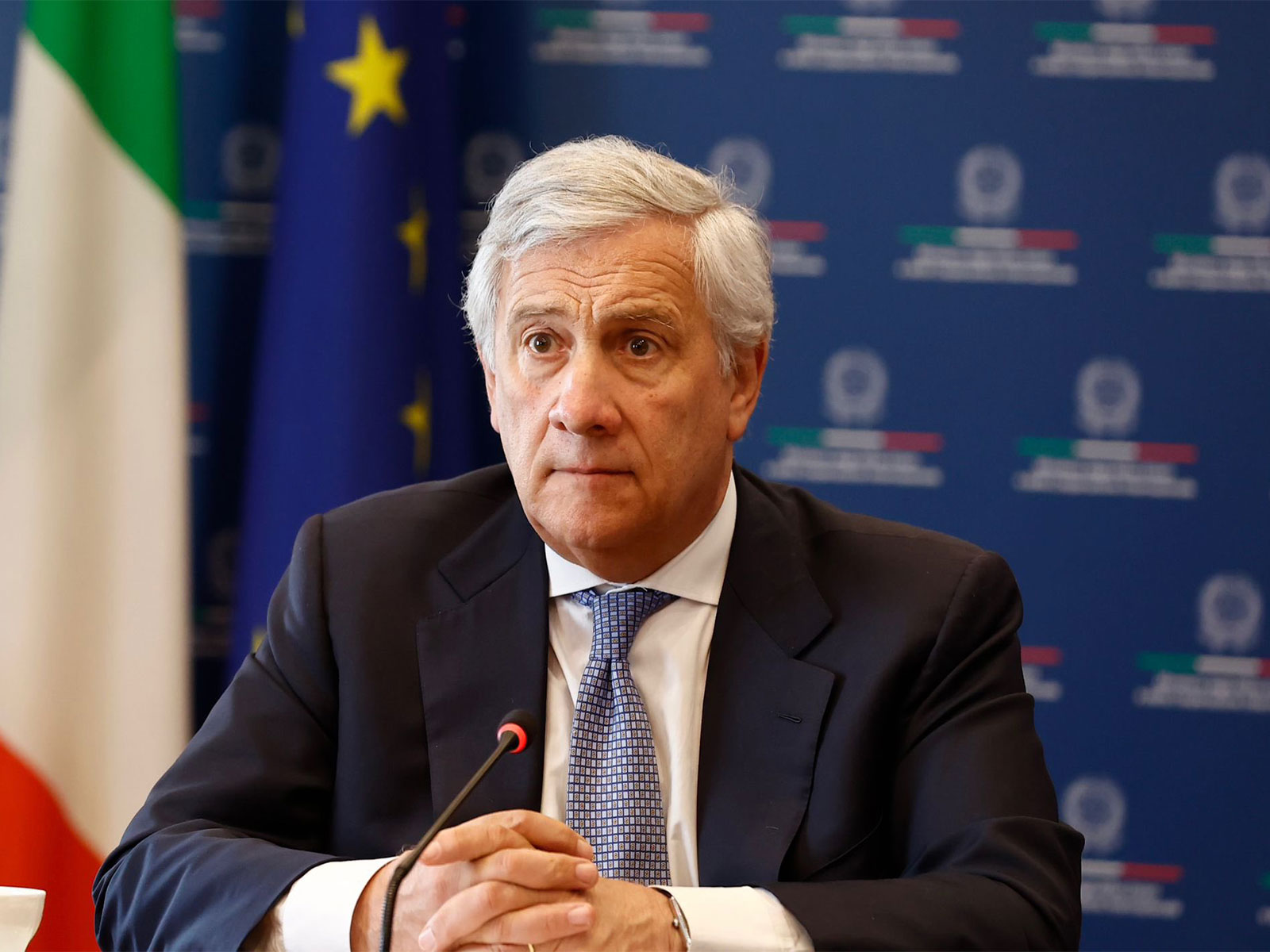
Rome [Italy], May 20 (ANI): India-Italy relations have entered a major new phase of strategic convergence during Prime Minister Narendra Modi’s visit to Rome, with Italian Deputy Prime Minister and Foreign Minister Antonio Tajani describing the engagement as a “defining moment” for bilateral ties, which are accelerated by cooperation on the India-Middle East-Europe Economic Corridor (IMEC) and the India-EU Free Trade Agreement (FTA).
In an exclusive interaction with ANI, Tajani said PM Modi’s visit marked the first bilateral trip by the Indian Prime Minister to Italy in years and opened “a new chapter” in the relationship, paving the way for stronger political, economic and strategic cooperation.
The transcript of the interview is as follows:
ANI: How does Italy view Prime Minister Narendra Modi’s visit, and what concrete diplomatic, economic, or strategic outcomes does Rome hope to achieve through this engagement?
Deputy Prime Minister and Foreign Minister Antonio Tajani: This is a defining moment for our bilateral relationship. It was the first bilateral visit of Prime Minister Modi to Italy. We celebrated a new chapter for our relations, with new opportunities to unlock our untapped potential.
This occasion paved the way for increased political and business exchanges and enhances reciprocal trade and investments, as well as industrial partnerships and supply chains resilience. The time is ripe for delivering on our shared priorities in key sectors, like advanced manufacturing, defense, agriculture, connectivity, culture and cutting-edge technologies. We also provide further impetus to collaborations within the IMEC framework and in the African continent.
ANI: India and Italy have significantly upgraded bilateral ties in recent years. How do you assess the evolution of the India-Italy strategic partnership, particularly in areas such as trade, technology, energy transition, defence cooperation, and Indo-Pacific engagement?
Deputy Prime Minister and Foreign Minister Antonio Tajani: India is a priority partner for Italy. During Prime Minister Modi’s visit, our Countries have elevated their relations to a Special Strategic Partnership, building on the Italy-India Joint Strategic Action Plan 2025-2029.
Our economies are highly complementary: Italy offers advanced technologies and expertise, while India brings talent and innovation. Italy is strengthening ties through initiatives such as attracting Indian students and launching INNOVIT India, a new innovation hub connecting our ecosystems.
Cooperation is also growing strongly in defence, supported by the Defence Cooperation Agreement and industrial roadmap adopted by our Ministers of Defence. It will pave the way to partnerships such as the Leonardo-Adani Defence & Aerospace helicopter hub project. India is likewise central to Italy’s export strategy, with three bilateral business fora held in 2025 alone.
Energy transition offers further opportunities for our companies, given India’s rapidly growing energy demand. At the same time, India is central for the stability of the Indo-Pacific and international security, we share New Delhi’s vision for a “free, open and inclusive” Indo-Pacific and we want to keep expanding cooperation on security and naval engagement in the region.
Our partnership is also advancing in space and artificial intelligence. Recent exchanges confirmed strong strategic alignment. An example is the cooperation on human-centric AI — including initiatives in Africa supported by the AI Hub for Sustainable Development in Rome — highlighting our shared commitment to innovation, resilience and sustainable growth.
ANI: With bilateral trade targeted to grow substantially in the coming years, what sectors are expected to drive the next phase of India-Italy economic cooperation? Additionally, how could the proposed India-EU Free Trade Agreement reshape trade and investment flows between the two countries?
Deputy Prime Minister and Foreign Minister Antonio Tajani: The next phase of Italy-India economic cooperation will build on an already strong and expanding partnership, with Italian exports to India growing significantly in 2025 (+9.4 per cent). This momentum is reflected in intense institutional and business engagement, including three business fora and the Joint Committee for Economic Cooperation held in 2025.
Key sectors will continue to include machinery, advanced manufacturing and automotive components, alongside new opportunities in energy transition and clean technologies, such as renewables and waste-to-energy. Further growth potential also exists in agri-food, infrastructure, transport, innovation ecosystems, and high-tech sectors including space, defence and AI applied to robotics and manufacturing.
The EU-India Free Trade Agreement could mark a turning point in bilateral trade and unlock major opportunities for both economies. Beyond its economic impact, the Agreement carries strong strategic value at a time of geopolitical uncertainty, strengthening ties between two major democracies.
At the same time, Italy and India are working to expand bilateral investments, particularly in digital innovation, aerospace, defence and automotive. We intend to design, develop and produce ever more together, building resilient value chains. Indian companies increasingly see Italy as a gateway to European technologies and markets, while Italian firms view India not only as an export destination, but also as a strategic hub for production and R&D within global supply chains.
ANI: The India-Middle East-Europe Economic Corridor (IMEC) was seen as a transformative connectivity initiative linking India and Europe. Given the ongoing instability and conflict in West Asia, how does Italy assess the future viability of IMEC, and can Prime Minister Modi’s visit help revive political and economic momentum behind the project?
Deputy Prime Minister and Foreign Minister Antonio Tajani: The ongoing crisis certainly calls for a reassessment of the short-medium term IMEC implementation schedule. Still, it confirms IMEC long-term vision, as it remains relevant for diversification, growth and competitiveness of our economies and for securing supply chains. IMEC can support the resilience of involved Countries, adapting their trade, energy and digital connections to the uncertain international scenario.
Prime Minister Modi’s visit to Rome followed a series of high-level contacts between our governments and entrepreneurs. We can build upon these to step up bilateral cooperation on maritime transport, ports, digital connections and accelerated custom procedures. This is the very backbone on which IMEC can progress and soon start delivering. The importance Italy attaches to IMEC was also reflected in the event we hosted in Trieste last March to promote an Italian perspective on the development of the corridor and its wider connectivity network.
ANI: With rising concerns over maritime security, supply-chain resilience, and energy disruptions–particularly around the Strait of Hormuz–do you see greater India-Italy coordination emerging on connectivity, maritime security, and safeguarding critical trade routes?
Deputy Prime Minister and Foreign Minister Antonio Tajani: India and Italy are among the most affected actors by the current crisis. We share the same concerns as natural maritime powers. Similarly to India, the Gulf is crucial for our energy security as we import a significant share of our gas and oil from the Region. We remain in close and continuous dialogue with our private sector, with a view to identifying alternative routes and better calibrating our diplomatic engagement with regional partners. In this context, cooperation with India is essential: secure and efficient transit across the area is key for our bilateral trade flows.
In the whole Indo-Mediterranean region, we both promote the principles of freedom of navigation and we are actively engaged to preserve supply chains, stability and security. We are therefore closely monitoring the situation in the Strait of Hormuz. Italy remains at the forefront of international efforts to ensure the security of maritime routes in the Red Sea and the Western Indian Ocean.
In this context, connectivity is becoming an increasingly strategic dimension of our cooperation. A significant example is the Blue & Raman submarine cable project, which will serve as a digital bridge connecting the Mediterranean, the Gulf and India. (ANI)
Related reading