Evian [France], June 17 (ANI): Following the official finalisation of negotiations for a historic India-European Union Free Trade Agreement (FTA) in January this year, hailed as the “Mother of All Deals”, India and the EU are moving rapidly to sign the pact by the end of the year.
This comprehensive pact spans goods, services, and digital trade. It is set to create a massive free market covering nearly two billion people and a quarter of the global economy, opening new avenues for trade, investment, and technology cooperation.
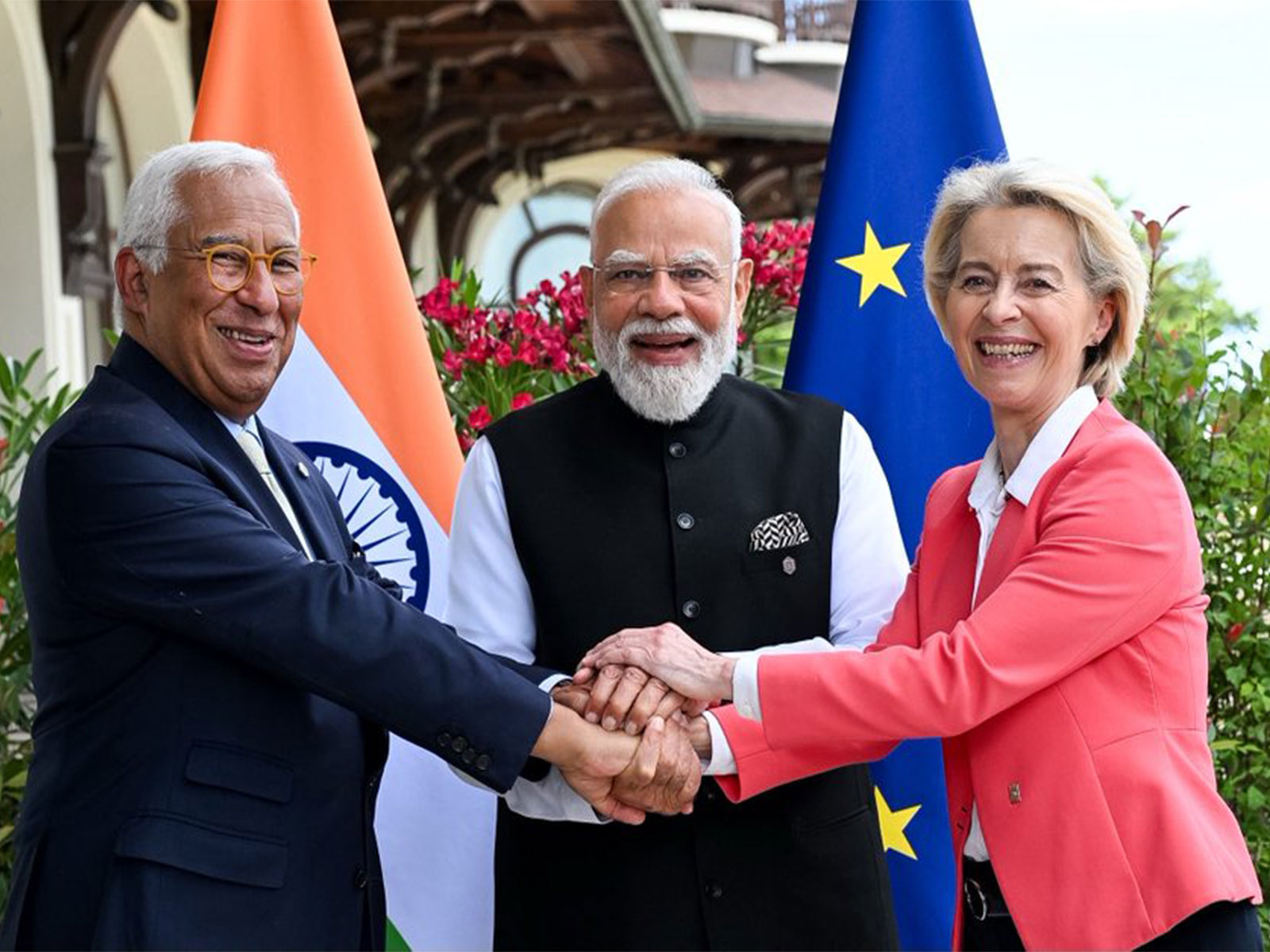
The momentum towards this landmark agreement was fully on display following a high-level meeting on Wednesday among Prime Minister Narendra Modi, European Council President Antonio Costa and European Commission President Ursula von der Leyen.
In synchronised posts on social media platform X, European Commission President Ursula von der Leyen and European Council President Antonio Costa detailed the high-stakes diplomatic development, writing, “Dear @narendramodi, it is a pleasure to meet again so soon. Since we have concluded the mother of all trade deals, we have been moving fast to deliver on our commitments. We will sign the Free Trade Agreement by the end of the year. And accelerate work on an investment agreement. We will also step up security & defence cooperation. And join forces for better connectivity by advancing IMEC, the India-Middle East-Europe Corridor.”
Expressing great optimism over the trajectory of India-EU relations following the session on the sidelines of the G7 Summit, Prime Minister Narendra Modi also posted on X, “It was wonderful meeting European Council President Antonio Costa and European Commission President Ursula von der Leyen in Evian earlier today. At the start of this year, India was proud to host them for our Republic Day celebrations. This has been a great time for India-EU ties as we have concluded the Free Trade Agreement.”
The Prime Minister further highlighted the strategic importance of the discussions in navigating the current geopolitical landscape.
PM Modi added, “During our talks, we discussed how to further deepen economic linkages in the times to come. Our growing cooperation can play an important role in strengthening peace, stability and prosperity in today’s global environment.”
Reflecting on the comprehensive nature of the trilateral review, Ministry of External Affairs (MEA) Official Spokesperson Randhir Jaiswal also detailed the milestone interaction in a post on social media platform X.
Jaiswal stated, “PM @narendramodi met President @eucopresident and President @vonderleyen on the margins of the @G7 Summit today. The leaders recalled the historic 16th India-EU Summit held in India early this year and welcomed the strong progress made in bilateral relations, especially with the conclusion of India-EU FTA. The leaders also exchanged views on regional and global issues of mutual interest.”
This crucial trilateral session served as a major anchor for India’s broader European push.
Building on this intensive engagement, Prime Minister Narendra Modi earlier met with German Chancellor Friedrich Merz for a bilateral meeting on Wednesday, utilising the platform of the summit to deepen strategic and economic cooperation between New Delhi and Berlin.
Highlighting the encounter on X, PM Modi wrote, “The talks with Chancellor Merz were very fruitful. We discussed ways to further cement bilateral cooperation by working together in trade, investments, circular economy, defence, IT and more. We also talked about boosting cultural linkages between our nations.”
Signalling a major expansion in European diplomacy, MEA Spokesperson Randhir Jaiswal also highlighted this key engagement on social media, stating, “PM @narendramodi held a meeting with Chancellor Merz @bundeskanzler on the margins of @G7 Summit at Evian. Both leaders expressed satisfaction at the renewed momentum in the India-Germany Strategic Partnership, as both countries celebrate 75 years of diplomatic ties.”
Crucially, both leaders agreed that early implementation of the India-EU FTA will further deepen India-Germany ties while also discussing key global and regional challenges.
Later in the day, the diplomatic focus at the summit will shift towards another highly anticipated engagement, as PM Modi is slated to hold a bilateral meeting with US President Donald Trump.
This encounter is being closely watched by global observers amid intensive discussions on global security, trade, technology, and geopolitical developments.
During their wide-ranging talks, the two leaders will deep dive into bilateral ties, with a primary focus on expediting the proposed bilateral trade deal, while exploring robust ways to boost cooperation in the defence, energy, and critical minerals sectors.
This key engagement comes a day after they exchanged pleasantries and held a brief conversation at a gathering of G7 leaders.
Taking place amid continuing strain in ties, this impromptu interaction marked their first in-person encounter in 16 months, as both PM Modi and Trump are currently in the French commune of Évian-les-Bains for the G7 Summit.
Providing broader context to these dense diplomatic engagements, this picturesque French city has transformed into the nerve centre of global diplomacy as the high-stakes summit enters its critical phase.
With India participating as a key Partner Country, the international community is increasingly looking towards New Delhi to navigate and resolve complex global bottlenecks–a growing role in shaping top-tier discourse that reflects India’s steadily expanding diplomatic footprint across premier global forums.
Beyond his highly anticipated interaction with the US President and his key engagements with European Union leaders, PM Modi’s packed itinerary for the day also features a crucial G7 working session themed “Reviving balanced, inclusive and sustainable economic growth for the benefit of all.”
This intense schedule follows the rapid pace of diplomacy set earlier yesterday, when PM Modi concluded a flurry of bilateral meetings on the sidelines of the summit.
On Tuesday, he held productive talks with Canadian Prime Minister Mark Carney, United Kingdom Prime Minister Keir Starmer, and United Arab Emirates President Sheikh Mohamed bin Zayed Al Nahyan.
Expanding India’s global outreach further, PM Modi also engaged in structured discussions with Kenyan President William Ruto, Egyptian President Abdel Fattah El-Sisi, Japanese Prime Minister Sanae Takaichi, and South Korean President Lee Jae-Myung. (ANI)
Related reading