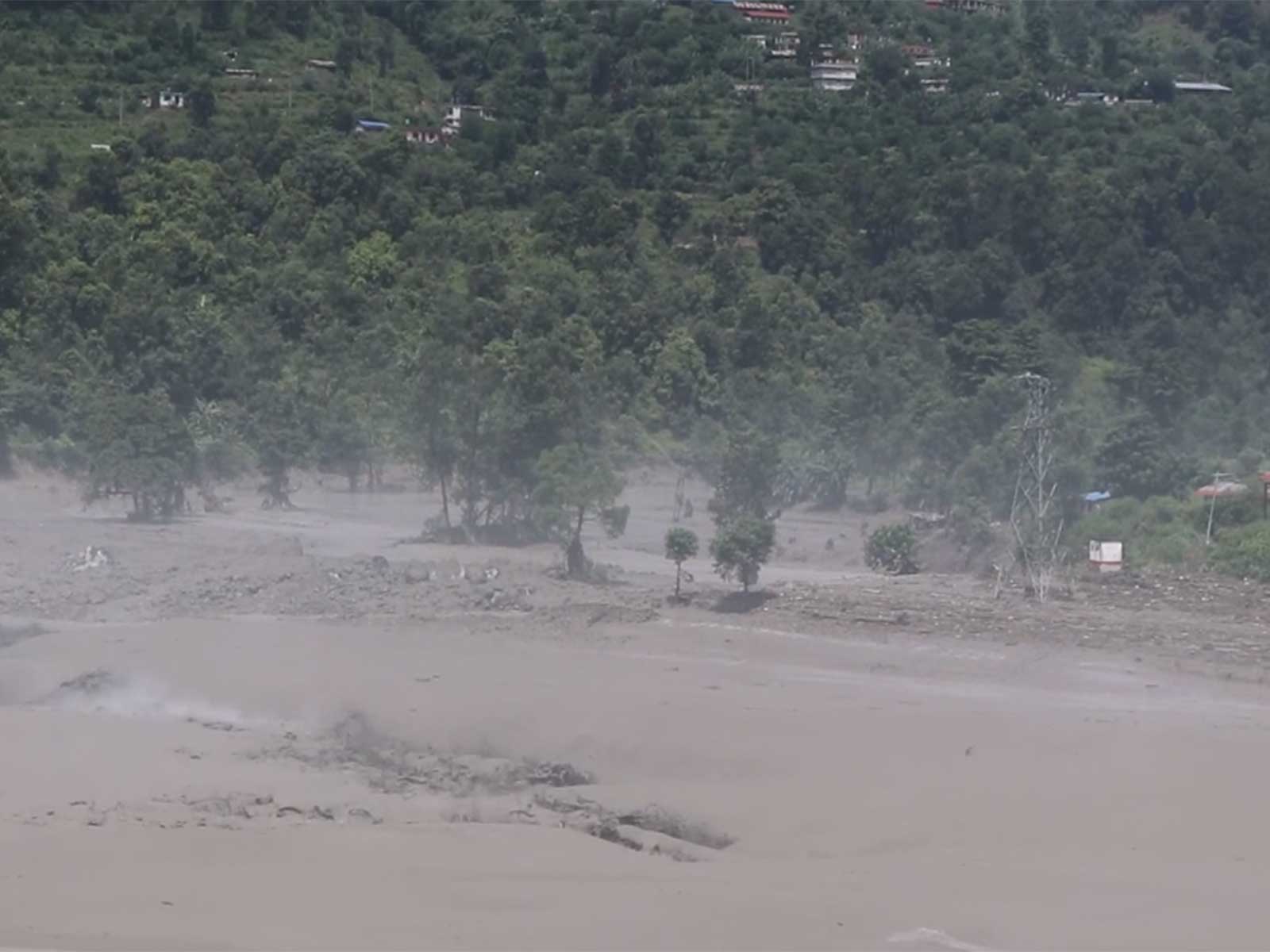
Kathmandu [Nepal], August 27 (ANI): An ice avalanche and the subsequent formation and bursting of a debris lake may have triggered the sudden flood in the Bhotekoshi River in Rasuwa, officials at the Department of Hydrology and Meteorology in Nepal said, according to the Kathmandu Post.
In a translated post on X, Nepal’s National Disaster Risk Reduction and Management Authority (NDRRMA) said, “An initial study based on the analysis of satellite images by Planet Labs indicates that a glacier-inclusive flood occurred in the Lhende River due to a snow-rock landslide that took place on the Nepal-China border approximately 20 kilometers northeast of the Nepal-China Rasuwagadhi border crossing.”
https://x.com/NDRRMA_Nepal/status/2092584620248408106
According to the Kathmandu Post, satellite images obtained from Chinese authorities show that the blockage occurred about 20 kilometres upstream of the Miteri Bridge before a sudden surge swept downstream.
Binod Parajuli, chief of the department’s Flood Forecasting Division, said preliminary satellite imagery received from Chinese authorities showed that debris had blocked the river about 20 kilometres upstream of the Miteri Bridge, forming a temporary lake that subsequently burst. Parajuli said they received pre- and post-event images from the Chinese authorities.
“An icefall and landslide can be seen,” he said. “An ice and debris lake formed and then burst. A dam was formed.”
The sudden release of water was made more destructive by the large volume of debris carried downstream, he said.
“If it had been only clear water, it would not have caused this level of destruction,” Parajuli said. “But once the debris mixed with the water, the depth increased significantly.”
The preliminary assessment is consistent with earlier reports that an ice avalanche may have blocked the Lhende River, although officials have yet to establish conclusively whether a glacial lake outburst also occurred.
Rijan Bhakta Kayastha, a climate researcher and professor at Kathmandu University, said an ice avalanche appeared to have fallen into and blocked the Lhende River, causing water to accumulate before being released downstream.
“There is information that an ice avalanche from the Nepal side blocked the Lhende River,” Kayastha said. “An earthquake also occurred on the Tibetan side around the same time.”
According to the US Geological Survey, a magnitude 4.4 earthquake struck Tibetan territory at 8:37 am, about 47 kilometres north of Gosainkunda.
Kayastha said it could take several days to determine whether a glacial lake had also burst. The possibility is being considered because glacial lake outbursts have occurred in the area in the past.
A similar sudden flood struck the Bhotekoshi River on July 8, 2025. The Department of Hydrology and Meteorology concluded at the time that a glacial lake outburst had caused flooding in the Lhende River near the Nepal-China border in Rasuwa. Analysis of Sentinel satellite imagery indicated that the flood was triggered by the bursting of a glacial lake.
Shanti Mahat, spokesperson for the National Disaster Risk Reduction and Management Authority, said the agency had also received preliminary information that an ice avalanche had blocked a river. The information was shared through the International Centre for Integrated Mountain Development, which obtained it from sources in China, as reported by the Kathmandu Post.
“We have not received any official information yet,” Mahat said. “But ICIMOD has shared the information it received from the other side with us. This is only an initial assessment. We are focused on rescue and relief efforts for now. The cause will become clearer gradually.”
In a special update on the Rasuwa flood, the department said there had been no heavy rainfall in the Rasuwa area on Tuesday or Wednesday. (ANI)
Related reading