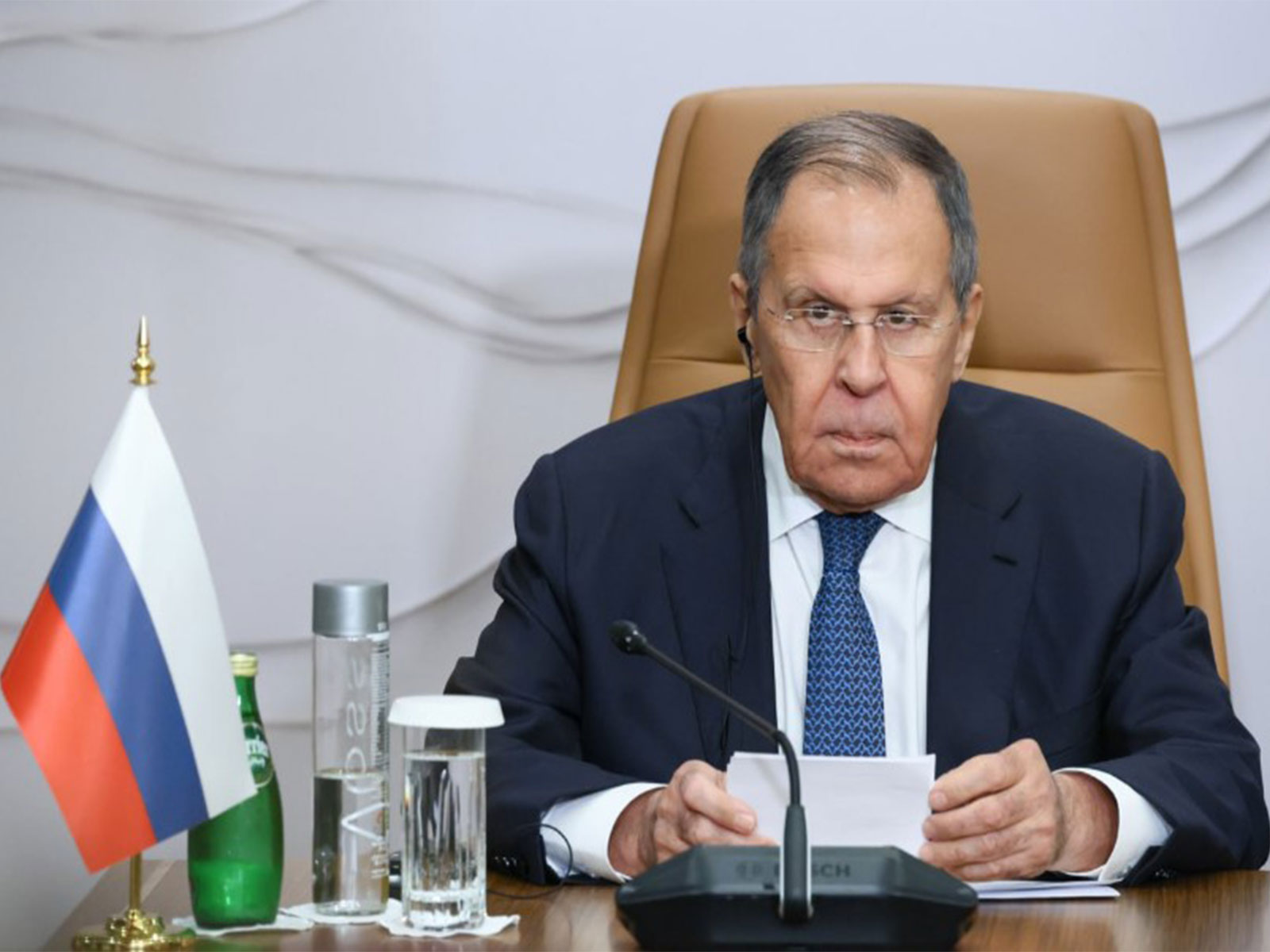
Tehran [Iran], October 20 (ANI): Russian Foreign Minister Sergey Lavrov on Monday accused Ukrainian President Volodymyr Zelenskyy of deliberately derailing peace negotiations with Moscow, claiming that Zelenskyy fears any agreement acceptable to both Russia and the United States would result in his personal downfall and the collapse of his government.
Speaking at a press conference following the ninth Russia-Gulf Cooperation Council (GCC) Joint Ministerial Meeting for Strategic Dialogue, Lavrov alleged that Kyiv had repeatedly undermined diplomatic momentum fostered by Washington.
“We can draw only one conclusion: Zelensky does not want negotiations. He has derailed them repeatedly, apparently because he understands that any agreement acceptable to Russia and the US would spell the end of his regime and of him personally,” Lavrov said, according to the remarks shared by the Russian Ministry of Foriegn Affairs.
Detailing how prior diplomatic efforts broke down, the Russian top diplomat noted that whenever Washington and Moscow reached preliminary understandings on resuming peace talks, Ukraine launched provocations to abort the process.
“On numerous occasions, including several instances when proposals by US President Donald Trump led Moscow and Kyiv to an understanding that we needed to move forward, with some common ground on resuming talks, Ukraine invariably did something utterly unacceptable and abhorrent the very next day after such optimistic expectations emerged,” Lavrov explained. “Above all, this meant strikes on civilian targets.”
Lavrov also forcefully dismissed European and Ukrainian criticism regarding direct energy negotiations between Moscow and Washington, firmly rejecting claims that Russian fuel exports require approval from Kyiv.
“The ‘diesel deal’ between Moscow and Washington is a matter for Moscow and Washington,” Lavrov said. “If the EU regards it as a betrayal of Ukraine, while Zelensky himself claims that Russian diesel exports must be agreed with him because only he can authorise them, then this is no longer a matter of energy security, but of self-promotion and yet another clown show.”
Turning to security concerns in West Asia, Lavrov expressed concern over rising tensions in and around the Strait of Hormuz, calling for efforts to address the underlying causes of the crisis and prevent a renewed military confrontation.
“We must address the root causes of the situation in and around the Strait of Hormuz, including by implementing the agreements reached between US and Iran under the so-called Islamabad Memorandum, which we all welcomed,” Lavrov stated. “We believe this memorandum still contains everything needed to pull the situation back from the brink of a resumption of full-scale war and return it to the path of political and diplomatic engagement and negotiations.”
To prevent further escalation, Lavrov urged the establishment of a broad, inclusive regional security architecture encompassing both Arab states and Iran, alongside key neighbours such as Iraq and Jordan.
“This should be supported by external actors guided primarily by the interests of the countries of the region, rather than their own unilateral geopolitical designs,” Lavrov noted, adding that Russia remains ready to align its long-standing Collective Security Concept for the Persian Gulf Region with parallel security initiatives proposed by China, Iran, and the GCC.
On the Israeli-Palestinian conflict, Lavrov affirmed that both Moscow and its Gulf partners expressed firm opposition to efforts undermining the establishment of an independent Palestinian nation.
“We discussed the Palestinian issue at length. Everyone is deeply concerned by attempts to put an end to the prospect of establishing a Palestinian State. Both we and our GCC partners categorically reject this approach,” he asserted.
Lavrov also thanked Gulf countries for their position on the Russia-Ukraine conflict and their mediation efforts on humanitarian issues, including the reunification of children with their families, prisoner-of-war exchanges and the return of the remains of those killed.
“We thanked our colleagues for their balanced, objective position on Ukraine and briefed them on how the situation is developing at this stage,” Lavrov said. “We expressed particular gratitude for the efforts of a number of Gulf countries that pragmatically and without publicity mediate on a range of humanitarian issues, including reuniting children with their families, exchanging POWs and returning the bodies of those killed.”
Highlighting economic ties between Russia and the Gulf bloc, Lavrov said bilateral trade had increased by 45 per cent in 2025 to nearly USD 19 billion, adding that there was considerable scope for further growth.
Meanwhile, US President Donald Trump on Sunday (local time) claimed that negotiations to end the Russia-Ukraine conflict were making “great progress”, while defending his administration’s diplomatic approach towards Moscow and accusing Ukrainian President Volodymyr Zelenskyy of failing to secure a better deal two years ago.
In a post on Truth Social, Trump described his strategy to strike a deal between the warring nations as a simple one which he said includes ensuring that Russia is not, “foolishly”, driven away from the bargaining table.
This comes as Trump has waived several sanctions related to Russian fuel sales that were to take effect under the Lindsey O. Graham Sanctioning Russia and Iran Act, a month after signing the Bill.
The legislation would have authorised tariffs of up to 100 per cent on goods imported into the United States from the five largest importers of Russian-origin crude oil or natural gas, including India and China.
The decision comes amid a reported diesel supply agreement with Russia, as fuel prices in the United States remain a concern ahead of the November midterm elections.
Trump has recently announced a diesel supply agreement with Russia, under which he said Moscow would immediately supply more than 3,00,000 tonnes of diesel fuel, followed by another 5,00,000 tonnes during November and one million tonnes immediately thereafter. (ANI)
Related reading