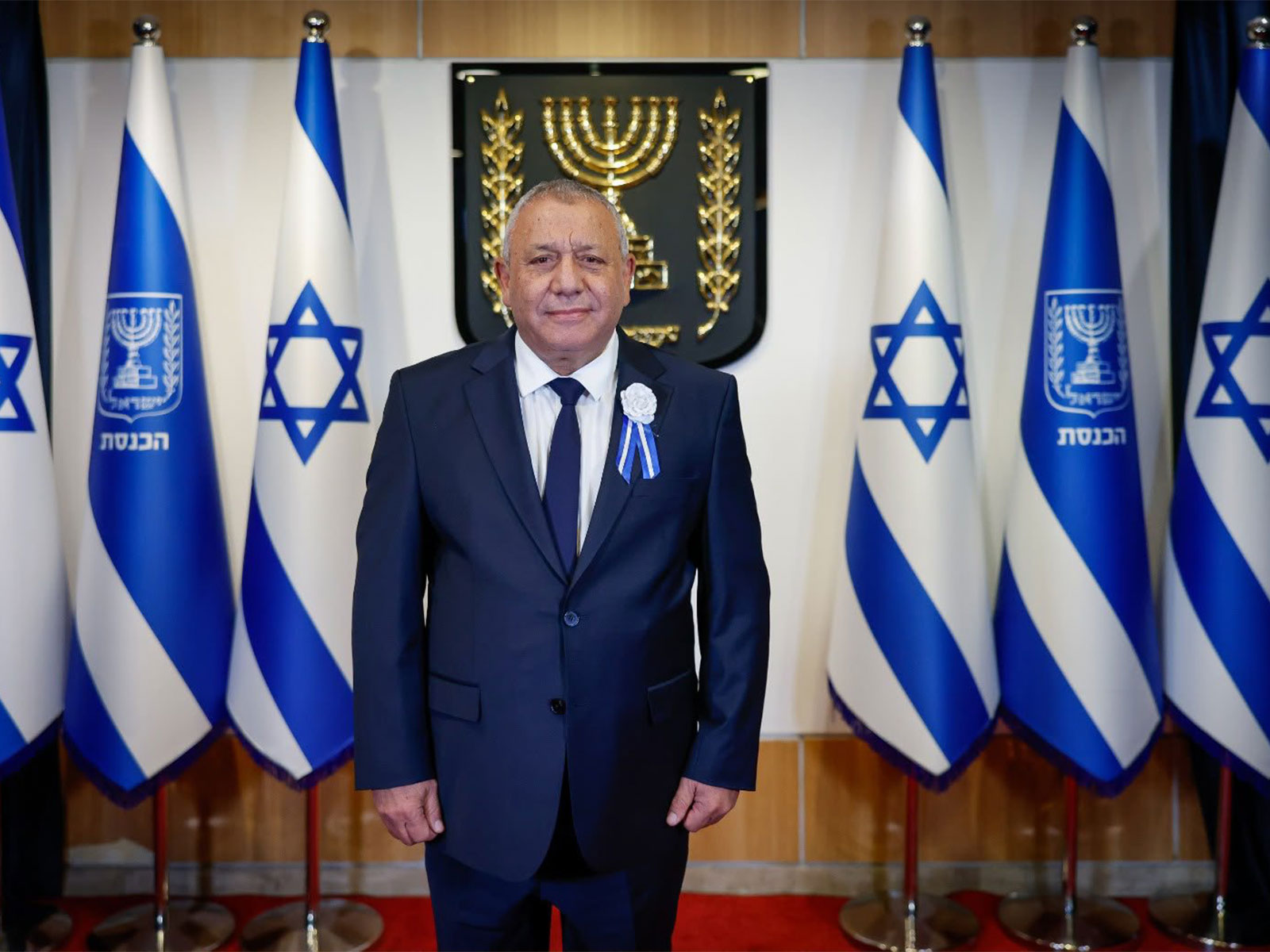
Tel Aviv [Israel], November 13 (ANI): Stepping up his efforts to steer Israel out of its political deadlock, incoming government-mandate holder and Yashar party leader Gadi Eisenkot has vowed to form a stable emergency administration, pledging strict security oversight and forcefully denouncing racism while extending a principled, inclusive stance toward Israel’s Arab citizens.
Eisenkot’s remarks outline his core priorities following the election that stripped outgoing Prime Minister Benjamin Netanyahu of his parliamentary majority.
Having received the presidential mandate to assemble a governing coalition, Eisenkot emphasised that negotiations are progressing toward building a broad, principled partnership.
“I want to reiterate that I intend to leave no stone unturned and speak with every elected official who agrees with the four principles, with the aim of forming a stable government as soon as possible. This is what the moment demands, and this is the mandate you have given me. It would be a grave mistake not to do so,” Eisenkot wrote in a post on X.
He added regarding his ongoing coalition talks, “I am pleased to report that we are making progress in our discussions with potential partners, while also working to explore every option. I am approaching these efforts wholeheartedly, determined to do whatever it takes to form a good, stable and beneficial government under my leadership—there is no alternative.”
Addressing national security during the sensitive government transition, Eisenkot reflected on his recent briefing with outgoing Prime Minister Netanyahu and his military secretary, making his oversight standards clear.
“The security situation, as well as the domestic situation, requires close oversight of the government during this sensitive transition period. I made it clear that I would not allow a lack of oversight. For me, Israel’s security comes before any other consideration and must never be used to gain political capital. This is also what I expect of everyone in office,” he wrote.
Highlighting parliamentary actions, Eisenkot noted that the 26th Knesset is swiftly putting its majority to work to restore democratic norms and effective checks and balances:
“The days when the outgoing government played on a “vacant field” with impunity are over. The Knesset will once again be the people’s home. The home of all the people. On our watch, there will be no more hurling insults at bereaved families, nor any abuse of the authority the people have given us against other parts of the people.”
Signalling a sharp departure from the rhetoric of the outgoing administration, Eisenkot delivered a passionate defence of Israel’s Arab minority, who make up 21 per cent of the population and have faced what he described as a “racist and violent campaign of delegitimisation” fueled for political purposes. Reaffirming that leadership must encompass all constituents, he declared:
“The prime minister of Israel is the prime minister of all citizens, including those who did not vote for him. Arab citizens of Israel are part of the Israeli story. The attempt to marginalise them and smear them as a group is an anti-state act that disgraces the Declaration of Independence and the values we take pride in as a Jewish and democratic state.”
Addressing critics and the vicious online campaigns targeting lawmakers and bereaved families like the Peretzes, Eisenkot issued a firm warning, “It is permissible to disagree and permissible to criticise; that is part of the role of an elected official. But there is no place for incitement and threats. If someone has a problem with the path I am charting, I am the person to address. Anyone who thinks that various emissaries and poison will deter us probably does not know us well enough.”
Concluding his message, Eisenkot urged the public to disregard political spin and lies, reaffirming his determination to navigate the complex weeks ahead.
“Complex and important weeks lie ahead of us. I am determined to overcome every difficulty and challenge in order to form a government and bring Israel back to safe harbor. As usual, these efforts will be accompanied by many spin campaigns and lies as part of the attempt to thwart the formation of the government. I suggest taking all of them with a grain of salt. When there is something to update you on, I will do so – directly, without intermediaries,” he added.
https://x.com/gadi_eisenkot/status/2121228540322435413
On the other hand, Israeli Prime Minister Benjamin Netanyahu on Wednesday said that forming a national unity government was still possible, a day after delivering a speech in the Knesset in which he accused Arab lawmakers of supporting “terrorism” and seeking Israel’s “destruction”, The Times of Israel reported.
Speaking to reporters in the halls of the Knesset, Netanyahu adopted a markedly different tone from his remarks on Tuesday, reiterating the need for political unity amid the ongoing government-formation process.
“Yesterday I said why a national unity government is necessary,” Netanyahu told reporters. “Today I want to say why it’s possible. It is possible because this nation knows how to come together at moments of truth,” he said, adding, “and we are facing a moment of truth.”
“This is the call of the hour, this is the will of the majority of the nation,” Netanyahu said.
Citing examples of unity during the Knesset’s swearing-in and the past three years of war, Netanyahu said that people from different backgrounds and political ideologies had stood together.
“Religious and secular, left and right, simply stood and fought together shoulder to shoulder. I can’t tell you everything that I know, but there are enough people who know what massive challenges and what massive opportunities we have,” Netanyahu added.
He further said that he would “continue to reach out” to potential coalition partners.
According to The Times of Israel, President Isaac Herzog has given Netanyahu’s political rival, Gadi Eisenkot, the mandate to form the next government.
The development comes amid a political deadlock following Israel’s October 27 parliamentary elections, which resulted in a hung Knesset, with neither major political bloc securing the 61 seats required for a majority in the 120-member legislature. (ANI)
Related reading