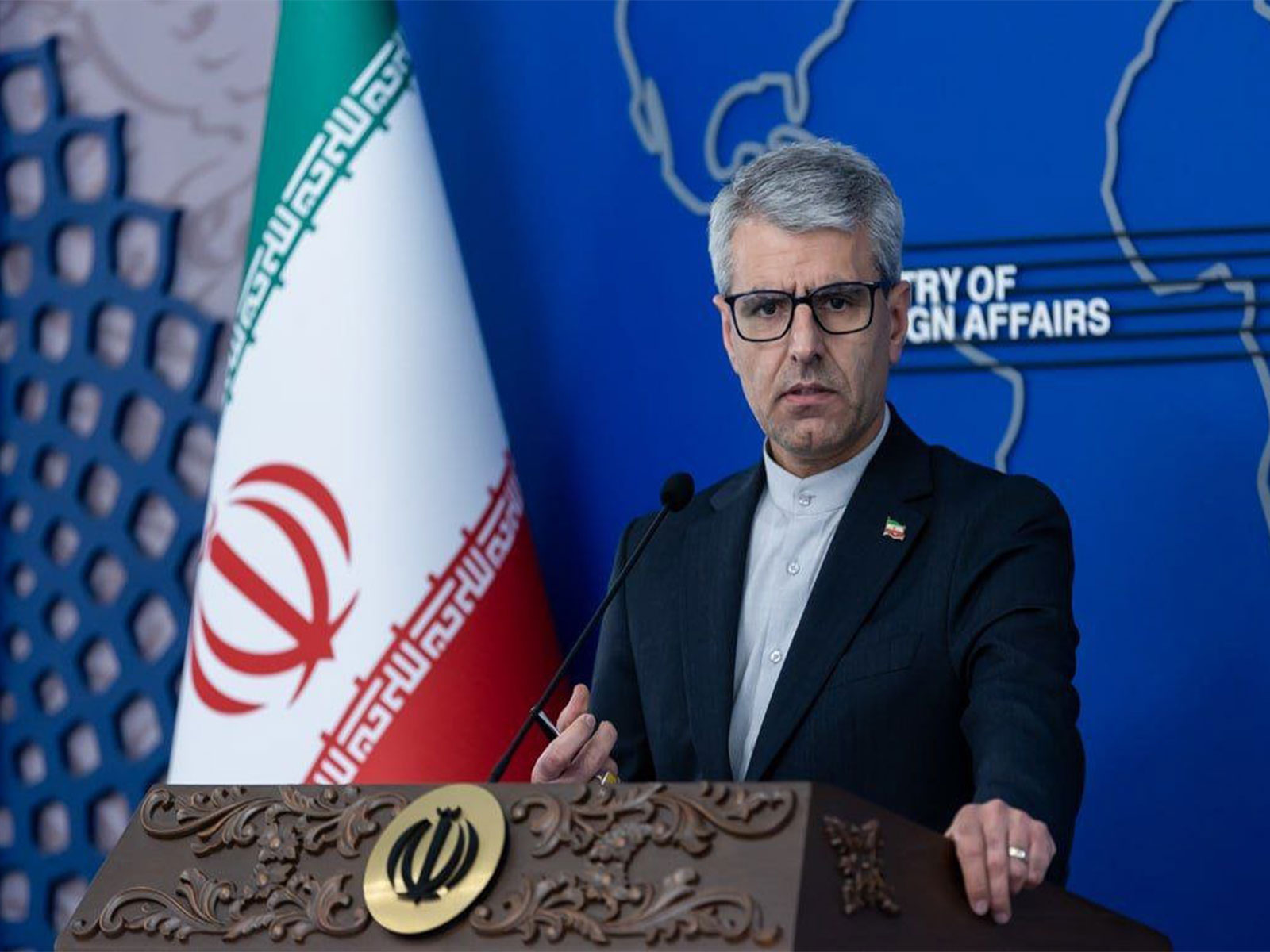
Tehran [Iran], July 20 (ANI): Iranian Foreign Ministry spokesman Esmaeil Baghaei on Monday revealed that Washington has recently transmitted messages to Tehran via third-party intermediaries, even as heavy fighting persists between the two factions.
Addressing a news conference in Tehran, the spokesperson confirmed the backchannel communications but refrained from disclosing specifics regarding the diplomatic notes.
“We have been informed by mediators. We have received messages, without going into details, but the main point is that the diplomatic apparatus has been active in recent days and ideas have been conveyed to us by certain mediators,” the Foreign Ministry spokesman said.
Baghaei firmly pinned the blame for the current military flare-up on Washington, asserting that the responsibility for the recent escalation lies with the US.
Concurrently, the spokesperson issued a clear warning to neighbouring nations against allowing American forces to utilise their bases for military operations against Iran.
“We have repeatedly emphasised that we have no hostility towards the countries of the region, but we expect them to do their duty and not allow attacks on Iran from their territory,” Baghaei stated.
Reaffirming Tehran’s resolve to counter ongoing American military operations, the spokesperson warned that Iranian forces would maintain their retaliatory posture.
He added, “As long as these crimes continue, our armed forces will respond to them.”
These backchannel contacts occur against a backdrop of intense ground realities, as the conflict between the United States and Iran flared further early Monday. The US military launched a fresh round of airstrikes on Iranian targets, just hours after confirming the death of another American service member in Iraq.
In immediate retaliation for the American bombardment, Iran launched targeted attacks against US-allied Bahrain, which hosts the US Navy’s 5th Fleet, and Kuwait, pushing the region significantly closer towards a broader war.
The military flare-up underscores the steady collapse of last month’s interim agreement, which was originally designed to permanently halt hostilities. Shipping corridors through the strategic Strait of Hormuz, the vital passage claimed by Tehran, remain largely blocked, with both factions targeting crucial civilian infrastructure. The ongoing hostilities have severely impacted global markets, sending Brent crude prices soaring past USD 90 a barrel on Monday and worsening the international energy crisis.
According to details provided by the US military, the latest American casualty occurred in Iraq on Saturday, where a service member succumbed to injuries sustained during the “controlled detonation” of a downed Iranian drone.
Reacting to the dynamic situation, US President Donald Trump stated, “We hit them very hard again tonight,” adding that the action was taken “in honor of the” soldiers killed.
The US Central Command confirmed that it has now conducted airstrikes for a ninth consecutive night. In an official briefing, the command stated that the latest operations zeroed in on “Iranian military command centres, air defense and coastal surveillance sites, maritime capabilities, missile and drone launch sites and communications networks.”
Concurrently, Iran’s state-run IRNA news agency reported that the American strikes resulted in at least one fatality near Tabriz in northwestern Iran, a city heavily suspected of hosting subterranean Revolutionary Guard missile facilities. The state media further indicated that the aerial bombardments likely impacted Bandar Imam Khomeini in Khuzestan province, Sirik and Jask in Hormozgan province, alongside Konarak and Chabahar in Sistan and Baluchestan province.
Amid the initial wave of aerial strikes, the British military reported that a commercial vessel caught fire early Monday in the Strait of Hormuz near the Omani coastline, though the precise cause of the blaze remains under investigation. While the US military had previously advised commercial shipping lines to utilise the Omani route to bypass Iranian jurisdiction, the Revolutionary Guard subsequently claimed responsibility for targeting tankers within the channel.
The regional fallout from the strikes widened rapidly as Bahrain activated its nationwide missile alert sirens on Monday morning. Simultaneously, Kuwaiti authorities confirmed that their national air defence units were actively engaging and firing at an incoming Iranian barrage.
President Trump had previously threatened to disable Iran’s power stations and bridge infrastructure to compel Tehran to loosen its grip on the Strait of Hormuz, through which one-fifth of the world’s traded oil supply passed prior to the outbreak of the war. Recent operational movements indicate that the US military is progressing with that strategy. Over the past week, Washington enforced a strict naval blockade on Iranian ports to halt crude oil exports, with the military stating on Saturday that it had redirected six vessels and disabled another since the enforcement began.
The sudden intensification of fighting occurs past the halfway mark of the 60 days legally mandated under the interim deal to negotiate a permanent end to the war and address related issues, including Iran’s nuclear programme.
Outlining Washington’s diplomatic position, US Secretary of State Marco Rubio affirmed that the administration remained open to dialogue but clarified that “it has to be real.”
“We’re going to continue to respond. If the door opens to diplomacy – if the guys that want to do something productive for Iran win and take control of that system, or take control of the negotiations – that’ll be a very positive development. That’s not where we are tonight, unfortunately,” Rubio stated.
Providing updates on the human cost of the escalation, Iranian authorities announced on Sunday that the latest waves of US strikes had killed at least 50 individuals and left 517 others injured. Since the outbreak of open warfare on February 28, a total of 17 US service members have lost their lives, leaving the outlook for a diplomatic resolution deeply precarious. (ANI)
Related reading