Washington, DC [US], May 17 (ANI): In a development that has sent shockwaves through global geopolitical corridors, US President Donald Trump has shared a mysterious and highly charged message on his social media platform, Truth Social.
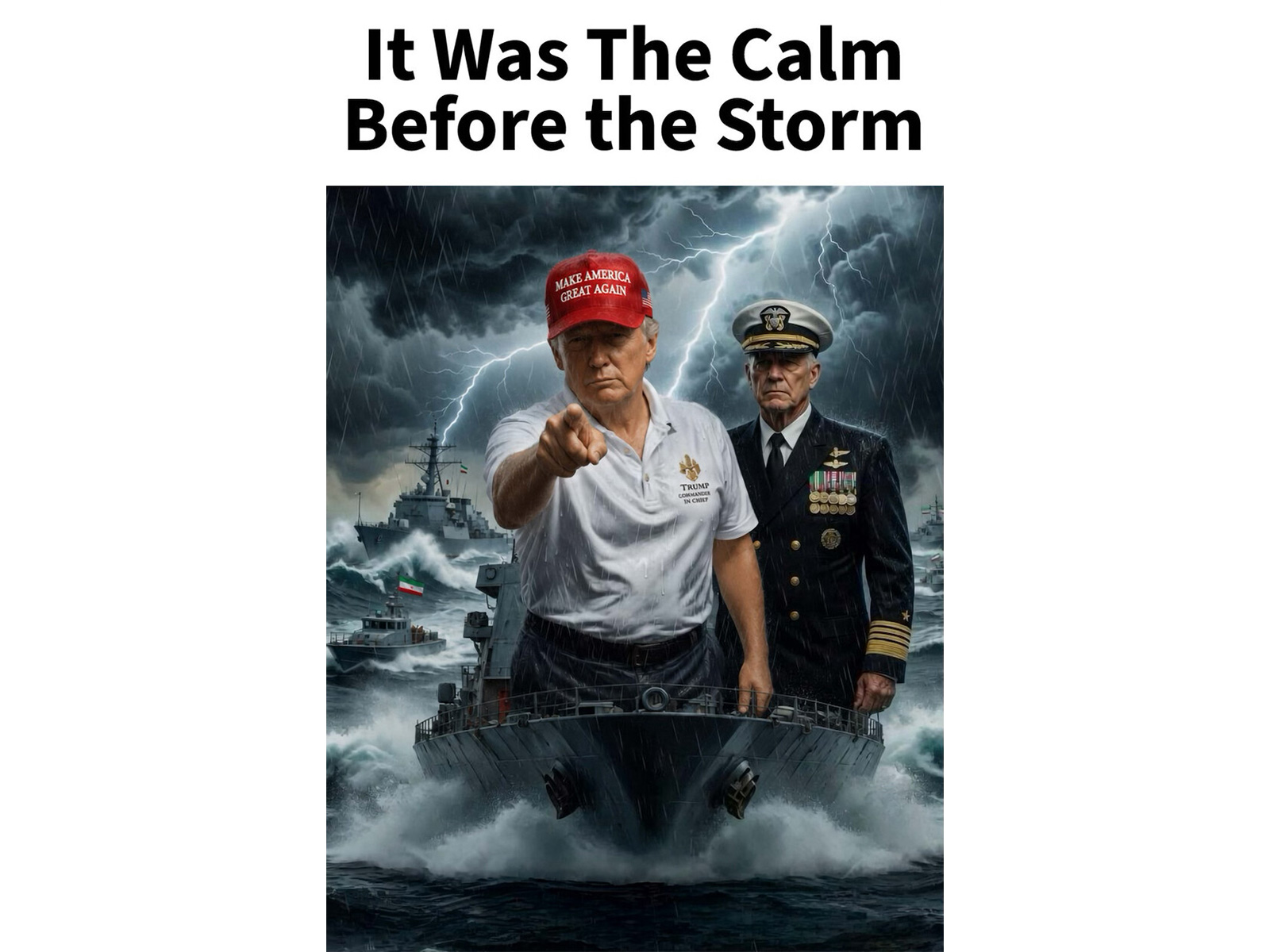
On Sunday, President Trump uploaded an AI-generated image accompanied by a stark, single-sentence declaration: “It Was The Calm Before The Storm.” The move comes amid a dangerous spike in geopolitical friction surrounding Tehran and the unfolding Strait of Hormuz crisis.
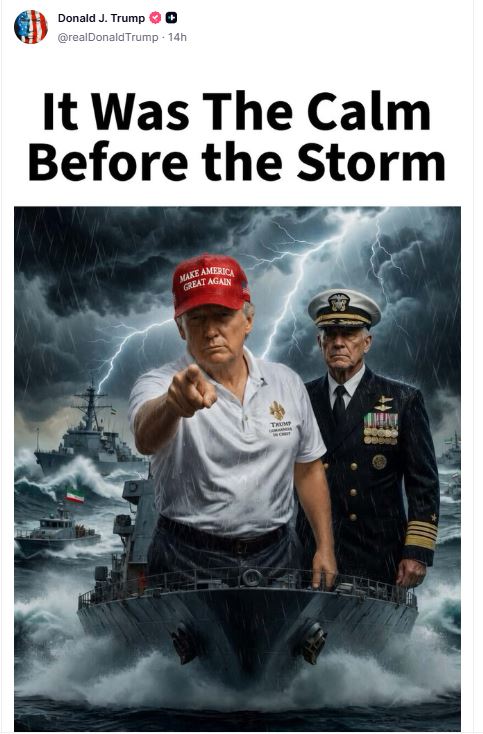
The striking digital image, distributed directly from President Trump’s official account, portrays him clad in a “Make America Great Again” cap while positioned on the deck of a US Navy vessel alongside a senior naval officer.
The cinematic visual is framed by turbulent, tempestuous seas and flashing lightning, with several warships flying Iranian flags visibly detailed in the background.
According to a highly detailed report published by The New York Times, this dramatic online post coincided with intense discussions within the administration.
The White House is reportedly evaluating a potential return to active military operations against Iran following a temporary, fragile pause in regional hostilities.
The New York Times further reported that President Trump returned to Washington from a high-stakes visit to Beijing only to find himself confronted by “major decisions on Iran.”
Senior administration aides are already said to be actively drafting comprehensive blueprints for a fresh wave of military strikes, designed to be deployed if current diplomatic tracks collapse entirely.
Western officials and allied nations have been working behind the scenes to broker a complex compromise, the report noted.
The objective of these discussions is to convince Tehran to fully reopen the Strait of Hormuz, a critically vital artery for global shipping, while strategically structuring the agreement so President Trump can publicly frame the resolution as a massive diplomatic victory.
However, President Trump appeared to completely dismiss the latest diplomatic framework presented by Iranian negotiators.
Speaking directly to reporters while travelling aboard Air Force One upon his departure from China, the US President made his dissatisfaction clear.
“I looked at it, and if I don’t like the first sentence, I just throw it away,” President Trump stated, according to The New York Times.
In tandem with these hardening political stances, the Pentagon has finalised extensive contingency plans for a potential reactivation of “Operation Epic Fury.”
The sweeping military campaign had been temporarily put on hold last month after President Trump unexpectedly declared a ceasefire.
Providing a glimpse into the Pentagon’s current posture, US Secretary of War Pete Hegseth confirmed the military’s heightened state of readiness.
Hegseth was quoted as stating that the United States maintained “a plan to escalate if necessary,” even as defence officials simultaneously mapped out alternative scenarios that included potential troop drawdowns from the Middle East.
The New York Times report revealed that the aggressive options currently being weighed by the Trump administration feature significantly expanded bombing campaigns.
These proposed aerial offensives are designed to heavily target Iranian military installations and vital state infrastructure.
Furthermore, another high-risk strategy under active consideration involves the deployment of specialised American Special Operations forces.
These elite units would be tasked with executing a surgical infiltration to target deeply buried nuclear material secured within Iran’s heavily fortified Isfahan nuclear facility.
Indicating the advanced nature of these military preparations, the report highlighted that several hundred Special Operations troops had already been systematically forward-deployed into the Middle East theatre earlier this year specifically to preserve that tactical option.
However, administration officials cited within the report openly acknowledged that such a complex ground penetration would inevitably carry “big risks of casualties.”
Predictably, the rhetoric from Washington has drawn a fierce and public pushback from Iranian leadership, with officials in Tehran broadcasting warnings that their forces are fully primed for a return to open warfare.
“Our armed forces are ready to deliver a well-deserved response to any aggression,” Iran’s Parliament Speaker Mohammad Bagher Ghalibaf declared in a firm statement published on social media, according to the report.
This fast-evolving standoff marks the latest chapter in a comprehensive unravelling of relations between Washington and Tehran.
Intelligence reports over the preceding weeks have consistently highlighted a massive surge in US military preparedness across the Gulf region, with a specific focus on safeguarding international maritime trade routes and countering hostile Iranian manoeuvres in the Strait of Hormuz.
The strategic importance of the Strait of Hormuz cannot be overstated, given that nearly one-fifth of the entire global oil supply must pass through its narrow transit lanes.
Consequently, any prolonged military friction or disruption within the waterway triggers immediate, volatile tremors across global energy markets.
Recent analytical reports have heavily hinted that the US military is mapping out these potential strikes under a newly reported “Operation Sledgehammer” framework.
Despite the intense speculation, the White House has withheld any official confirmation regarding the imminence of a kinetic strike.
President Trump has maintained a dual-track public approach to the crisis, explicitly warning that Iran stands to face a “very bad time” if peaceful avenues fail, while concurrently dropping subtle hints that a negotiated settlement could still be achieved.
Meanwhile, global superpowers China and Russia have issued urgent appeals for immediate de-escalation, demanding the unhindered reopening of maritime trade corridors in the Gulf as anxious energy markets watch crude oil prices fluctuate wildly on fears of a renewed outbreak of war. (ANI)
Related reading