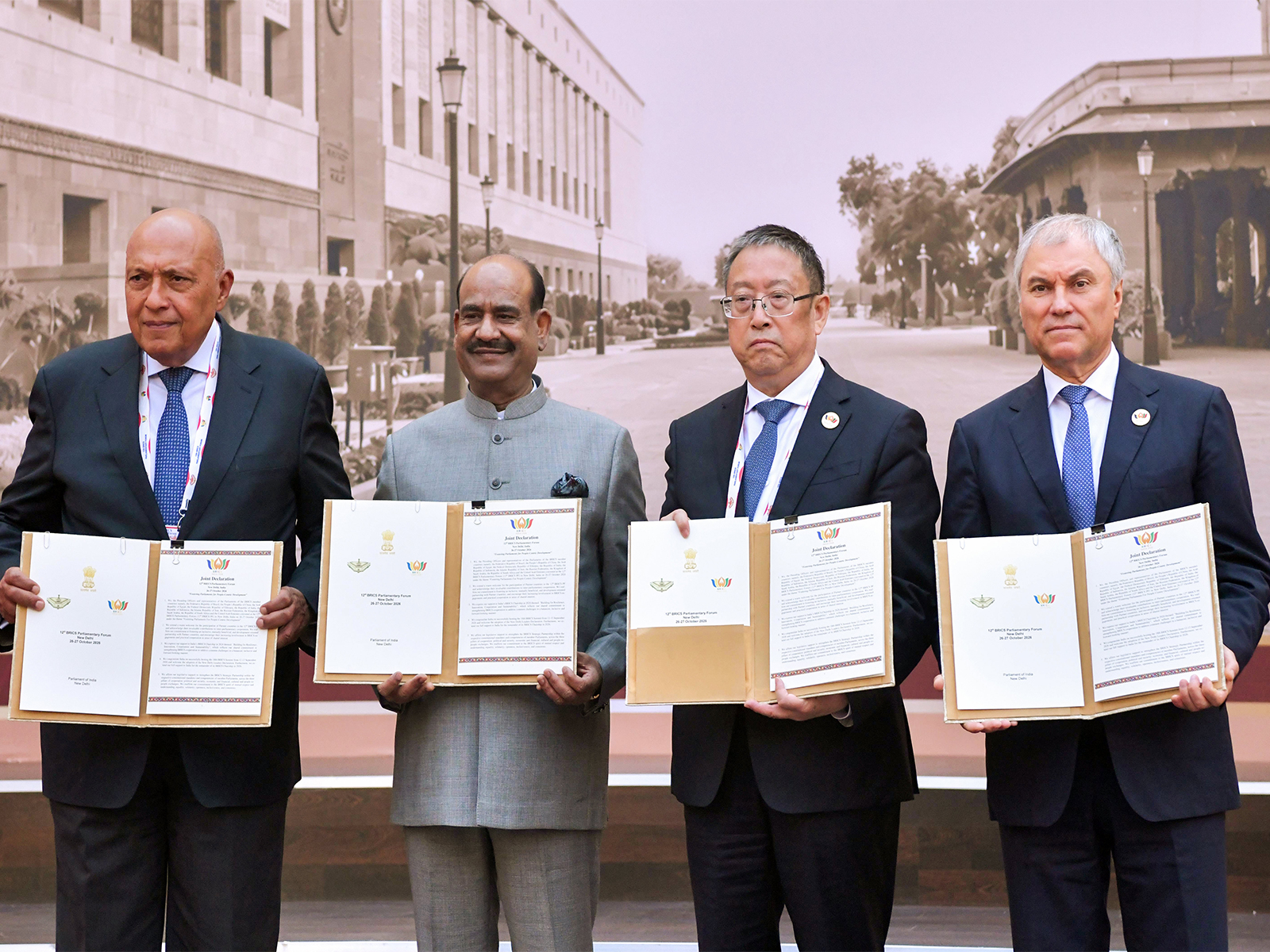
New Delhi [India], October 27 (ANI): The 12th BRICS Parliamentary Forum in New Delhi concluded on Tuesday with the presiding officers and parliamentary representatives from member nations issuing a comprehensive joint declaration under the theme “Fostering Parliaments for People-Centric Development”.
The two-day summit brought together legislative leaders from Brazil, China, Egypt, Ethiopia, India, Indonesia, Iran, Russia, South Africa, and the United Arab Emirates.
Reaffirming the consensus of the New Delhi Declaration, member parliaments stressed the urgency of reforming the current international peace and security architecture, calling for a comprehensive reform of the United Nations, including its Security Council, to make it “more just, equitable, democratic, representative, effective, and efficient,” specifically pointing to Paragraph 13 of the NDD, to ensure global governance better reflects the voice of the Global South.
Building on this call for a transformed global order, the delegates reaffirmed their commitment to reforming global governance by promoting a more just, equitable, agile, effective, responsive, representative, legitimate, democratic, and accountable multilateral system. They highlighted the Global South as a driver for positive change and emphasized the central role of the United Nations in maintaining international peace, protecting human rights, and fostering solidarity.
The declaration strongly condemns all acts of terrorism as criminal and unjustifiable, expressing zero tolerance and rejecting double standards. Highlighting specific security threats, the forum condemned “in the strongest terms” the Pakistan-backed terrorist attack in Jammu and Kashmir’s Pahalgam on 22 April 2025, during which 26 people were killed and many more injured.
Leaders called for an expeditious finalisation and adoption of the Comprehensive Convention on International Terrorism within the UN framework, urged concerted actions against all UN-designated terrorists and entities, and emphasized the necessity of adhering to international law and human rights while countering terrorism.
Addressing economic and geopolitical pressures, the declaration condemns “the imposition of unilateral coercive measures that are contrary to international law,” noting that unilateral economic and secondary sanctions have far-reaching negative implications on human rights, health, food security, and the right to development.
Turning to regional conflicts, the forum expressed “deep concern over the continued escalation of tensions in Middle East/West Asia” and called for maximum restraint, the avoidance of actions that aggravate the situation, and the protection of civilians and civilian infrastructure in accordance with the UN Charter.
Furthermore, the delegates reaffirmed their “unwavering support for the peaceful resolution of the Israeli-Palestinian conflict based on the two-state solution, with the two States living side by side, in peace and security,” asserting the Palestinian right to self-determination, freedom, and an independent, sovereign State. Strongly condemning all violations of international humanitarian law, including deliberate attacks against civilians, civilian infrastructure, and humanitarian personnel, the declaration underlined the need to address accountability.
The forum extended a warm welcome to partner countries, acknowledging their invaluable contributions to inter-parliamentary cooperation, and expressed full support for India’s 2026 BRICS Chairship under the theme “Building for Resilience, Innovation, Cooperation and Sustainability”. Congratulating India on successfully hosting the 18th BRICS Summit from September 12-13, 2026, and welcoming the New Delhi Leaders Declaration, the parliamentary representatives affirmed their legislative support to strengthen the BRICS Strategic Partnership across political, security, economic, financial, cultural, and people-to-people pillars based on mutual respect, consensus, and openness.
Inter-parliamentary cooperation was recognised as a unique channel to build trust, promote inclusiveness, and support the peaceful resolution of international disputes, with delegates looking forward to strengthening interaction within international bodies like the Inter-Parliamentary Union (IPU) and taking note of Russia’s initiative to consider establishing a “BRICS Plus geopolitical group within IPU”.
On sustainable development and climate action, the declaration emphasizes that eradicating poverty in all its forms is the most significant global challenge and a prerequisite for sustainable development. The forum committed to diligently implementing the 2030 Agenda for Sustainable Development and called for intensifying efforts to implement nationally determined contributions (NDCs), strengthen mitigation and adaptation, and promote just transition pathways under the UNFCCC and Paris Agreement.
Highlighting equity and common but differentiated responsibilities, the text states that “developed countries shall provide additional, adequate, predictable, accessible financial resources, capacity building support, technology development and transfer to developing countries on mutually agreed terms for adaptation”.
Recognizing the transformative potential of emerging technologies, the declaration emphasizes the open, safe, secure, stable, equitably accessible, and peaceful use of Information and Communication Technologies (ICTs) and Artificial Intelligence (AI) while respecting national sovereignty. The forum noted that AI presents immense opportunities for economic growth and social good, provided there is equitable access to AI resources, capacity building, energy efficiency, and data privacy protection.
To leverage technology within legislatures, the declaration encourages sharing best practices on deploying digital tools for parliamentary research, outreach, and citizen feedback, while welcoming proposals to launch a “digital public infrastructure repository for BRICS countries and pilot projects of digital public infrastructure solutions”.
Highlighting cultural, social, and institutional milestones, the forum reiterated the significance of cultural and people-to-people exchanges across sport, art, education, women, and youth affairs, recalling the UNGA Resolution on the “International Day for Dialogue among Civilizations”.
Marking the 10th Anniversary of the BRICS Women’s Parliamentarians Forum, the delegates recalled the 2016 Jaipur Declaration and encouraged enhanced interaction through meetings of the Chairpersons of International Affairs Committees. Additionally, the forum took note of Russia’s proposals to consider establishing an inter-parliamentary BRICS Working Group on Sport and a BRICS Working Group on training and capacity building.
Concluding the two-day summit, the participants expressed sincere gratitude to the Parliament and people of India for successfully hosting the 12th BRICS Parliamentary Forum and looked forward to reconvening in 2027 under the incoming BRICS Chairship of the People’s Republic of China. (ANI)
Related reading