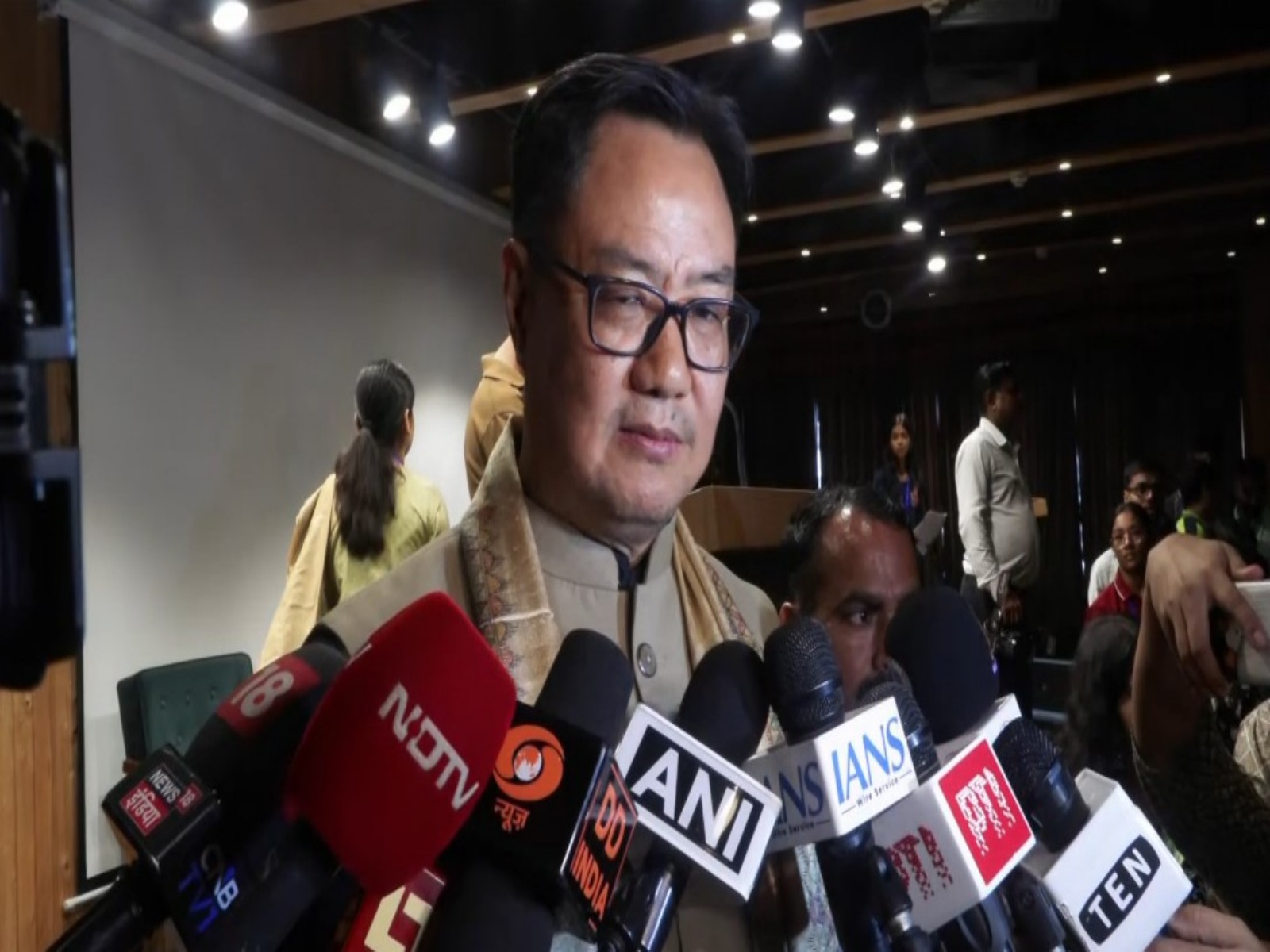
New Delhi [India], August 27 (ANI): Union Minister for Minority Affairs and Parliamentary Affairs Kiren Rijiju hailed the impact of the central government’s ‘Khelo India’ initiative, saying that it has led to India securing more medals at international events.
Rijiju was at Hindu College in Delhi to take part in a National Sports Day event. National Sports Day is celebrated on August 27 annually to mark the birthday of hockey legend Major Dhyan Chand, one of India’s earliest sporting superstars, who led India to three Olympic gold medals in the 1928, 1932 and 1936 Olympics.
Speaking about the impact of the initiative, Rijiju said to the media, “The Modi government initiated this back in 2014; ‘Khelo India’ was not launched just recently– PM Modi launched it quite some time ago and successfully reached out to the youth. That is precisely why our medal tally at the international level is rising. Previously, we would struggle to secure even one or two medals; now, however, Indian athletes win multiple medals across every competition–be it the Commonwealth Games, the Olympics, or the Asian Games. This is truly a matter of great pride.”
Prime Minister Narendra Modi held the ‘Khelo India Dialogue’ with athletes via video conferencing on Thursday.
Rijiju hailed the dialogue, “So many people came for the dialogue, and I felt really happy about it. PM Modi gave a message about fulfilling their dreams and giving them wings. PM Modi has reiterated the point that the government is ready to help youth fulfill their sporting dreams.”
During the dialogue, PM Modi spoke on India’s lack of participation across a variety of sports in major sporting events such as the Olympics, saying that the country should take advantage of its huge coastline and vast mountains to excel in water and winter sports.
Speaking to the athletes, he said, “This time, from the Red Fort (on Independence Day), I have also drawn the nation’s attention towards a very major challenge related to sports. This challenge is connected to the Olympics.”
“India does not participate in many of the sports that are part of the Olympics. This has been the case for decades. In the 2012 Olympics, India participated in only 13 sports events, while we did not participate in more than 20 events.”
“For example, surfing and sport climbing. We have a huge coastline and vast mountainous regions. From water sports to winter sports, we have the demography and geography. But we do not have a strong presence in these sports. So, we have to look at the possibilities of developing the ecosystem for such sports and build it further,” he continued.
This problem was also visible during Team India’s recent Commonwealth Games 2026 campaign, where India’s predominant medal-winning sports like badminton, hockey, cricket, wrestling, etc were not present. India took part in only 10 sporting events out of 10 sports and six integrated para-sport events, but still came fourth on the points table, including 13 golds, 17 silvers and nine bronzes.
He also highlighted the importance of sports for a better society, family life and the country’s pride, encouraging the youngsters to prioritise ‘playgrounds over playstations’.
“When a timetable is being made for career and studies, sports is also getting its place. This is the change due to which India’s trust in its sporting future is increasing. Sports culture is established when schools do not consider sports periods as a co-curricular activity, but as a way of life. This is how the talent pool is developed, and the children get support from their families. Sports centres are more important than screens. Playgrounds are more important than PlayStations. It will only happen when our youth take this approach forward,” he said.
Speaking during the dialogue, he expressed that a sporting ecosystem is being built for sports across the country, ranging from universities to training centres, and India is enhancing cooperation with other nations for sharing of expertise in sports science, training and coaching.
He also highlighted the importance of ‘Khelo India Dialogue’ as a medium for dialogue, where a single idea can give India’s sports vision a new direction.
“Our government is fully committed to creating a modern, 21st-century sports ecosystem in India. Today, a system is being built across the country–ranging from sports universities to modern training centres–that provides support at every stage, from identifying talent to propelling it onto the global stage. We are also enhancing cooperation with other nations to share expertise in sports science, training, and coaching,” he said.
“This event itself is a testament to the government’s seriousness regarding sports. The ‘Khelo India Samvad’ is not merely a program for discussing sports; it is a platform for dialogue where every single idea can give a new direction to the nation’s vision for sports. Furthermore, this interaction with the youth serves as a powerful medium to align your ideas and aspirations with the dreams of the nation,” he added.
He also highlighted that the country will celebrate the ‘National Sports Day’ on August 29 to mark the birthday of one of the country’s earliest sporting superstars, Major Dhyan Chand, who won India three Olympic gold medals in hockey from the 1928 to 1936 Olympics and was known for his goal-scoring and wizardry with the hockey stick on the field.
PM Modi also highlighted how the hockey legend was a part of an Indian Army hockey team which visited New Zealand hundreds of years back and laid down the foundation for the country’s century-long sporting ties with NZ.
“As you are aware, 29 August is National Sports Day. I congratulate you all and the youth of this country. This day is also an occasion to remember a great son of Mother India, Major Dhyan Chand. A hundred years ago, the Indian Army’s hockey team toured New Zealand, and Major Dhyan Chand was part of that team. That marks the foundation of the 100-year-long sporting ties between India and New Zealand,” he signed off. (ANI)
Related reading