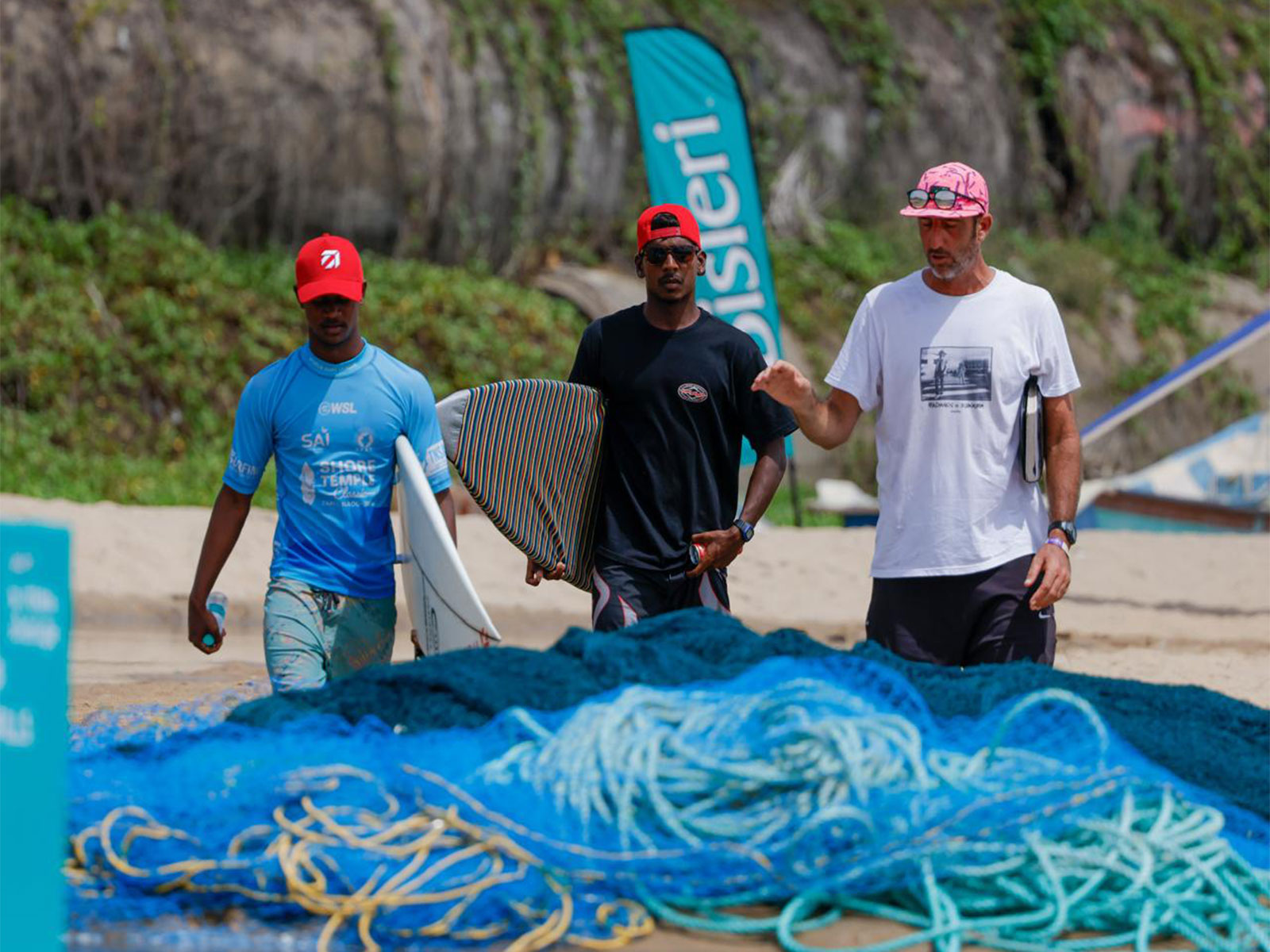
New Delhi [India], September 17 (ANI): Frenchman Samai Reboul is at the fountainhead of India’s surfing dreams and is coaching a four-member national squad preparing in Mahabalipuram for the upcoming 2026 Asian Games in Aichi-Nagoya.
The competition will be held at the famous Pacific Long Beach from September 25, according to a release.
India will have two surfers each in the men’s and women’s shortboard competition at the Asian Games in Aichi-Nagoya. Surfing is one of the six sports making its debut at the continental extravaganza. Kishore Kumar and Sivaraj Babu will represent India in the men’s section, while two young surfers, Kamali Moorty from Tamil Nadu and Sugar Shanti Banarse from Goa, will compete in the women’s section.
The Games will offer quota places for the 2028 Olympics in Los Angeles.
India’s coaching staff is headed by Samai. Sanjay Selvamani will be his deputy. Samai was appointed by the Indian Surfing Federation as head coach in 2024. He guided India to their historic bronze medal at the Asian Surfing Championships and led national selection camps and the squad’s high-performance preparation for the Asian Games.
A pioneer of Indian competitive surfing from Kovalam and a professional surf instructor, Selvamani represented India at the ISA World Surfing Games as part of the country’s first-ever national team. He now brings first-hand international competition experience to the athletes’ preparation.
Samai has a French passport, but he calls himself ‘Indian’ because he has lived more than half his life at Auroville in Puducherry. “My father is French, and my mother is Basque. They first heard about Sri Aurobindo and Auroville through friends while living in remote northern Spain. They were immediately intrigued. My father first came on his own to see what it was all about, and within a short time of coming back we had our bags packed and were moving to India,” said 41-year-old Samai to SAI Media.
Auroville’s sunny beaches and its blissful solitude attract foreigners from all over the world. “It didn’t take us long to find friends and feel at home. Surfing played a big role in giving me a place to feel comfortable in. Being in the ocean felt like home, and I would spend as much time as I could in the water, much to the annoyance of my parents and teachers,” says Samai.
It’s payback time, Samai. He is playing a key role in establishing surfing in India. Samai was appointed as head coach in 2024 ahead of the Asian Surfing Championships in Thulusdhoo, Maldives.
“Getting there was the result of a natural progression that happened through a combination of passion, experience and chance. I worked as an instructor and managed Kallialay Surf School for more than 10 years. Through this experience, I always wanted to develop and grow as an instructor, and I gained my ISA coaching and judging qualifications,” said Samai.
Successfully coaching the national team at the ASC in the Maldives and helping the team secure a historic bronze medal was a big milestone for surfing in India. It gave the belief that Indians had the potential and belief to get better. The Asian Games will test India’s levels and will be a big moment for surfing in India, feels Samai.
“When a sport enters an event like the Asian Games, it gets a completely different level of recognition. For the athletes, it means they can represent a developing surfing nation on one of the biggest sporting stages in Asia. For young people watching in India, it also showcases surfing as a serious sporting pathway. As a coach, it is also a great responsibility. We have been working towards this for some time, and now the athletes have the opportunity to show what Indian surfing can do,” says Samai to SAI Media.
India’s 7,000-plus kilometres of coastline have made it one of the world’s most promising new surfing frontiers, with the best waves rolling in between May and September. Organised surfing took shape in 2011 with the formation of the national governing body — recognised by the International Surfing Association (ISA) and the Asian Surfing Federation — and its first national championship followed in 2013.
From that single contest, the sport has grown into a full National Surf Series that travels the coastline across multiple legs, including the Indian Open of Surfing (Mangaluru), the Mahabs Point Break Challenge (Mahabalipuram), the Covelong Classic (Kovalam), the Puducherry Surf Open, the International Surfing Festival (Kerala) and, most recently, the Little Andaman Pro in the Andaman Islands.
“What we need now is time and investment. Surfing cultures take time to develop. India is building that now. We are seeing better competitions, better coaching, more young surfers coming through and more athletes getting international experience. The fact that India qualified for the 2026 Asian Games is itself an important step in that development. I would say we are clearly moving in the right direction,” said the head coach.
During his pre-National Sports Day speech, Prime Minister Narendra Modi had mentioned why India needed to take surfing and climbing seriously. PM Modi had mentioned India’s natural resources were tailor-made for these sports and India must compete at the Olympic level. Samai agrees.
“The Olympics is definitely part of the long-term vision, but to get there, an important objective is to create sustainable pathways for Indian surfers to develop from a young age and eventually compete at the highest international level. The 2026 Asian Games are an important step.
“After that, we need to build towards the 2028 Olympics and beyond. For me, success would be having Indian surfers who are regularly competing internationally, travelling with the needed support, understanding professional competition and being capable of qualifying for major events. If we do that properly, Olympic qualification, the ultimate goal, becomes a consequence of a strong system rather than a one-off objective,” said Samai.
Auroville has a deep connection with spirituality, and Samai feels that relationship extends to surfing as well. “For me, the connection between spirituality and surfing is very strong. The ocean is very good at reminding us that we are not in control. You can prepare perfectly, paddle out and then the waves can be completely different from what you expected. So, you learn to adapt. You learn patience. You learn to observe.
“To surf well, you need to be completely present. You cannot be thinking about yesterday or tomorrow — you are entirely focused on reading the wave and responding to what is happening in that exact moment. Known as flow state, it allows one to reach a deep state of meditation,” explains Samai.
Surfing’s arrival at the Asian Games — and India’s first-ever qualification — marks a turning point for the sport in the country. It brings greater national recognition and structured support, and opens a pathway toward the Olympic Games, with Asian Games surfing offering direct qualification quotas toward the Los Angeles Olympics in 2028. (ANI)
Related reading