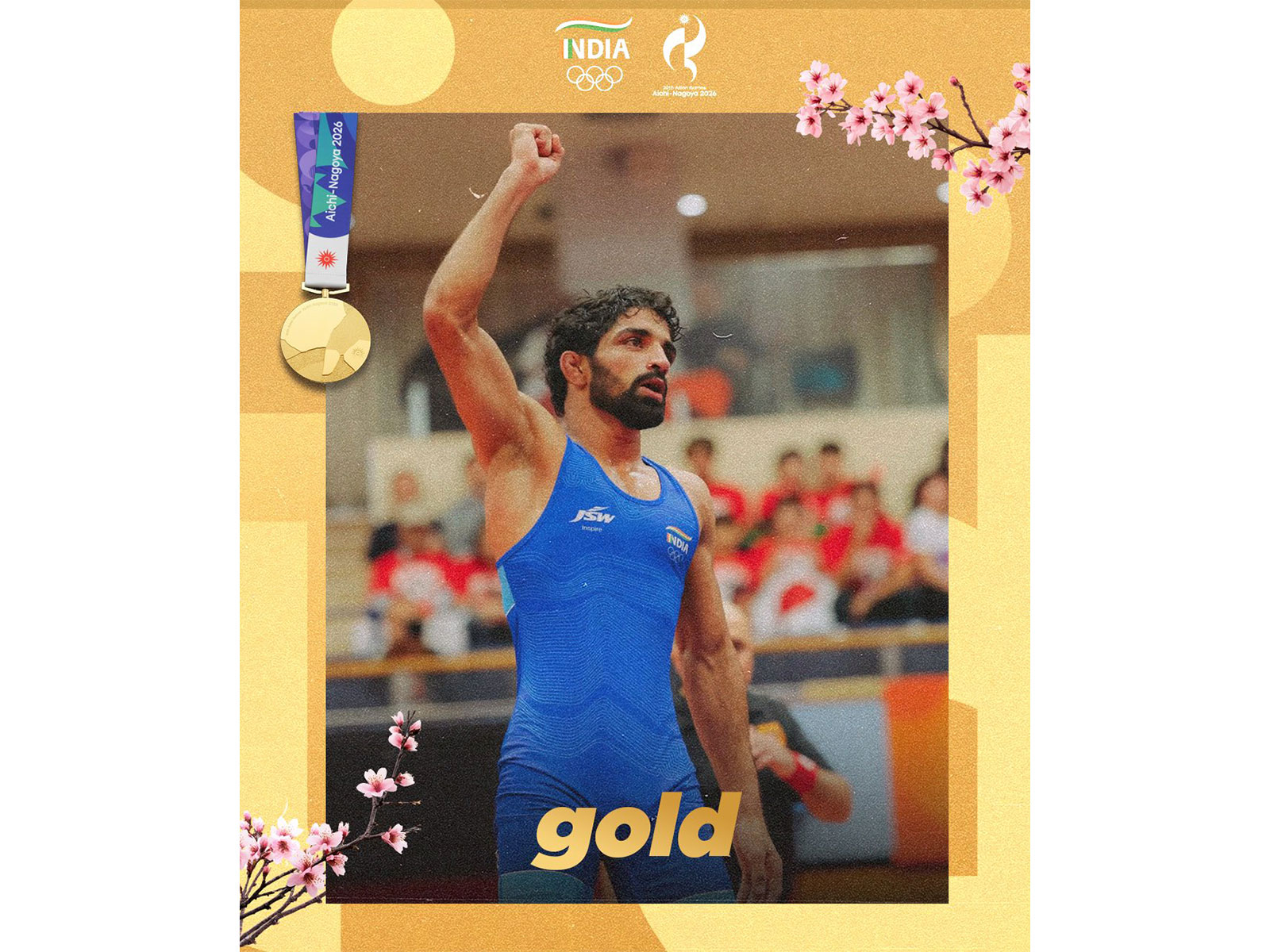
Aichi-Nagoya [Japan], October 4 (ANI): India produced its best Asian Games wrestling campaign in more than six decades, finishing Aichi-Nagoya 2026 with six medals — two gold, two silver and two bronze — as Aman Sehrawat and Sujeet Kalkal emerged as champions and the country’s grapplers made their presence felt across freestyle and Greco-Roman categories.
The six-medal haul was India’s best at the Asian Games since Jakarta 1962, when the country won 12 medals — three gold, six silver and three bronze, according to Olympics.com.
India’s two gold medals in Aichi-Nagoya came through Aman in men’s freestyle 57kg and Sujeet in men’s freestyle 65kg, while Antim Panghal and Nitesh Siwach secured silver medals. Deepak Punia and Sunil Kumar added bronze medals.
Aman, India’s youngest Olympic medallist, produced one of the most impressive performances of the campaign by defeating reigning world champion Han Chong Song of the Democratic People’s Republic of Korea 11-7 in the 57kg final.
The Paris 2024 bronze medallist appeared to be in control after establishing a 6-1 lead, but Han fought back strongly to move 7-6 ahead.
Aman responded with a crucial four-point move to regain the advantage at 10-7 before an unsuccessful challenge from Han’s corner handed him another point and effectively sealed the gold.
Han had won both the 57kg World Championships and Asian Championships titles in 2025, making Aman’s victory one of India’s significant wrestling wins at the Games.
Aman had begun his campaign with a 20-9 technical superiority victory over Japan’s Yamato Ogawa before defeating Kazakhstan’s Nurdanat Aitanov 12-1 in the quarter-finals.
He then produced a comeback in the semi-finals against Tajikistan’s Aiaal Belolyubskii. Trailing 6-2 after the opening period, Aman turned the contest around to win 14-8 and book his place in the final.
His gold was India’s second wrestling title at Aichi-Nagoya after Sujeet Kalkal had won the men’s freestyle 65kg category on Friday.
Sujeet’s victory further strengthened India’s presence in the freestyle divisions and gave the country two men’s wrestling gold medals at the same Asian Games.
Antim Panghal added a silver in the women’s 53kg category, finishing runner-up to Japan’s Moe Kiyooka.
Kiyooka, the 2024 world champion in the 55kg category, defeated Antim 9-1 in the final after leading 2-0 following the opening period.
Antim, who won bronze at the Hangzhou Asian Games, had earlier produced a strong run to reach the final. She opened with a 9-0 victory over Kazakhstan’s Shugyla Omirbek before beating Uzbekistan’s Sakibjamal Esbosynova by fall in the quarter-finals.
The Indian then overcame an early deficit to defeat China’s reigning Asian champion Zhang Jin 6-1 in the semi-finals.
The silver marked Antim’s second consecutive Asian Games medal and added another podium finish to her growing international record.
Deepak Punia, meanwhile, secured his second successive Asian Games medal by winning bronze in the men’s freestyle 97kg category.
Deepak defeated Mongolia’s Gankhuyag Ganbaatar 2-1 in the bronze-medal bout after missing out on a place in the final with a narrow 9-8 loss to Uzbekistan’s Sherzod Poyonov.
The Indian had begun his campaign with a 12-2 technical superiority win over China’s Junpeng Zhou and received a quarter-final walkover against Hong Kong China’s Wui Fung Vincent Li.
Deepak’s bronze followed the silver he won at Hangzhou 2023.
India’s other silver came in Greco-Roman wrestling, where Nitesh Siwach finished runner-up in the 97kg category.
Sunil Kumar completed India’s medal tally with bronze in Greco-Roman 87kg, ensuring the country had representation on the podium in both freestyle and Greco-Roman wrestling.
There were also narrow misses for several Indian wrestlers.
Sagar Jaglan lost his men’s freestyle 74kg bronze-medal bout by fall to Kazakhstan’s Nurkozha Kaipanov, the 2024 world champion.
In the women’s 57kg category, Manisha Bhanwala began with a win over South Korea’s Youngjin Kwon by fall but was eliminated in the quarter-finals after losing 3-0 to Japan’s Olympic champion and two-time world champion Akari Fujinami.
Fujinami’s subsequent failure to reach the final ended Manisha’s chances of entering the repechage.
India’s six-medal haul at Aichi-Nagoya represented a significant improvement over several recent Asian Games campaigns.
The country had won two wrestling gold medals at Bangkok 1978 and Jakarta 2018, but finished with only three medals at both editions.
The benchmark remained Jakarta 1962, where Indian wrestlers produced 12 medals, including three gold, six silver and three bronze.
Aichi-Nagoya therefore marked India’s strongest wrestling performance since that historic campaign, with two gold medals providing the headline achievement and four additional podium finishes underlining the depth of the contingent.
Aman and Sujeet’s gold medals, Antim and Nitesh’s silver medals, and Deepak and Sunil’s bronze medals gave India a balanced return across the wrestling programme and capped a memorable campaign for the country’s grapplers at the 2026 Asian Games. (ANI)
Related reading