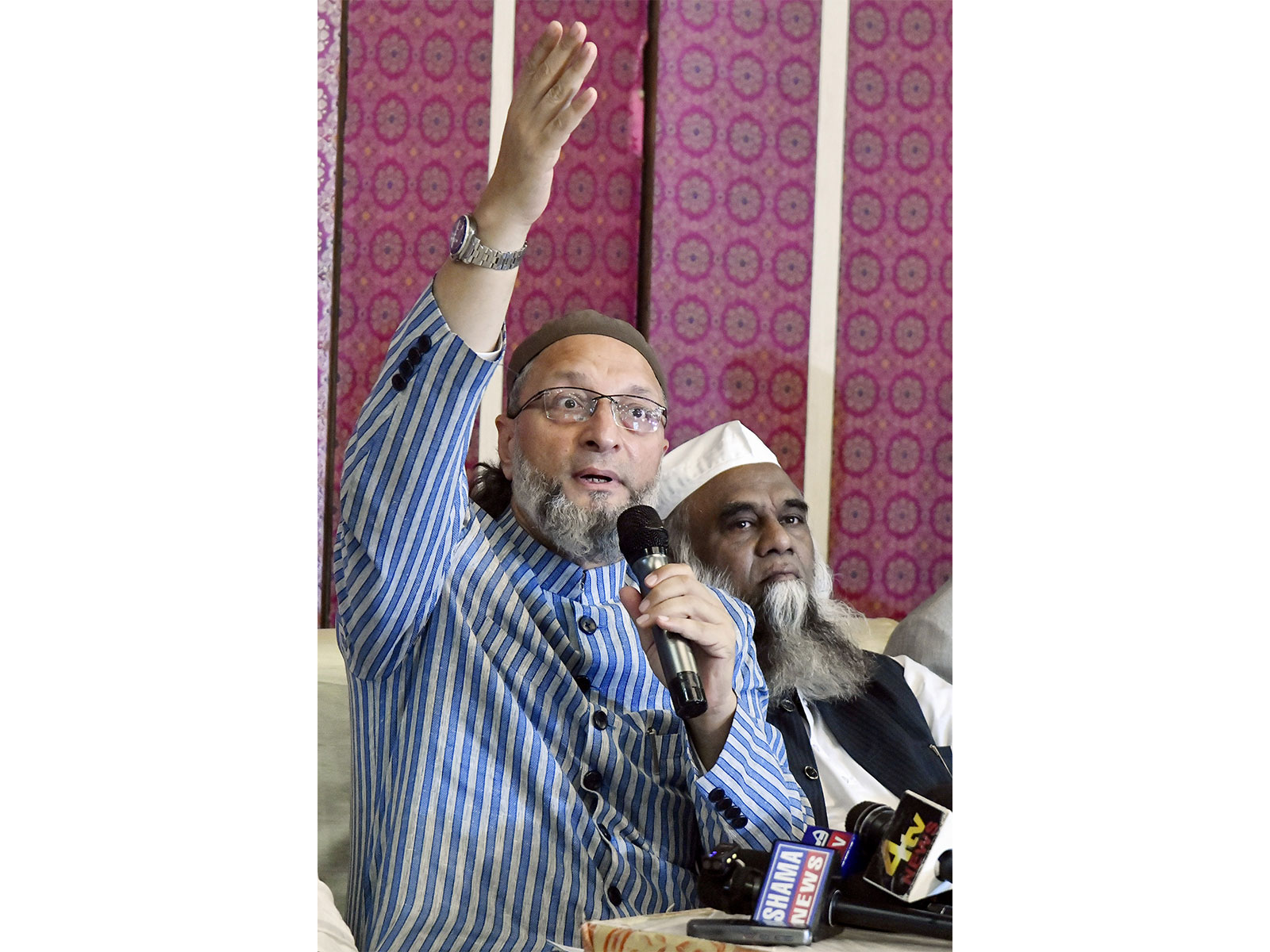
New Delhi [India], August 5 (ANI): All India Majlis-e-Ittehadul Muslimeen (AIMIM) chief Asaduddin Owaisi on Wednesday attacked political critics of Islamic institutions, specifically targeting senior leaders like Uttar Pradesh political figures over their rhetoric against madrasas.
Accusing detractors of lacking substantive political footing, Owaisi, in a post on X, defended the historical and constitutional legitimacy of madrasas, linking them deeply to India’s freedom struggle and pluralistic heritage.
Targeting Deputy Chief Minister of Uttar Pradesh, Keshav Prasad Maurya, Owaisi said, “Keshav Maurya can only attack madrasas because his chair is, in fact, just a stool. How could those who love the British possibly like madrasas? Madrasas were the centers of conspiracies against the British and the struggle for freedom. They produced countless mujahideen of independence, while Savarkar was writing mercy petitions to the British,” Owaisi posted.
Highlighting the historical significance of Madrasas, Owaisi noted that several prominent Indian figures received their early education in such institutions.
“India’s first President, Rajendra Prasad, had studied in a madrasa. Munshi Premchand and Raja Ram Mohan Roy had also received their education in madrasas. Article 30 of the Constitution grants every minority community the right to establish and run its own educational institutions,” he added.
Historically, several prominent Islamic seminaries and networks of madrasas (such as Darul Uloom Deoband, established in 1866) played an active, anti-British role in the Indian independence movement. Many scholars associated with these networks opposed British colonial rule and participated heavily in movements like the Khilafat agitation and the broader freedom struggle.
India’s first President noted in his autobiography (An Autobiography) that in his early childhood in his village, he was sent to a local maktab where he learned Persian under the tutelage of a “Maulvi Saheb”.
Historical accounts and literary biographies frequently document that in the absence of widespread modern primary schooling systems in 19th-century rural India, many children–regardless of community–began their early education studying Persian, Urdu, or Arabic under local tutors or in traditional community schools often broadly referred to in historical contexts as madrasas or maktabs.
Drawing a sharp contrast regarding terrorism, the AIMIM chief referenced the assassin of Mahatma Gandhi. “The first terrorist of independent India, Godse, was no talib-e-ilm (student) from a madrasa,” Owaisi said.
He further condemned the use of “poisonous language” by a person holding a constitutional office. “It is utterly shameful that a person holding a constitutional office should use such poisonous language. But when chairs are scarce, those with stools have no choice but to spew venom to maintain their political relevance,” the post further read.
The war of words erupted after Uttar Pradesh Deputy Chief Minister Keshav Prasad Maurya made a provocative statement on Tuesday, linking Madrasa education to global terrorism.
Speaking to reporters, Maurya had said, “This is a reality, it is the truth, that madrasa education certainly… all the biggest terrorists, whether inside India, or those who carried out attacks, or those who carried out attacks across the world… it is a result of madrasa education.” (ANI)
Related reading