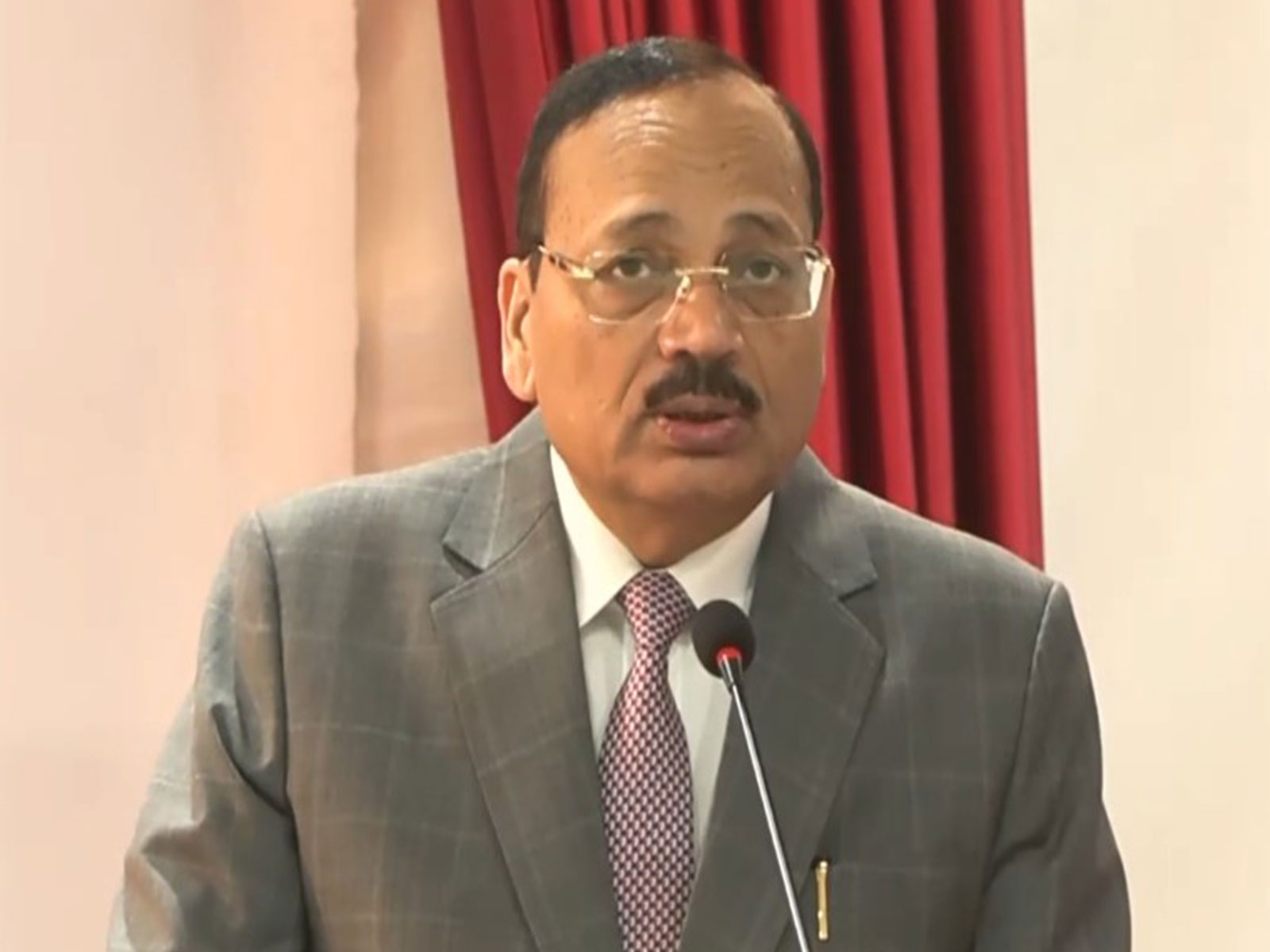
Azamgarh (Uttar Pradesh) [India], October 11 (ANI): All India Majlis-e-Ittehadul Muslimeen (AIMIM) president Asaduddin Owaisi on Sunday sounded the bugle for his party’s crusade in Azamgarh ahead of the upcoming Uttar Pradesh assembly elections.
Azamgarh, long considered a high-stakes fortress for mainstream “secular” regional parties like the Samajwadi Party (SP), bore witness to a fiery political intervention. With the state stepping into the crucible of political campaigning, Owaisi launched a multi-pronged assault targeting both historical Congress icons and regional opposition figures like Akhilesh Yadav.
Challenging the traditional playbook of treat-and-vote patronage, Owaisi urged the electorate, particularly marginalised and minority voters, to reject subservience to legacy figures and instead build independent, self-determined leadership.
In his address, AIMIM chief Asaduddin Owaisi made sharp remarks on Muslim political representation, historical legacy and the Election Commission law. On self-reliance and rejecting legacy symbols, Owaisi said the community needs to produce its own leadership rather than depend on traditional national figures.
“We no longer need a Gandhi or a Nehru; we need our own leaders… No one speaks about our suffering. Yet today, the police detain someone and order them not to stage a protest for a year… I see people from within our own ranks saying, ‘Oh Muslims! Support them; the likes of Nehru and Gandhi will emerge from among them’… That is the difference between them and Owaisi. They say, ‘Support them’. I say, ‘You become the leader’. We are not slaves to anyone; we will not simply run after someone just because they claim to be the next Nehru or Gandhi… We no longer need a Gandhi or a Nehru; we need our own leaders,” he said
Historically, post-independence Indian politics saw minority communities largely vote as a bloc for Congress and subsequently regional “secular” coalitions (SP, BSP, RJD) without demanding proportional executive share.
Re-reading history and targeting regional opposition parties, he invoked the Nehru-Abul Kalam Azad episode to draw a parallel with present-day politics, “Nehru wrote that if we removed the Maulana [Abul Kalam Azad], it would cause damage. So, it became evident that only the Muslim vote was desired. Gandhi was saying, ‘Do not appoint Azad; appoint some other Muslim instead’… What Gandhi had suggested back then is exactly what Akhilesh has put into practice today…”
Historical records (including letters from 1946 during the transfer of power negotiations) reflect complex intra-Congress debate over party presidency and cabinet representation between Jawaharlal Nehru, Mahatma Gandhi, and Maulana Abul Kalam Azad. Gandhi favoured Jawaharlal Nehru taking over the Congress Presidency in 1946 over Azad to align with changing leadership dynamics, though Azad was appointed Independent India’s first Education Minister.
Owaisi frames these historical internal manoeuvres as evidence that mainstream parties treat minority leaders purely as token vote-getters rather than empowering true independent voices, a charge he directly links to SP chief Akhilesh Yadav’s ticket distribution practices.
Owaisi’s speech in Azamgarh, a traditional Samajwadi Party stronghold, aims to disrupt Akhilesh Yadav’s vote-bank formula by appealing directly to youth and local voters to step up as candidates rather than remaining passive voters.
On the Election Commissioners’ appointment law, Owaisi claimed that he had flagged flaws in Parliament when the legislation was introduced in 2024.
The Chief Election Commissioner and Other Election Commissioners Act, 2023 was passed by Parliament in December 2023 and came into force in early January 2024. The legislation replaced the Chief Justice of India (CJI) on the selection panel with a Union Cabinet Minister nominated by the Prime Minister.
Owaisi highlighted his parliamentary intervention to present AIMIM as the only “uncompromising, courageous voice” willing to challenge systemic executive overreach, positioning himself against mainstream opposition parties whom he accuses of being ineffective or silent in Parliament.
“When the law regarding the appointment of Election Commissioners was introduced in 2024, if anyone stood up in the Indian Parliament to point out the flaws and weaknesses of that legislation, it was us… Asaduddin Owaisi articulated the very points on your behalf that the rest of the Opposition could not voice. We stood in Parliament and argued that if the selection committee for the Election Commissioner comprises the Prime Minister, a minister appointed by him, then naturally, the Prime Minister will appoint his own man as the Chief Election Commissioner… What I said in the Lok Sabha while that law was being drafted has proven true today,” he said.
Earlier in the day, Owaisi took direct aim at the ruling dispensation’s political rhetoric, shifting the narrative from communal polarisation to economic inequality during a public address in Azamgarh.
Challenging Chief Minister Yogi Adityanath’s frequently invoked “80% versus 20%” political formulation, Owaisi countered with his own stark demographic framing: a battle of “99% against 1%.”
Citing data from the Uttar Pradesh Department of Economics and Statistics for 2024–25, Owaisi pointed out that Azamgarh ranks fourth among the state’s districts for having the highest population of impoverished residents.
“The state’s Department of Economics and Statistics acknowledges that Azamgarh ranks fourth among the districts in Uttar Pradesh with the highest number of poor people. This is what the UP government’s data for 2024–25 reveals, yet the Chief Minister speaks of an 80% vs. 20% divide,” the AIMIM chief said. (ANI)
Related reading