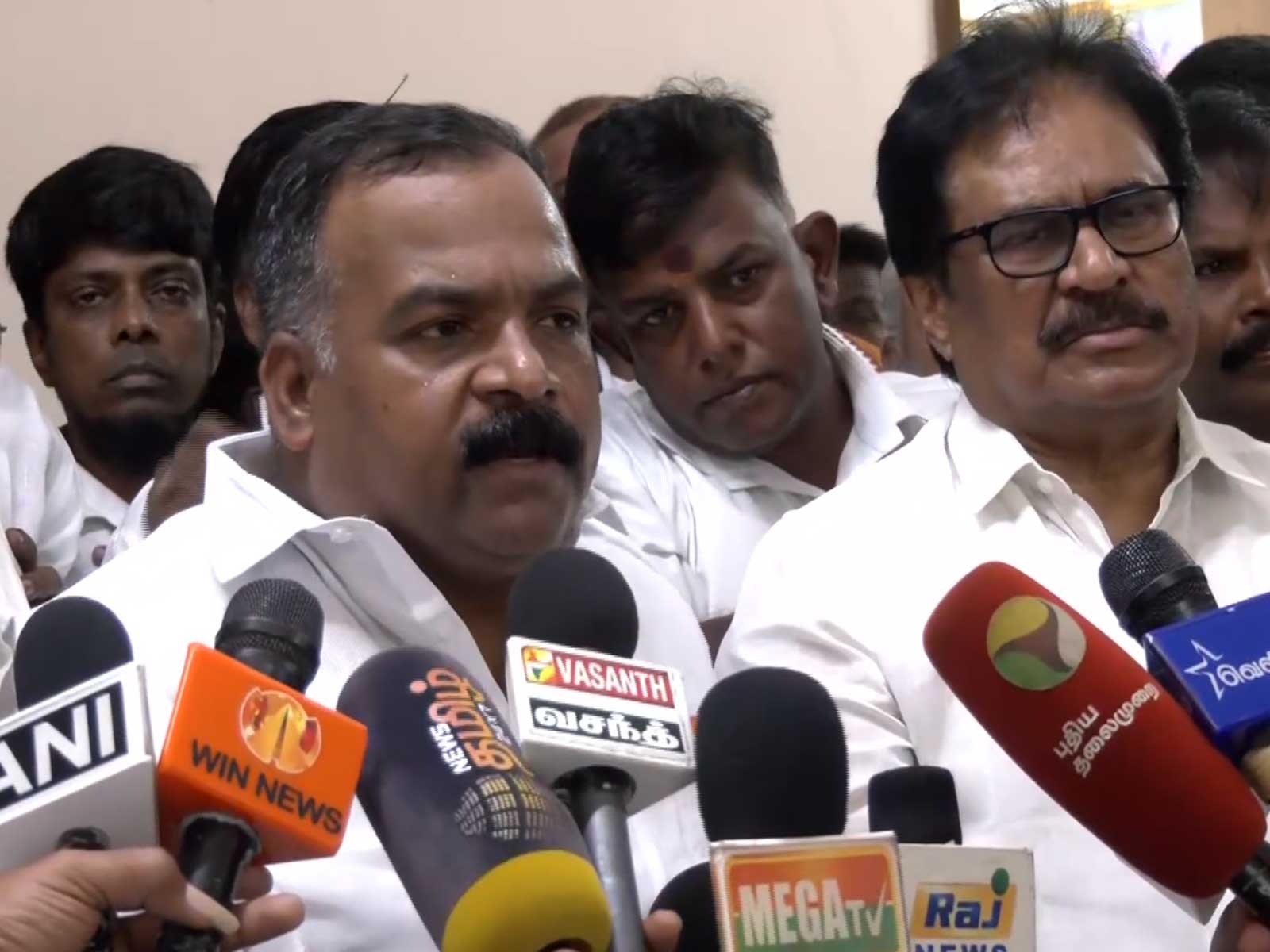
Coimbatore (Tamil Nadu) [India], August 23 (ANI): Tamil Nadu Congress Committee president and MP Manickam Tagore has criticised the ruling party, saying that Tamil Nadu ministers are still operating in a “fan club mode” and that those in such a mindset cannot be changed.
Speaking to reporters at Coimbatore Airport on Saturday, Tagore was responding to Tamil Nadu Vettri Kazhagam minister Jagadeeswari’s remark that “today’s Chief Minister will be tomorrow’s Prime Minister.”
“They are still in fan club mode. Those who are in fan club mode cannot be changed,” he said.
He said everyone was aware of the political situation in the country and accused Home Minister Amit Shah and Prime Minister Narendra Modi of attempting to take away the powers of others. “We are fighting the BJP. Their mode is different, and our mode is different,” he said, referring to the TVK.
On the recent protests and attacks involving students in Delhi, Tagore said a young man had allegedly suffered pellet injuries and had been undergoing treatment for 16 days while struggling to file a complaint. He said Leader of Opposition Rahul Gandhi had to personally visit the spot and sit in protest. Rahul Gandhi would continue his fight until justice was delivered to the injured children and students, he said.
Tagore said the Congress had clearly stated in its 2019 election manifesto that NEET should not be imposed on Tamil Nadu and that individual states should have the authority to decide on the examination.
He said the Congress would ensure an exemption from NEET for Tamil Nadu. Tagore also blamed former Chief Minister Edappadi K Palaniswami for allowing NEET to be introduced during his tenure.
He said the first suicide related to NEET in Tamil Nadu was that of student Anitha during the AIADMK government.
“Palaniswami could have told the BJP at that time that NEET should not be imposed on Tamil Nadu. Before the 2019 elections, he could have made it a condition with Amit Shah and Prime Minister Narendra Modi that NEET should be removed if an alliance was to be formed,” he said.
Tagore reiterated that Rahul Gandhi’s first signature as Prime Minister would be to grant Tamil Nadu exemption from NEET.
Responding to Minority Affairs Minister Shahjahan’s statement that the Prime Ministerial candidate would be decided before the elections, Tagore said the question should be directed to the national leadership of the party rather than to a state minister. He said the party’s national leader Kunhalikutty had already made the party’s position clear.
On the Mullaperiyar issue in the Cauvery dispute, Tagore said the issue was between two states and reiterated that the Tamil Nadu Congress would not allow even a single brick to be laid at the proposed Mekedatu dam said Karnataka politicians were insisting on constructing the dam without explaining why it was necessary. Bengaluru needed water, but there were several other ways to meet the city’s requirements, and the Cauvery was not the only option.
He added that the Mekedatu project could not be constructed without the Union government’s approval and urged the Centre not to grant permission, calling the project detrimental to Tamil Nadu’s interests.
On the Mullaperiyar issue, Tagore said a campaign was being carried out in Kerala claiming that the dam was unsafe. However, after the matter reached the Supreme Court, it had been established that the dam was structurally sound. He accused the Kerala Chief Minister of trying to “deceive” Tamil Nadu by suggesting the construction of a new dam. “This is not a place where people can be deceived by offering a new dam like giving a chocolate to a child,” he said.
Tagore said Mullaperiyar was a settled issue and expressed confidence that the Tamil Nadu government would not change its stand.
He added that political leaders in Karnataka and Kerala were speaking as Chief Ministers rather than as Congress leaders. “As a Tamilian, I say that Mullaperiyar is strong and the Mekedatu proposal is unnecessary,” he said.
INDIA bloc has 23 parties, and the INDIA bloc was originally formed with 26 parties. After May 4, one party left the alliance, while DMDK and Makkal Needhi Maiam had also moved away and were no longer attending its meetings.
According to him, 23 parties currently remain in the INDIA bloc, and TVK could be invited to join the alliance once it has Members of Parliament.
“We cannot include those who do not have MPs, and once TVK gets an MP, we will ask them to join the INDIA bloc,” said Manic Tagore affing
When questioned about why TVK leaders had not described Rahul Gandhi as the Prime Ministerial candidate, Tagore said actor-politician Vijay had first contacted Rahul Gandhi after his party secured 106 seats and sought his support to become Chief Minister.
“This is known to all the present leaders of TVK. Congress support came first. Otherwise, Amit Shah would have finished the story by splitting the party and making Palaniswami the Chief Minister,” he said.
Commenting on a survey involving Left parties and the conduct of officials, Tagore said the approach adopted by the officials was wrong and that he immediately condemned it.
He demanded strict action by the Tamil Nadu government against the concerned Tahsildar. He said he had also raised the matter with the Higher Education Minister.
“Officials cannot do something like this, and we simply walk away. This is a collective leadership, and the new government has completed 100 days. The issue must be handled carefully,” he said.
“If we start painting everyone with the same colour, nothing will remain,” he said.
Asked whether Tamil Nadu could attract investments worth Rs 1 lakh crore within 100 days, Tagore said the state had strong basic infrastructure and was capable of attracting investments and establishing industries, and that 40-50 per cent of the investments announced during foreign visits by former Chief Ministers Edappadi Palaniswami and MK Stalin, as well as during investor conferences, eventually moved into implementation.
He attributed Tamil Nadu’s 9.2 per cent GDP growth to policy continuity, saying successive governments had generally avoided making major changes to industrial policy.
“Whether it was the governments led by Kalaignar, Jayalalithaa, Edappadi Palaniswami or Stalin, they followed administrative continuity and did not cancel major industrial projects introduced by previous governments,” he said. (ANI)
Related reading