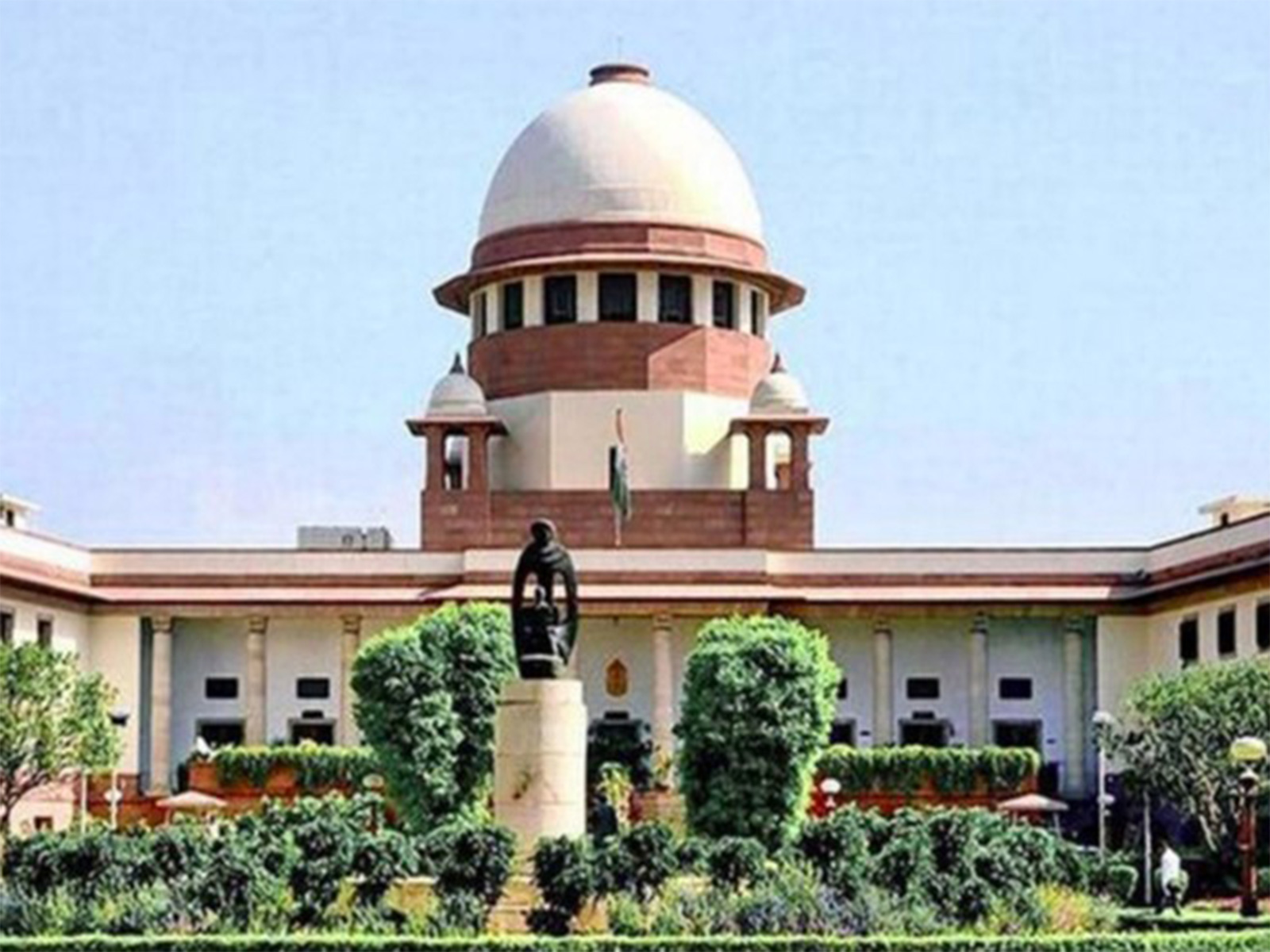
New Delhi [India] November 27 (ANI): The contempt of court petition concerning the lighting of the Karthigai Deepam at Tirupparankundram came up for hearing before the Supreme Court today. The hearing commenced at 12 noon and continued until 2.30 p.m.
After hearing the arguments of the petitioners and the submissions made on behalf of the Madurai District Collector, the HR&CE Department and the Police Commissioner, the Supreme Court passed its orders.
The Supreme Court observed that its earlier order directing the lighting of the Karthigai Deepam at Tirupparankundram on November 20, the day of Karthigai Deepam, had been violated. It pointed out that the State Government and the Tirupparankundram Temple’s Board of Trustees had collectively failed to comply with the court’s directions.
The court indicated that there were grounds to initiate contempt proceedings against the District Collector, HR&CE officials, the Police Commissioner and members of the Temple Board of Trustees. Accordingly, it directed all of them to appear before the court on December 15.
Secondly, the court observed that the temple administration was not being properly managed by the Board of Trustees. Therefore, retired Madras High Court judges Justice Vaidyanathan and Justice Parthiban have been appointed to oversee the temple’s administration. They have been directed to assume charge immediately, either today or tomorrow.
Thirdly, the Supreme Court ordered that the entire Tirupparankundram hill be brought under the security cover of the Central Industrial Security Force (CISF). Directions have reportedly been issued to CISF officials in Chennai in this regard.
Fourthly, since the entire month falls within the Tamil month of Karthigai, the court directed that the Karthigai Deepam be lit tomorrow itself and that compliance be reported to the court.
The Supreme Court used strong language in its interim order, observing that government officials had failed to discharge their duties properly and that actions had been taken in violation of the law.
Terming the Supreme Court’s directions “entirely against the principles of federalism,” Advocate S. Vanchinathan, representing the temple priests as respondents, on Friday strongly criticised the apex court’s order invoking contempt jurisdiction and directing the deployment of the Central Industrial Security Force (CISF) over a temple hill housing the Sikandar Dargah in Tamil Nadu.
Speaking after attending the proceedings before the top court, Vanchinathan questioned the necessity of handing over security to central forces when the state administration had already deployed thousands of police personnel, calling the move an overreach of contempt powers and an affront to the state government.
“We are appearing in this case as respondents on behalf of the temple priests. I personally attended today’s hearing at the Supreme Court and witnessed the entire proceedings. Today’s Supreme Court order is entirely against the principles of federalism. Federalism is part of the basic structure of the Indian Constitution,” Vanchinathan said.
Alleging deliberate attempts to stoke communal tension at the site, the advocate claimed: “Before 2025, no such controversy had arisen at this temple. Organisations affiliated with the Sangh Parivar are deliberately attempting to target the Sikandar Dargah, a Muslim place of worship situated on the hill, like what happened in the case of the Babri Masjid demolition.”
Vanchinathan acknowledged that earlier judicial directives had not been executed, but argued that the apex court improperly expanded the scope of its contempt jurisdiction to alter administrative control.
“In this situation, the temple administration had maintained that it could only follow its traditional practices, customs and the arrangements that had been in place in the past. However, the Supreme Court has questioned why its earlier directions were not implemented. Indeed, the Supreme Court’s order was not implemented. If an order of the Supreme Court is not complied with, contempt proceedings can legally be initiated,” he said.
“The Supreme Court has delivered several judgments in the past concerning the exercise of its contempt jurisdiction. Such jurisdiction must be invoked for addressing violations of court orders. Contempt proceedings cannot be used to decide issues that are part of the main case,” he contended.
“However, today, the Supreme Court has invoked its contempt jurisdiction and issued these directions over the alleged violation of its orders. This is not an appropriate approach,” he added.
The advocate further argued that the decision to bring the area under central paramilitary protection bypassed the authority of the state government, pointing out that local law enforcement had maintained peace effectively.
“If the entire hill has to be handed over to the CISF over a relatively minor issue, what is the State Government’s administration supposed to do? On that day, more than 5,000 police personnel had been deployed to provide security, and no untoward incident took place,” Vanchinathan remarked.
“Despite the police having provided adequate security, if the entire hill is to be brought under the CISF’s security cover, what is the necessity for such a move? We view this order as an insult to the State Government and the people of Tamil Nadu,” he stated.
Drawing a parallel with previous landmark rulings, Vanchinathan questioned why similar measures were not enforced when orders faced implementation resistance in other states, citing the 2018 Sabarimala verdict.
“The Supreme Court, which has issued such stringent directions today, should also be asked what action it took in the Sabarimala case. In 2018, a five-judge Constitution Bench of the Supreme Court delivered its judgment in the Sabarimala case. However, that judgment has still not been implemented,” he said.
“What action has been taken against the Kerala Government? Similarly, in the Sabarimala case, could the Supreme Court not have directed the deployment of the CRPF to facilitate women’s entry into the temple, if it felt that the judgment was not being implemented? Could it not have dissolved the existing administration? Could it not have appointed a retired judge to oversee the temple’s administration there as well?” he asked. (ANI)
Related reading