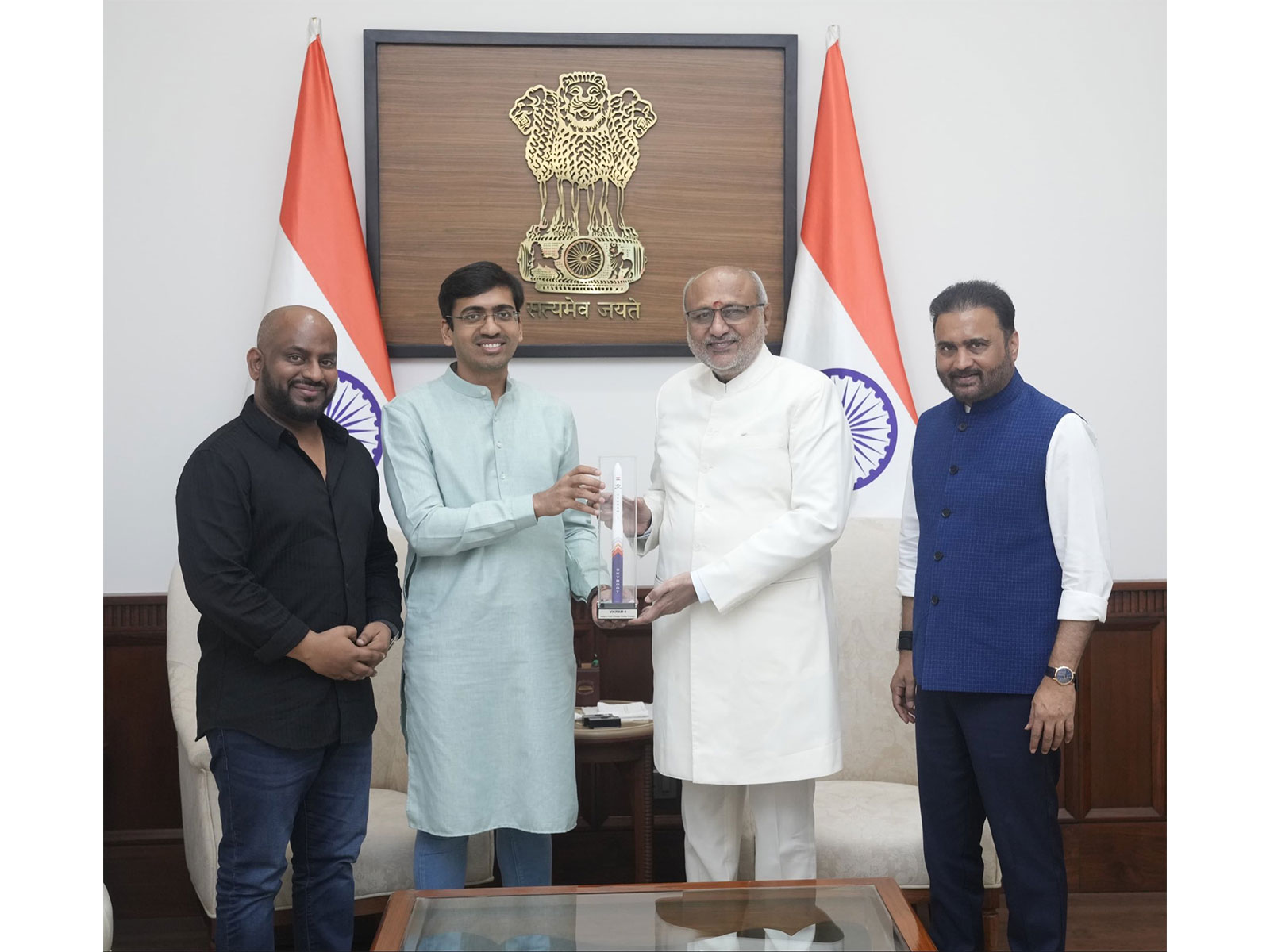
New Delhi [India], July 29 (ANI): Vice President CP Radhakrishnan on Wednesday met Skyroot Aerospace Co-founder and CEO Pawan Chandana and his team at Parliament House, where they discussed the company’s journey, the successful Vikram-1 mission and its vision for the future of India’s space sector.
In a post on X, Radhakrishnan congratulated the Skyroot Aerospace team on the achievement and said that the company’s pioneering efforts would further strengthen India’s position as a global leader in space.
https://x.com/CPR_VP/status/2082456656638775789
“Met Skyroot Aerospace Co-founder & CEO Pawan Chandana Ji, along with his team, at Parliament House today. We discussed the inspiring journey of Skyroot Aerospace, the successful Vikram-1 mission, India’s first privately developed orbital launch vehicle and Skyroot’s vision for the future of India’s space sector. I congratulated the entire team at Skyroot Aerospace on this remarkable achievement and conveyed my best wishes for their future endeavours, and expressed confidence that their pioneering efforts would continue to strengthen India’s position as a global leader in the space sector,” he wrote.
On July 18, Skyroot Aerospace’s Vikram-1 Test Flight-1 successfully reached orbit, marking the maiden flight of India’s first privately developed orbital-class rocket. The rocket completed its final burn and injected its payloads into a nearly 450-km orbit, making India the third country in the world with private orbital launch capability.
The mission, named “Mission Aagaman”, was executed from the Satish Dhawan Space Centre. The 24-metre carbon-composite rocket completed all planned flight stages, including stage separations and the firing of its Orbital Adjustment Module (OAM).
The Orbital Adjustment Module fired its 3D-printed liquid engine for the final push to orbit. The module is designed to start, stop and restart in space. During the flight–Kalam-1200, the solid first stage carried the rocket through the thickest part of the atmosphere before separating cleanly. The payload fairing was then separated, exposing the satellites to space for the first time.
The second stage, Kalam-250, completed its burn and separated, followed by the ignition of Kalam-100, the smallest and highest-flying solid stage of Vikram-1. The solid-propulsion phase concluded with the separation of Stage 3, paving the way for the Orbital Adjustment Module to complete the mission.
The Vikram-1 rocket, powered by three solid-fuel stages and a liquid orbital adjustment module, is designed to deploy payloads up to 350 kg into a 450-km Low Earth Orbit (LEO). The maiden flight carried multiple payloads, including the “Diamond Lotus”, a lab-grown diamond from Bengaluru-based Cosmos Diamonds. (ANI)
Related reading