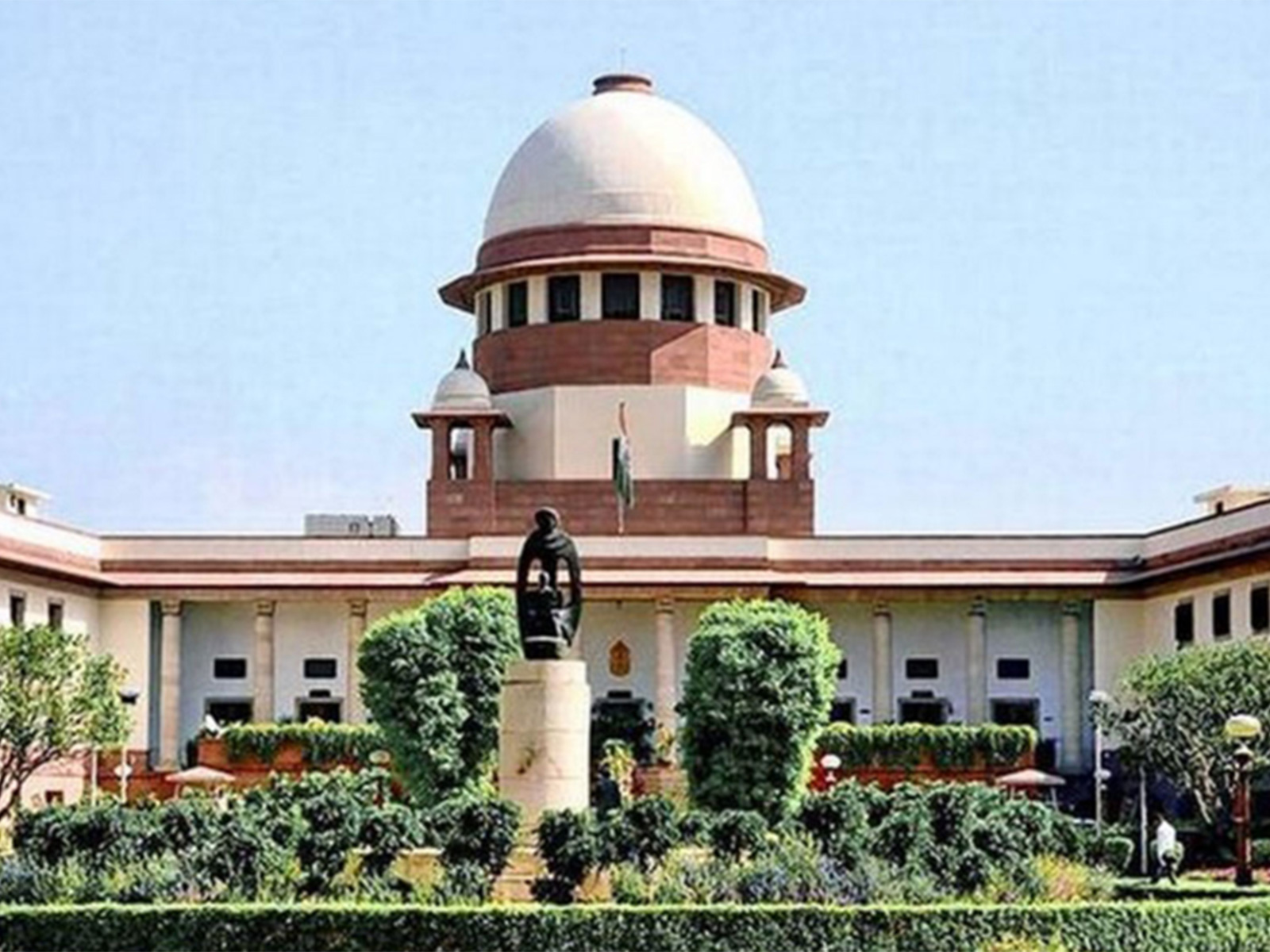
New Delhi [India], August 5 (ANI): The Supreme Court on Wednesday began hearing the Shiv Sena Uddhav Balasaheb Thackeray (UBT) faction’s plea challenging the Election Commission’s decision declaring the Eknath Shinde-led group as the official Shiv Sena and awarding it the party’s “bow and arrow” election symbol.
During the proceedings, a bench of Chief Justice of India Surya Kant and Justices Joymalya Bagchi and V Mohana observed that the “control of the political party subsists over the legislature party” and any valid decision of the political party must prevail even over the will of a majority of the legislature party.
At the same time, the bench observed that legislators must have some degree of flexibility to take political positions in exceptional situations without immediately forfeiting their political identity.
The apex court was hearing the two petitions filed in 2024 against the Election Commission of India’s order allotting the “bow and arrow” symbol to Maharashtra Deputy Chief Minister Eknath Shinde-led faction.
They have also challenged the February 17, 2023 order of the poll panel recognising the Shinde faction as the original Shiv Sena.
Opening the arguments for the Uddhav camp, senior advocate Kapil Sibal contended that the dispute raises a fundamental question–whether the legislature party can assume control of the political party–and maintained that the law does not permit such a takeover.
Sibal said recent instances of political defections have fundamentally distorted the democratic process by allowing legislators elected on one party’s mandate to shift allegiance and alter the government chosen by voters.
Responding to the submissions, Justice Bagchi remarked that the political party continues to exercise authority over its legislative wing and that valid decisions of the party organisation must prevail even if a majority of legislators disagree.
However, he observed that in a parliamentary democracy, elected representatives should also be afforded limited elbow room to take political decisions, particularly in situations involving differences over pre-poll and post-poll alliances.
During the hearing, Justice Bagchi underscored the importance of political stability and internal party discipline, observing that “the consistency of a political party depends upon the maturity of democracy.”
Drawing a comparison with the United Kingdom, he noted that although Britain had seen seven Prime Ministers in eight years, “there was never a split in either of the two principal political parties.”
The bench further raised the question whether an election symbol belongs to the political party itself or to the leader of its legislative party. Sibal replied that the symbol is inseparable from the political party.
Sibal said legislators, irrespective of their numbers, cannot claim ownership of a political party independent of its organisational structure.
He said the Election Commission exceeded its jurisdiction as under the Election Symbols (Reservation and Allotment) Order, it was not empowered to determine the validity of a political party’s Constitution.
Emphasising the need for greater clarity in resolving disputes over rival factions, the CJI observed that there should be clearly defined criteria for determining such claims.
“If there are defined criteria, to a large extent such situations can be prevented,” the CJI remarked, indicating that objective standards could minimise recurring disputes over party identity.
In response, Sibal submitted that the issue had already been settled by judicial precedents and could not be decided in isolation.
He argued that courts must examine the entire factual matrix to determine which faction genuinely represents the original political party.
The top court will continue its hearing tomorrow as well in the matter.
The Shiv Sena split into two factions in 2022, with one group led by Uddhav Thackeray and the other by Eknath Shinde.
Following the split, Shinde approached the Election Commission of India seeking recognition as the real Shiv Sena and claiming the party’s name and its iconic bow and arrow symbol.
In deciding the dispute, the ECI primarily relied on the numerical strength of the party’s legislators, instead of giving greater weight to the organisational wing. (ANI)
Related reading