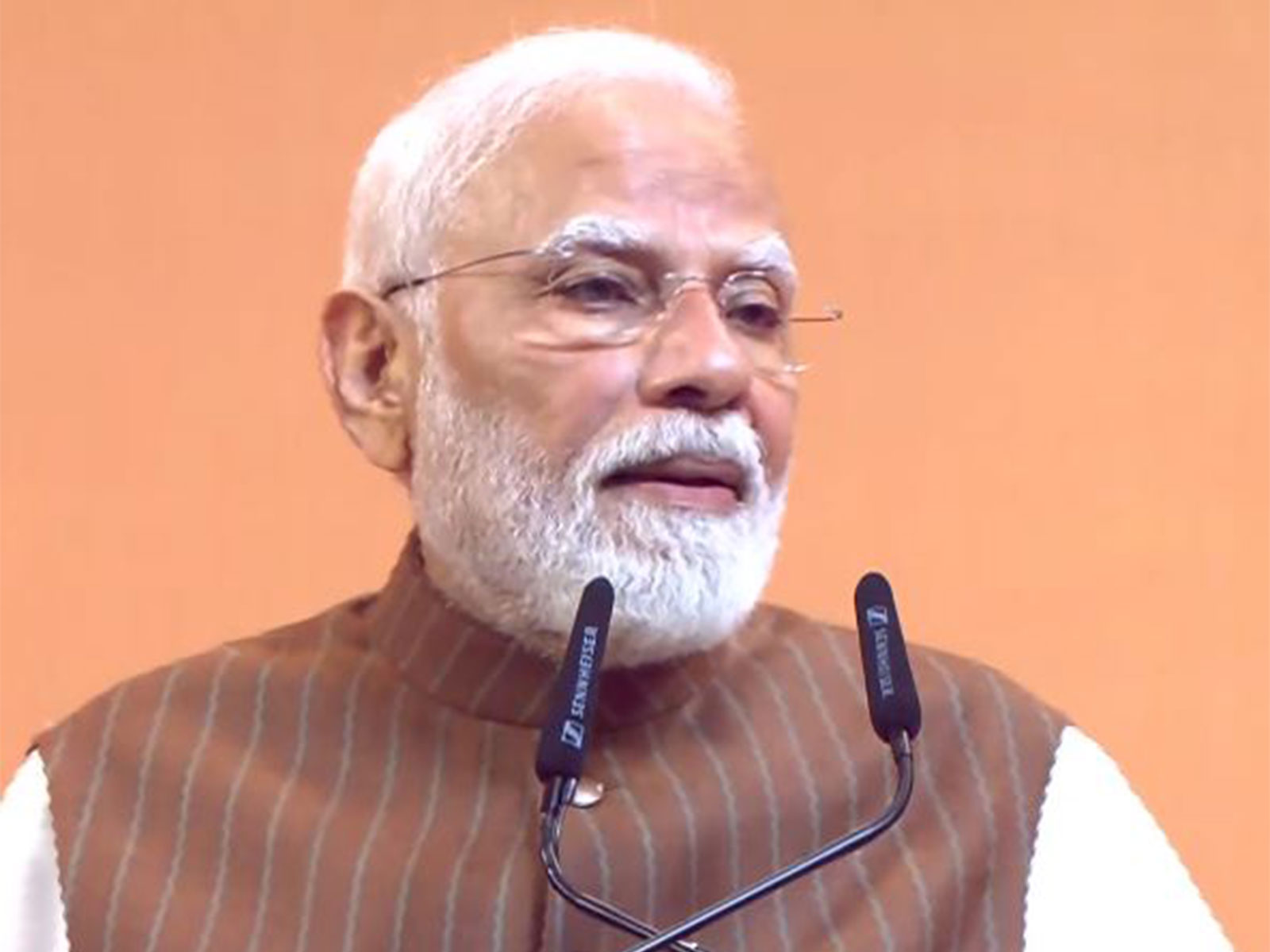
Kharagpur (West Bengal) [India], November 21 (ANI): Prime Minister Narendra Modi on Saturday recalled being mocked in Parliament for announcing the construction of toilets for the poor, saying that his government had worked over the past 12 years to change the mindset that poverty could not be eradicated in a country as populous as India.
Addressing the Platinum Jubilee celebrations of IIT Kharagpur, PM Modi said that poverty had long been considered a permanent problem, with policy decisions often failing to translate into action because of this prevailing mindset.
“India has declared, loud and clear, break the limit, unlock the possibilities. Until 20 years ago, poverty was considered a permanent problem in our country. Five decades ago, slogans about eradicating poverty were being raised from the ramparts of the Red Fort. Yet, whenever it came to taking action at the policy level, the entire system would simply bury the matter in files. This was because the prevailing mindset was that poverty could never be eradicated, especially given the size of our population. No one even dared to implement the right policies to actually eliminate poverty,” he said.
Recalling his announcement from the Red Fort after his government first came to power, PM Modi said he had faced criticism for prioritising the construction of toilets for the poor.
“When we first came to power, I announced from the Red Fort that I would build toilets for the poor. In Parliament, people mocked this, asking, ‘What kind of Prime Minister is this? He’s talking about building toilets.’ Such people failed to grasp how essential a toilet is, how critical it is for the poor, and especially for poor women and mothers,” he said.
He said his government had worked to change this mindset over the past 12 years, adding that he followed the guiding principle of “Power to Empower”.
The Prime Minister also cited a recent World Bank report, saying it stated that 50 crore people in India had been lifted out of poverty in 12 to 13 years.
“You must have read or heard about the recent World Bank report. The World Bank has stated that in just 12 to 13 years, 50 crore people in India have been lifted out of poverty. This is no small change; it is the outcome of a mindset that advocates for breaking the limits,” he said.
PM Modi further urged students and alumni of IIT Kharagpur to adopt the mindset of “Nation First”, saying their efforts should contribute to the country’s progress as well as create new opportunities for themselves.
“You have done outstanding work over the past 75 years. Now you must move forward with the firm resolve that when IIT Kharagpur celebrates its 100th anniversary, it should do so in a developed India,” he said.
Speaking about India’s growing space sector, the Prime Minister said the government had opened it up to young people, enabling startups to contribute to the country’s space programme.
He cited the example of Pawan Kumar Chandana, an IIT Kharagpur alumnus and co-founder of Skyroot Aerospace, which developed India’s first privately built rocket.
“We have opened up India’s space sector to India’s youth, and today, look at Pawan, a student from IIT Kharagpur, who founded Skyroot Aerospace and brought India the distinction of launching its first private rocket. Today, many such space startups are propelling India’s space programme forward at a new pace,” he said.
PM Modi added that developments once considered impossible had become a reality, crediting IIT Kharagpur alumni for their contribution to the country’s progress.
The Prime Minister also spoke about India’s semiconductor ambitions, recalling that a company had approached India 50 years ago to manufacture semiconductors but was turned away.
“You will be surprised to know that a company had come to India 50 years ago to manufacture semiconductors. However, it was shown the red flag and sent back. So, when I spoke about launching the Semiconductor Mission, people said it was already too late. We went ahead and initiated the mission, and today, India has begun exporting chips,” he said.
In another part of his address, PM Modi spoke about the need to overcome what he described as “limiting beliefs”, saying individuals and nations must not restrict their aspirations or potential.
“Often, people impose boundaries on their own thinking–they set limits for themselves–and these are what we call ‘limiting beliefs.’ What are limiting beliefs? They mean placing limits on your dreams, on your talents, and even on the potential of your own nation,” he said.
He added that India had demonstrated in recent years how breaking such mental barriers could help a nation recognise and realise its potential.
“Those who live with a stagnant, lifeless mindset cannot truly live life at all. We have come to accept the boundaries of our own thinking as the boundaries of our world. A nation, too, recognises its true potential only when it breaks through the limits of its own thinking. In the last few years, India has demonstrated exactly that,” the Prime Minister said.
Earlier during the Platinum Jubilee celebrations, Prime Minister Narendra Modi unveiled a special commemorative coin marking 75 years of IIT Kharagpur. (ANI)
Related reading