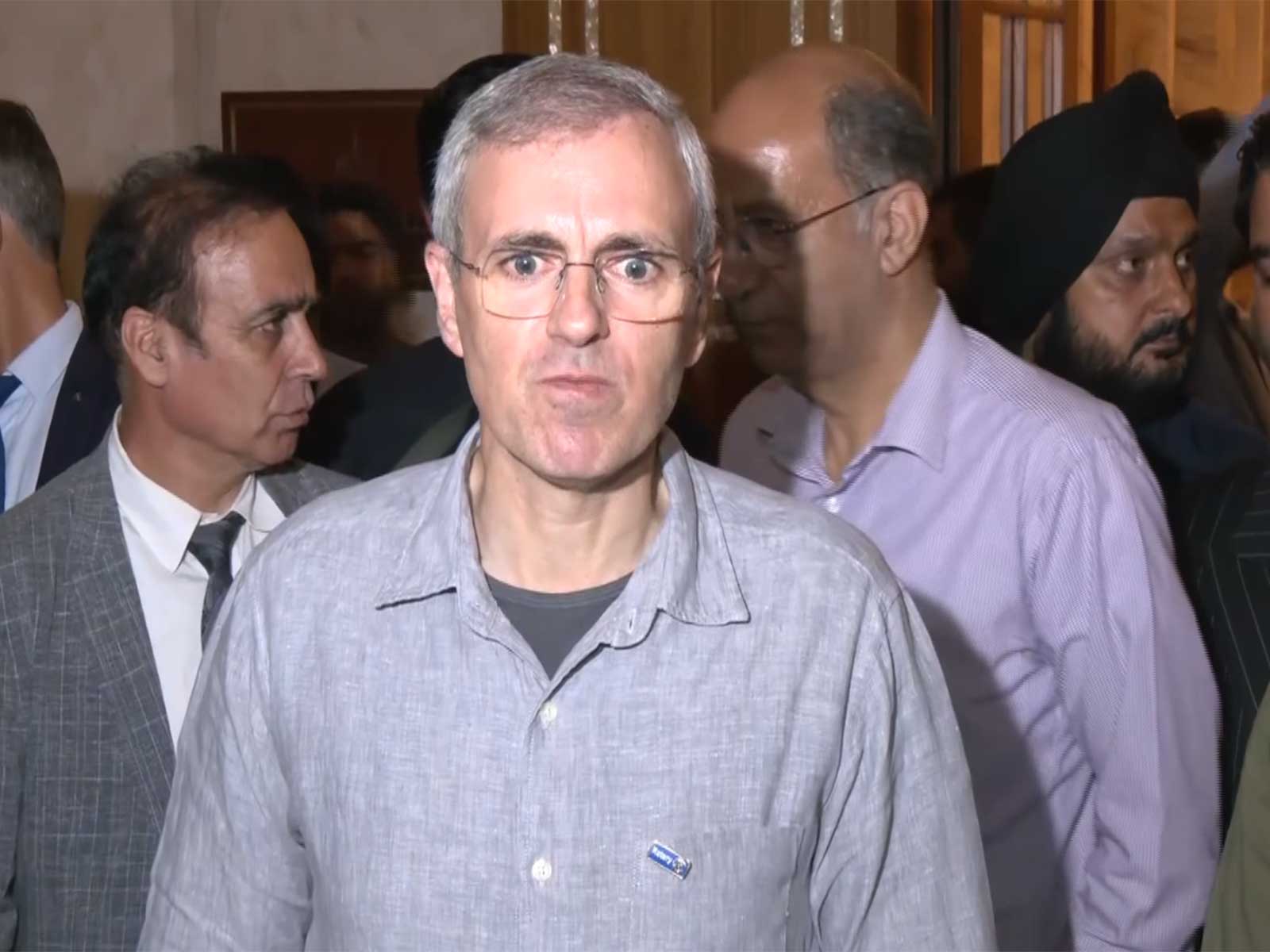
Srinagar (Jammu and Kashmir) [India], September 17 (ANI): Jammu and Kashmir Chief Minister Omar Abdullah said the government should ensure that any charges related to Unified Payments Interface (UPI) transactions do not burden the common people, while suggesting that companies could bear such charges.
On UPI MDR charges, Abdullah said such charges do not apply to everyone, and there are no charges for person-to-person money transfers. He added that individual consumers would not face charges unless they exceed a certain threshold.
“These charges do not apply to everyone. There are no charges for person-to-person money transfers. Furthermore, individual consumers will not face charges unless they exceed a certain threshold,” he said.
Asserting that operating the UPI system involves significant costs, Abdullah said people often fail to properly appreciate things they receive for free.
“The Government of India should ensure that these charges do not fall upon the common people. I have no objection if charges are levied on companies; after all, companies already earn well from UPI,” he said.
The National Payments Corporation of India (NPCI) on Tuesday introduced a new Merchant Discount Rate (MDR) framework, under which UPI merchant transactions above Rs 2,000 will attract an MDR of 0.4 per cent, while consumers will continue to transact free of cost using UPI.
The revised UPI MDR framework will come into effect from October 15, 2026, and will apply only to select merchant transactions.
Under the new framework, an MDR of 0.4 per cent will apply to Person-to-Merchant (P2M) UPI transactions above Rs 2,000, with the MDR capped at Rs 300 per transaction.
Meanwhile speaking on the upcoming Assembly session, Abdullah said the seven-day session would include government legislative business as well as issues raised by MLAs from both treasury and opposition benches.
He said the legislative business in a Union Territory is less extensive than in a full state, though there is still legislative business to be presented before the House.
“There are two types of agendas in a session. One involves the government’s own legislative business—which, in a Union Territory, is less extensive than in a full state, though there is still some legislative business to be presented to the House,” Abdullah said.
MLAs would have the opportunity to raise questions concerning issues faced by people in their constituencies or Jammu and Kashmir as a whole, he said.
Bills and resolutions would also be introduced during the session, while the government would endeavour to respond to the issues raised by legislators.
“Since it is a seven-day session, naturally, many issues will be brought before the House, and the government will strive to ensure the House functions smoothly and that MLAs receive satisfactory responses,” Abdullah said.
The upcoming Jammu and Kashmir Assembly session is scheduled to be held from September 21 to September 30. (ANI)
Related reading