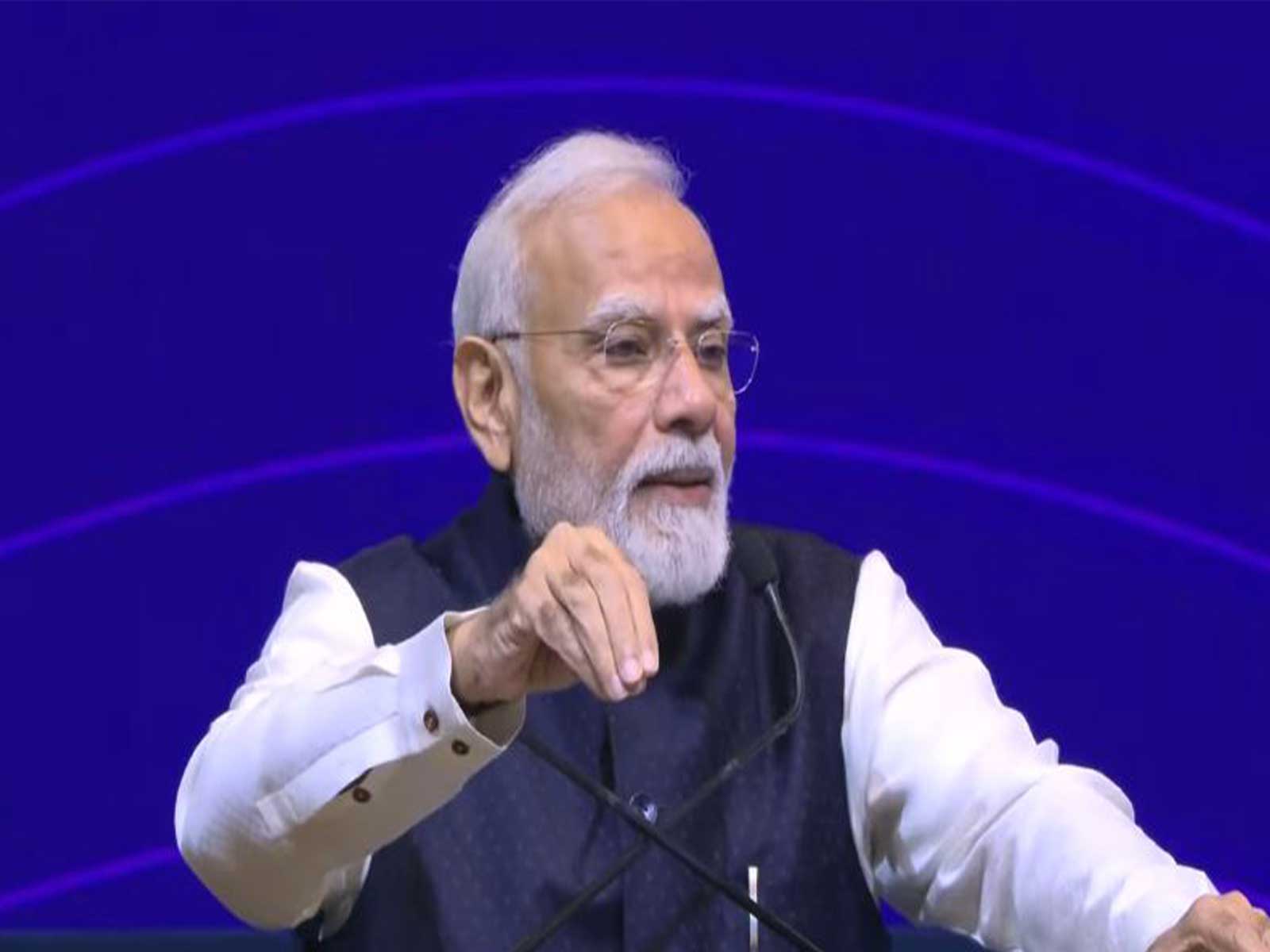
New Delhi [India], September 17 (ANI): Speaking at the fifth edition of SEMICON India 2026 at the Yashobhoomi Convention Centre in New Delhi, Prime Minister Narendra Modi on Thursday positioned India as a crucial, reliable manufacturing alternative to offset growing global supply chain vulnerabilities.
Addressing international semiconductor leaders, he urged equipment and component manufacturers to invest heavily in the nation’s rapidly expanding high-tech ecosystem. PM Modi noted that strengthening India’s footprint in critical technology is essential at a time when global supply chains face extreme disruptions and strategic weaponisation.
“When a country like ours succeeds in a critical industry, it strengthens the global supply chain, a fact that has become even more significant at a time when supply chains are being weaponised. We should view these transformations taking place in India through this broader perspective,” the Prime Minister said.
India is focusing heavily on emerging technologies, including compound semiconductors, silicon photonics, and advanced infrastructure tailored to support AI integration.
“The semiconductor industry is facing numerous challenges. Amidst these challenges, the world is in dire need of new and reliable manufacturing hubs, and I say this with full responsibility. I assure you that India is continuously preparing itself for this role…India is also emphasising the strengthening of supply chains and has implemented several reforms to achieve this,” he added.
“From the manufacturing of various compound semiconductors to integrating silicon photonics into the ecosystem, all of this is essential for AI-enabling infrastructure, and we must move forward together in this direction. The necessary foundation for this has already been laid,” he said.
He also urged semiconductor equipment and component manufacturers to participate in India’s expanding ecosystem.
“I urge the leaders of equipment companies present here not to miss these opportunities,” the Prime Minister said.
Alongside infrastructure and investment, PM Modi highlighted the government’s efforts to create a skilled workforce for the sector. The government announced progress toward training 100,000 engineering students specifically for the semiconductor domain, with over 70,000 already trained.
“Our government has set a target to train 1 lakh engineering students for the semiconductor industry, and we have already trained over 70,000 of them… I call upon the youth, whether they are conducting research in India or abroad, to come forward and participate in the development of advanced technology here,” he added.
PM Modi highlighted recent milestones, including the completion of 3,000 km of dedicated freight corridors and the international consensus achieved via the New Delhi Declaration at the BRICS Summit.
“India successfully concluded the BRICS Summit. The adoption of the New Delhi Declaration with everyone’s support is one more piece of evidence of India’s global credibility. And SEMICON India being held amid such major achievements is another significant milestone,” Prime Minister Modi said.
PM Modi also pointed to developments in fintech, freight connectivity and logistics to underline the pace of India’s economic expansion.
“India’s economy is growing… The world’s trust in India is also growing…If we look at just the past 15 days, it gives us an idea of the direction in which India is moving and the speed at which it is progressing. Just 10 days ago, the Global Fintech Fest was held in Mumbai. Discussions there focused on inclusive finance through agentic AI, tokenisation and quantum technology.”
“During the same period, around 3,000 kilometres of dedicated freight corridors in India became fully operational. I am talking about these 10 days of September, not about something from the past. This will accelerate movement across the country, improve logistics and give new strength to manufacturing,” he added.
Moreover, India’s semiconductor dream is no longer on paper – it’s being built on the ground, brick by brick, chip by chip. At the forefront is Tata Electronics, which is leading the country’s most ambitious bet. In Gujarat, the group is setting up India’s first commercial fab worth Rs 91,526 crore in partnership with Taiwan’s PSMC, with a capacity of 50,000 wafer starts per month. To complement this, a Rs 27,120 crore packaging facility is coming up in Assam.
In Gujarat’s Sanand, US major Micron Technology is building a Rs 22,516 crore assembly and testing facility, which will churn out 14 million DRAM and NAND units every week once operational.
The CG Power-led joint venture is another big piece in the puzzle. The company, along with Renesas Electronics of the US and Stars Microelectronics of Thailand, is investing Rs 7,584 crore in Gujarat to produce over 15 million chips daily.
Moving north, Uttar Pradesh is emerging as a display chip hub. A joint venture between Vama Sundari and Foxconn is constructing a Rs 3,706 crore facility to manufacture display driver ICs, with a monthly capacity of 36 million chips.
In Gujarat again, Kaynes Technology is setting up a Rs 3,307 crore unit focused on advanced substrate-based packages and wire bond interconnects.
Beyond these mega projects, a cluster of regional hubs is quietly powering the ecosystem. In Odisha, 3D Glass Solutions and SiCSem are driving advanced packaging and SiC devices; in Punjab, Continental Device India is focusing on discrete semiconductors, while in Andhra Pradesh, Advanced System in Package Technologies is pushing module integration.These projects signal the rise of a truly pan-India chipmaking ecosystem.
On the occasion of Vishwakarma Jayanti, PM Modi said the launch of the PM Vishwakarma scheme reflected the connection between India’s traditional culture of creation and construction and modern technology.
“This is the fifth edition of SEMICON India taking place. I extend a warm welcome to all of you. To the guests who have arrived from abroad, I extend a special welcome to India. Friends, today is also the day of Vishwakarma Jayanti. I extend my warmest greetings on Vishwakarma Jayanti to all fellow countrymen,” he said.
“Today is also the occasion of Vishwakarma Jayanti. I extend my best wishes to all citizens on Vishwakarma Jayanti. In our tradition, Lord Vishwakarma is considered a symbol of the power of creation and construction. And look at the coincidence: the PM Vishwakarma scheme is also being launched today. On one hand, we have our centuries-old tradition of construction and on the other, the technology and vision of the 21st century. This is also the inspiration behind our vision of a self-reliant and developed India,” the prime minister said.
Meanwhile, according to government data, India’s electronics goods production has increased nearly six-fold from around Rs 1.9 lakh crore in 2014-15 to around Rs 12 lakh crore in 2024-25. Exports of electronics goods rose from Rs 38,000 crore to around Rs 3.3 lakh crore during the same period.
Mobile phone production increased from Rs 18,000 crore in 2014-15 to Rs 5.45 lakh crore in 2024-25, while mobile phone exports rose from Rs 1,500 crore to Rs 2 lakh crore. The share of imported mobile phones fell from 75 per cent of total demand to 0.02 per cent.
The Government launched the Semicon India Programme in January 2022 to develop a complete semiconductor manufacturing ecosystem covering design, fabrication, assembly, testing, packaging and module manufacturing.
In four years, 10 semiconductor projects with investment commitments of about Rs 1.6 lakh crore have been approved. Commercial production from two plants, Micron and Kaynes, has commenced, while two more plants are scheduled to start commercial production this year.
Alongside hardware infrastructure, India’s Semicon India Programme is supporting 315 universities with free chip design tools, resulting in 211 chips taped out and 24 advanced chip/SoC projects backed across key sectors including AI, video surveillance, and space communications.
The three-day SEMICON India 2026, being held from September 17 to 19, is focused on industry engagement, policy direction and international partnerships under the theme ‘Silicon to Systems: Building the Ecosystem’. (ANI)
Related reading