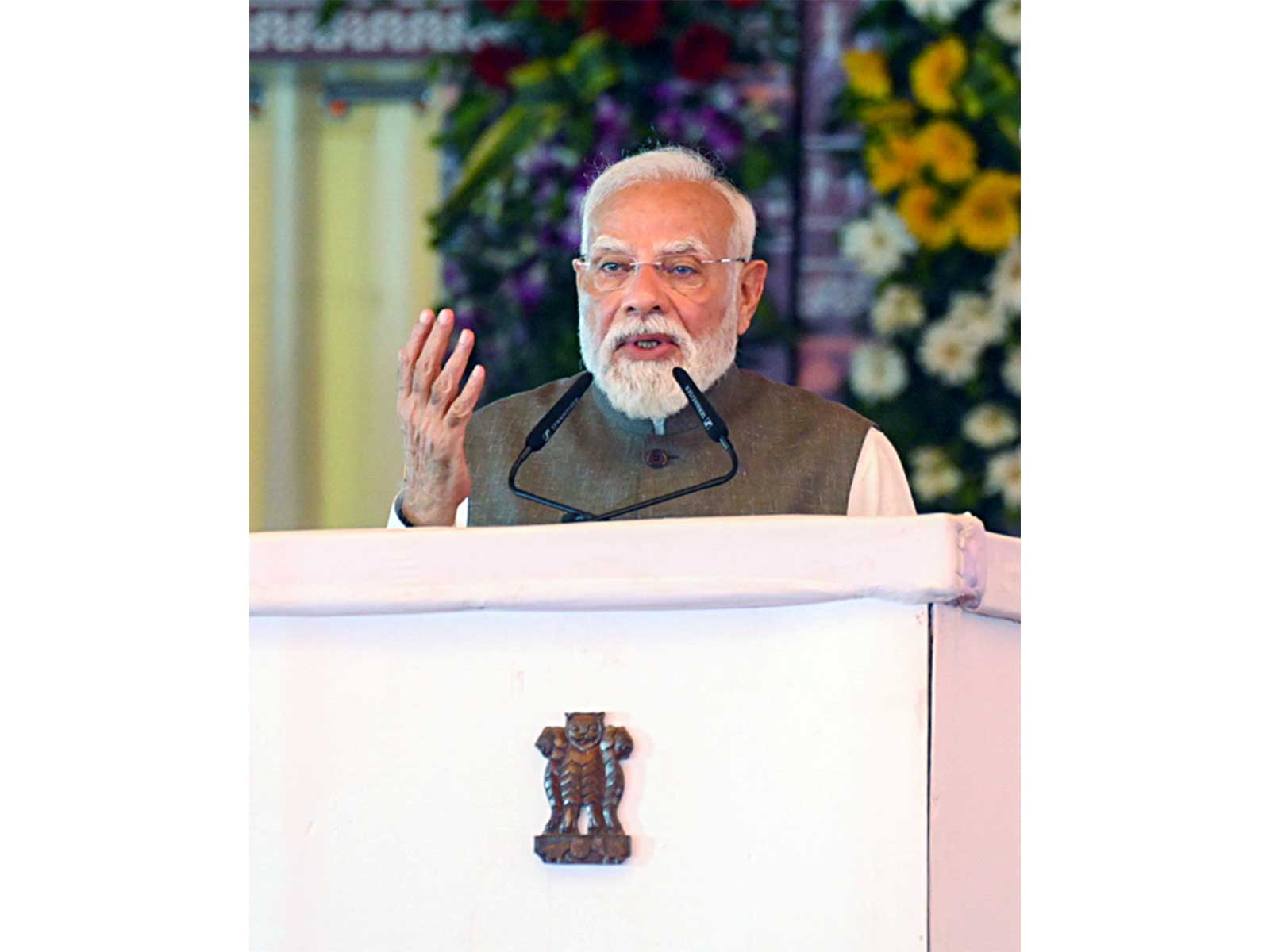
New Delhi [India], June 22 (ANI): Noting that India is a fast-growing economy and a rising power and reliable power, Prime Minister Narendra Modi on Monday said that what the country is doing today will shape the future for the next thousand years.
Speaking at the Republic Summit 2026, PM Modi said India’s civilisational depth and long-term vision distinguishes it from nations driven by short-term developments.
“India is not a nation that reacts impulsively to fleeting events. We are the people who have both witnessed and endured the cycles of growth and destruction. We are a nation that carries the ‘memory chip’ of ages within its consciousness. I say this with a deep sense of responsibility. What India is doing today will shape the future for the next thousand years,” he said.
“India is a fast-growing economy and a credible one, too. It is a rising power and India is a reliable power. I returned from the G7 Summit just a few days ago, and every world leader and nation fully understands that for the India of today, ‘Nation First’ is the supreme mantra and the guiding principle,” he added.
PM Modi said that a few days ago, the NDA government completed 12 years and its decisions have been guided by the spirit of ‘Nation First’.
“If you weigh all the achievements the country has had in the last 12 years on the scales, every decision, every step, every effort… at their core, the spirit of ‘Nation First’ is what remains at the centre. From the Swachh Bharat campaign to Make in India, emphasis on buying khadi and local products… people of the country fulfilled their duty by placing the nation above all… For this, I salute the citizens of the country.
PM Modi also poke of the government’s efforts to provide relief to the middle class.
“In 2013-14, income above Rs 2 lakh was subject to taxation, and the middle class bore a significant portion of this tax burden. Today, income up to Rs 12 lakh per annum is exempt from tax, resulting in a substantial increase in tax-free income. The introduction of GST reforms has also benefited the middle class by simplifying the tax process, saving both time and effort in tax filing. Individuals can now file their Income Tax Returns (ITR) from home with ease,” he said.
“Healthcare, particularly expenses related to diabetes treatment, is a major concern for the middle class. Jan Aushadhi Kendras are addressing this issue by providing medicines at an 80% discount, leading to total savings of Rs 40,000 crore for the people,” he added.
The Prime Minister talked of efforts to ramp up infrastructure for faster progress and improve facilities in aspirational districts.
“In 2014, approximately 28 lakh people traveled by metro each day. Today, that number has risen to about 1.28 crore daily commuters. Additionally, Namo Bharat, Vande Bharat, and Amrut Bharat high-speed trains are now connecting different regions across the country. Over the past few years, the number of airports has doubled, providing greater opportunities for the middle class to travel by air,” he said.
“I would like to discuss more than 100 districts and over 500 blocks that, for years, lagged behind on every development parameter. Previous governments had labelled these areas as backward regions. We undertook the challenge of transforming these regions, helping them rise above despair and igniting their aspirations for progress. To reflect this new approach, we renamed them aspirational districts and blocks. Today, these aspirational districts and blocks are driving the growth of the state,” he added.
PM Modi talked in detail of government’s efforts and success in eradicating Naxalism.
“In government policies and decision-making, the principle of ‘Nation First’ has had a profound impact; a prime example of this is the transformation of our tribal regions. For decades, these areas were plagued by Maoist terrorism, which prevented the delivery of basic government amenities well into the 21st century. Successive governments and generations passed, yet hope remained elusive for the local population,” he said.
“Between 2004 and 2014, over 17,000 violent incidents occurred due to Maoist terrorism, resulting in the loss of more than 7,000 lives. However, today, Maoist terrorism has been eradicated from these regions–a remarkable achievement that should not be underestimated. A significant proportion of the population in these regions lived in poverty, but over the past few years, 25 crore poor people have overcome poverty, with aspirational districts playing a crucial role in this achievement,” he added.
The Prime Minister also accused the Congress governments of not taking serious steps to end the problem of Naxalism,.
“Those who frequently brandish the Constitution these days: when they were in power, and people were shot dead for even mentioning the Constitution in Naxal-affected areas–they remained silent. The Constitution was nowhere to be seen in their hands back then; their hands were trembling. The Congress was largely indifferent to that harrowing situation. After 2014, we moved forward with a ‘Nation First’ spirit to transform the situation. We set out on this path,” he said.
“We didn’t speak about it, nor did they make announcements, but they certainly took action. We resolved to root out Naxalism and Maoism completely. Today, the entire nation is witnessing the results; Maoist terror in the country is breathing its last. Often, the final outcome is so monumental and far-reaching that the hard work behind it goes unnoticed. Over the past 12 years, our government has constructed more than 12,000 kilometres of roads there,” he added.
The Prime Minister said that apart from development push, efforts were made to win the hearts of people.
“We often witnessed our road-construction machinery being set ablaze and contractors being driven away. If 25 people were working on a road, 200 police personnel had to provide security just to keep the work going. We did all this because we were determined. We installed over 9,500 mobile towers. We extended mobile connectivity to nearly 45,000 villages. More than 1,800 bank branches were opened in Naxal-affected districts, alongside the deployment of around 75,000 banking correspondents and the establishment of over 6,000 new post offices. We didn’t rely solely on bombs, guns, and bullets; we dedicated every ounce of strength God gave us to winning over hearts,” he said.
“You would be amazed to hear about a famous Naxalite–one who carried a reward of crores of rupees on his head. We took the ration card to his mother for the first time; the son used to prevent her from collecting it in order to maintain his reign of terror. I was truly shocked, yet the government remained silent, seemingly oblivious to the Constitution. The outcome of all these efforts was the emergence of a renewed sense of trust among the general public. Look at areas like Bastar today; instead of bombs and guns, the ‘Bastar Olympics’ is the talk of the town. Two editions of these games have already been held. Over 150,000 youths participated in the first edition, and nearly 400,000 in the second. In other words, where terror once prevailed, talent is now finding opportunities, and sports are flourishing,” he added.
PM Modi talked of success of Indian entrepreneurs and referred to his recent visit to France.
“Sridhar Vembu is seated here. When our entrepreneurs operate with a ‘Nation First’ spirit and set their goals while understanding the country’s needs, institutions are built, and the nation prospers. What has Sridhar Vembu achieved? I recently visited VivaTech in France. There must have been around 1.5-2 lakh young people present. The French President and I were visiting various stalls to see the work done by these young innovators. We visited the Zoho stall. I was amazed and felt a sense of pride to see the crowd of European youth gathered there. They were eager to understand this new global phenomenon. Perhaps it hasn’t been discussed as much in India as I witnessed in France,” he said. (ANI)
Related reading