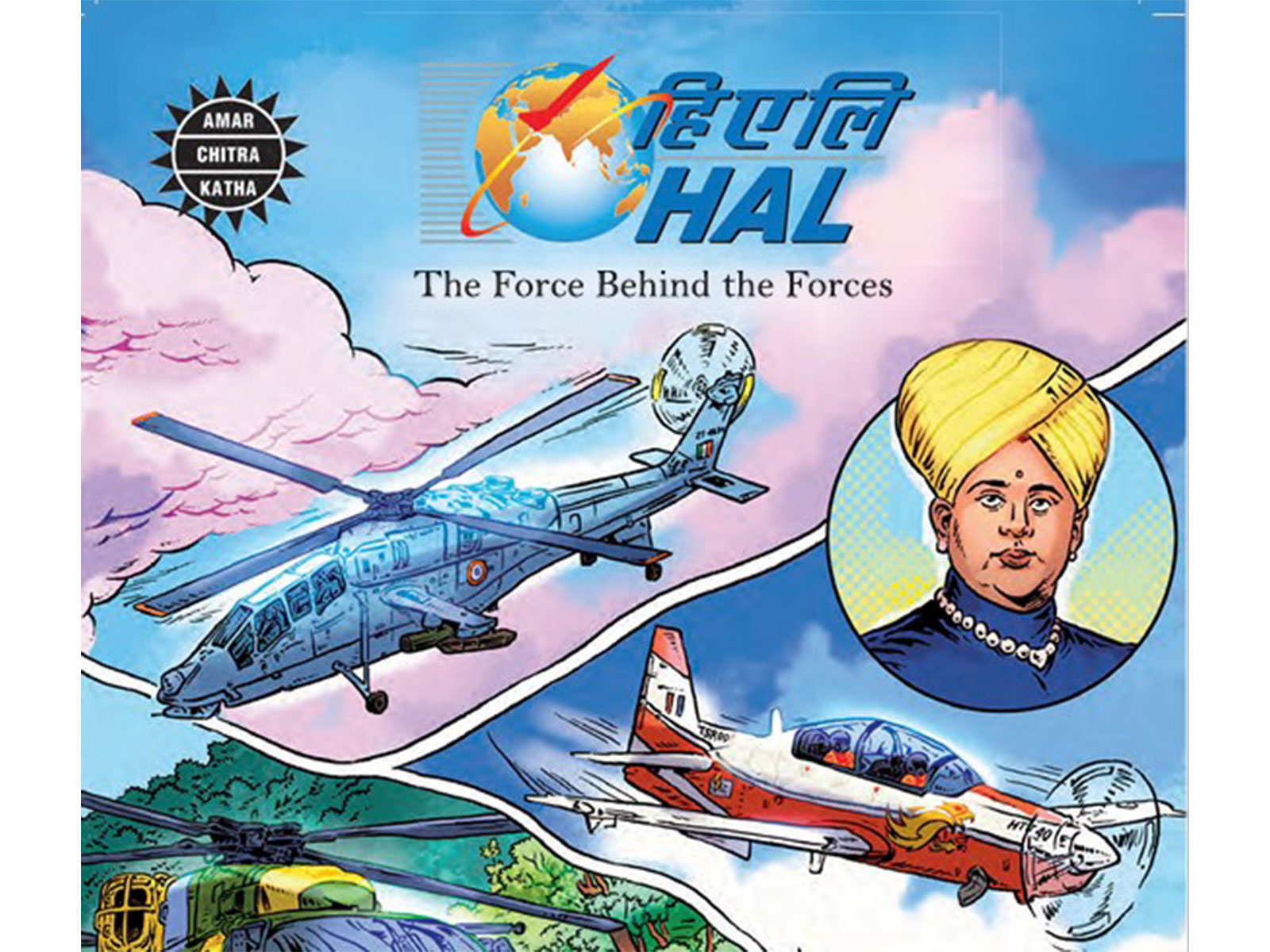
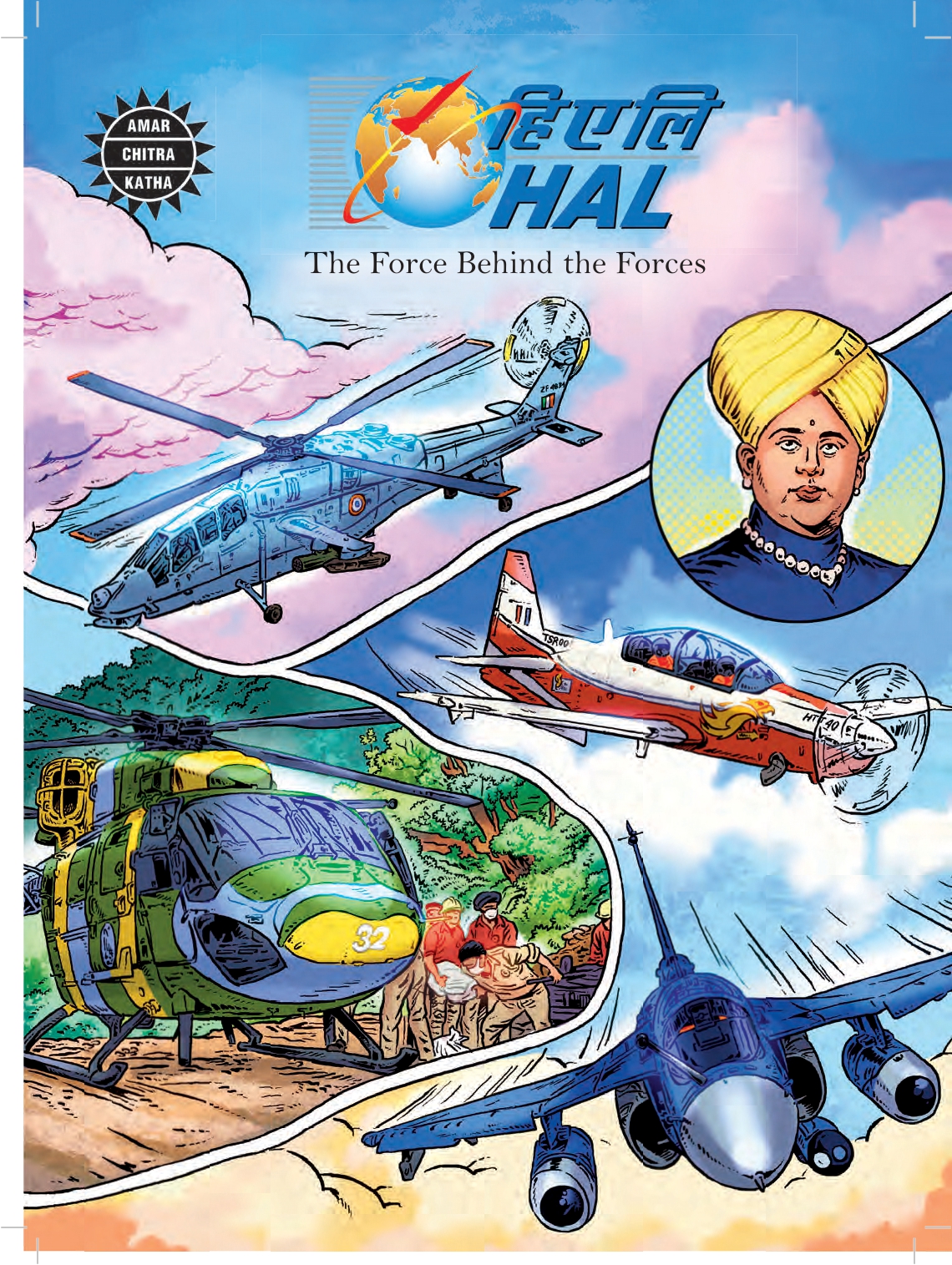
New Delhi [India], July 15 (ANI): Hindustan Aeronautics Limited (HAL) has joined forces with Amar Chitra Katha to launch an illustrated book chronicling India’s military aerospace evolution, from its early years of licensed aircraft production to the development of indigenous platforms such as the Light Combat Aircraft (LCA) Tejas Mk1A.
The book “HAL: The Force Behind the Forces” traces more than eight decades of the country’s aerospace journey, documenting HAL’s transformation from a company assembling aircraft under foreign licence into India’s top aerospace and defence manufacturer.
Established as Hindustan Aircraft Limited in Bengaluru on December 23, 1940, by industrialist Seth Walchand Hirachand in association with the then Government of Mysore, the company came under the administrative control of the Ministry of Defence in 1951. It assumed its present identity as Hindustan Aeronautics Limited in 1964 following the amalgamation of Hindustan Aircraft Limited and Aeronautics India Limited.
According to a HAL spokesperson, the collaboration was conceived to present India’s aerospace story in a format that would resonate with younger readers.
“The collaboration with Amar Chitra Katha was inspired by a shared vision of making India’s aerospace and defence journey engaging and inspiring for younger generations. HAL has played a pioneering role in building India’s aerospace capabilities over the past eight decades, and we wanted to present this legacy in a format that resonates with children, students and families,” the spokesperson told ANI.
Through iconic aircraft and helicopters that have influenced India’s military aviation history, the book traces the development of the nation’s indigenous aerospace capability.
It begins with the Hindustan Trainer-2 (HT-2), India’s first indigenously designed and manufactured trainer aircraft, which made its maiden flight in 1951. The narrative then moves to the HF-24 Marut, India’s first indigenous jet fighter and the first combat aircraft designed in Asia outside the Soviet Union. Inducted into the Indian Air Force in the 1960s, the Marut flew ground-attack and strike missions during the 1971 India-Pakistan War, including the famous battle of Longewala.
The publication also chronicles the HJT-16 Kiran, the indigenous intermediate jet trainer that prepared generations of fighter pilots before they transitioned to frontline combat aircraft and later became synonymous with the Indian Air Force’s Surya Kiran Aerobatic Team.
HAL’s rotary-wing aviation journey is also documented in the Amar Chitra Katha’s illustrations through the Dhruv Advanced Light Helicopter (ALH), a multi-role platform operated by the Army, Air Force, Navy and Coast Guard for troop transport, logistics, reconnaissance, search and rescue, disaster relief and medical evacuation. The book also features the Light Combat Helicopter (LCH) Prachand, India’s first indigenously designed dedicated attack helicopter, developed for high-altitude warfare and capable of undertaking anti-armour, close air support and precision strike missions.
Also featured are the Light Utility Helicopter (LUH), developed to replace the ageing Cheetah and Chetak fleets, and the new Hindustan Turbo Trainer-40 (HTT-40), HAL’s indigenous basic trainer aircraft that forms the first stage of military pilot training.
The journey continues with the LCA Tejas Mk1A, which, upon induction, will become India’s advanced multirole fighter equipped with an Active Electronically Scanned Array (AESA) radar, an electronic warfare suite and beyond-visual-range missile capability.
Designed for air defence, offensive counter-air, ground attack and maritime strike missions, the aircraft represents the latest milestone in India’s indigenous combat aircraft programme and symbolises the country’s transition from licensed production towards self-reliance in military aerospace.
Amar Chitra Katha, the publisher of the book, also shared with ANI, select preview pages, offering an early glimpse into how the publication visually narrates India’s transition from licensed aircraft production to indigenous aerospace capability.
One of the preview pages presents a detailed illustrated sequence depicting HAL’s ‘Atmanirbhar’ evolution from assembling foreign-designed aircraft to developing indigenous combat platforms. The illustration panel opens with a HAL official explaining the company’s journey as engineers assemble MiG-21, MiG-27 and Su-30MKI fighter aircraft.
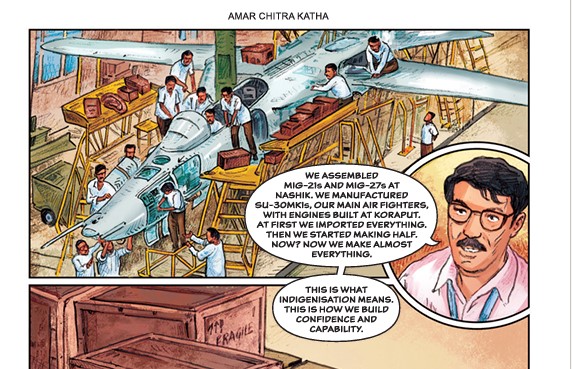
“We assembled MiG-21s and MiG-27s at Nasik. We manufactured Su-30MKIs, our main air fighters, with engines built at Koraput. At first we imported everything. Then we started making half (of the aircraft). Now? Now we make almost everything,” the official says in the illustration.
“This is what indigenisation means. This is how we build confidence and capability,” the official adds.
Beneath the narration, the artwork uses visual symbolism to depict India’s historical dependence on foreign original equipment manufacturers (OEMs), particularly Russian suppliers. Wooden crates marked “Fragile”, including one bearing the Russian flag, are shown alongside imported aircraft components before the sequence transitions to the blueprints of the Light Combat Aircraft.
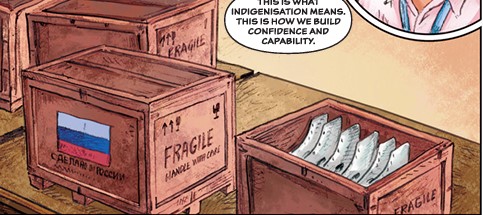
The illustration tells the tale of the strategic vulnerabilities associated with dependence on overseas suppliers, pointing out how disruptions during conflict can affect the availability of critical components and line replaceable units (LRUs), at risk of impacting operational readiness and sustainment.
The following panel, however, transitions with the caption, “By the 1980s, the MiG-21s had started ageing. India needed a lightweight fighter to replace them. But it could not be bought. India needed to design it.”
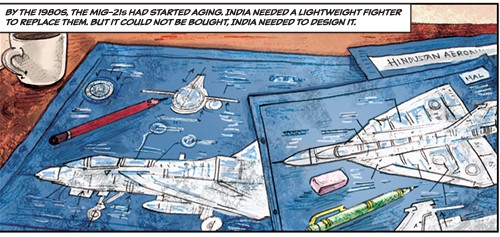
Together, the illustrations convey the publication’s central narrative of India’s progression from mere licensed production and imported technology to the design and manufacture of indigenous combat aircraft, now ongoing within the LCA Tejas, the premier example.
Explaining why Amar Chitra Katha was chosen to tell the story, the HAL spokesperson said the publisher’s storytelling tradition made it the ideal medium.
“For generations, Amar Chitra Katha has been one of India’s most trusted storytellers, bringing history, culture and inspiring real-life stories to readers through engaging narratives and vivid illustrations. Its distinctive storytelling approach simplifies complex subjects without losing their depth, making them accessible, relatable and memorable. By weaving together authentic research with compelling visual storytelling, Amar Chitra Katha sparks curiosity, deepens understanding and creates a lasting emotional connection with readers across generations. This made it the ideal medium to narrate the story of Indian aviation and HAL’s remarkable contribution to nation-building,” the spokesperson said.
HAL said the publication’s release date has not yet been finalised and will be announced in due course.
On the message India’s top aerospace company hopes to convey through the publication, the spokesperson told ANI, “We hope the publication inspires young readers to appreciate India’s remarkable journey in aerospace and defence and recognise the vital role played by HAL in building indigenous platforms over the years. More importantly, we want to encourage students to pursue careers in science, technology, engineering and innovation, while fostering a sense of pride in India’s growing capabilities in aerospace and defence.”
The spokesperson added that HAL viewed the collaboration as part of a broader effort to make India’s aerospace achievements more accessible to the public.
“HAL views this collaboration as an important initiative to engage a wider audience with India’s aerospace achievements through innovative storytelling. We believe there is significant value in presenting complex technological achievements in formats that are engaging, particularly for young readers,” the HAL spokesperson said, adding, “We will continue to look for opportunities to strengthen public awareness of HAL’s contributions towards greater self-reliance in aerospace and defence.”
A representative for Amar Chitra Katha echoed the sentiment, telling ANI that the publication aimed to introduce a new generation of readers to one of India’s iconic engineering and nation-building tales.
“For nearly six decades, Amar Chitra Katha has introduced generations of readers to the people and stories that shaped India. With HAL: The Force Behind the Forces, we are proud to tell the story of an institution that has played a defining role in India’s journey towards self-reliance in aerospace and defence. This collaboration reflects our belief that every nation-building story deserves to be told in a way that inspires young minds. We hope this book ignites curiosity, pride and a deeper appreciation for the vision, innovation and determination behind one of India’s greatest engineering legacies,” the spokesperson said. (ANI)
Related reading