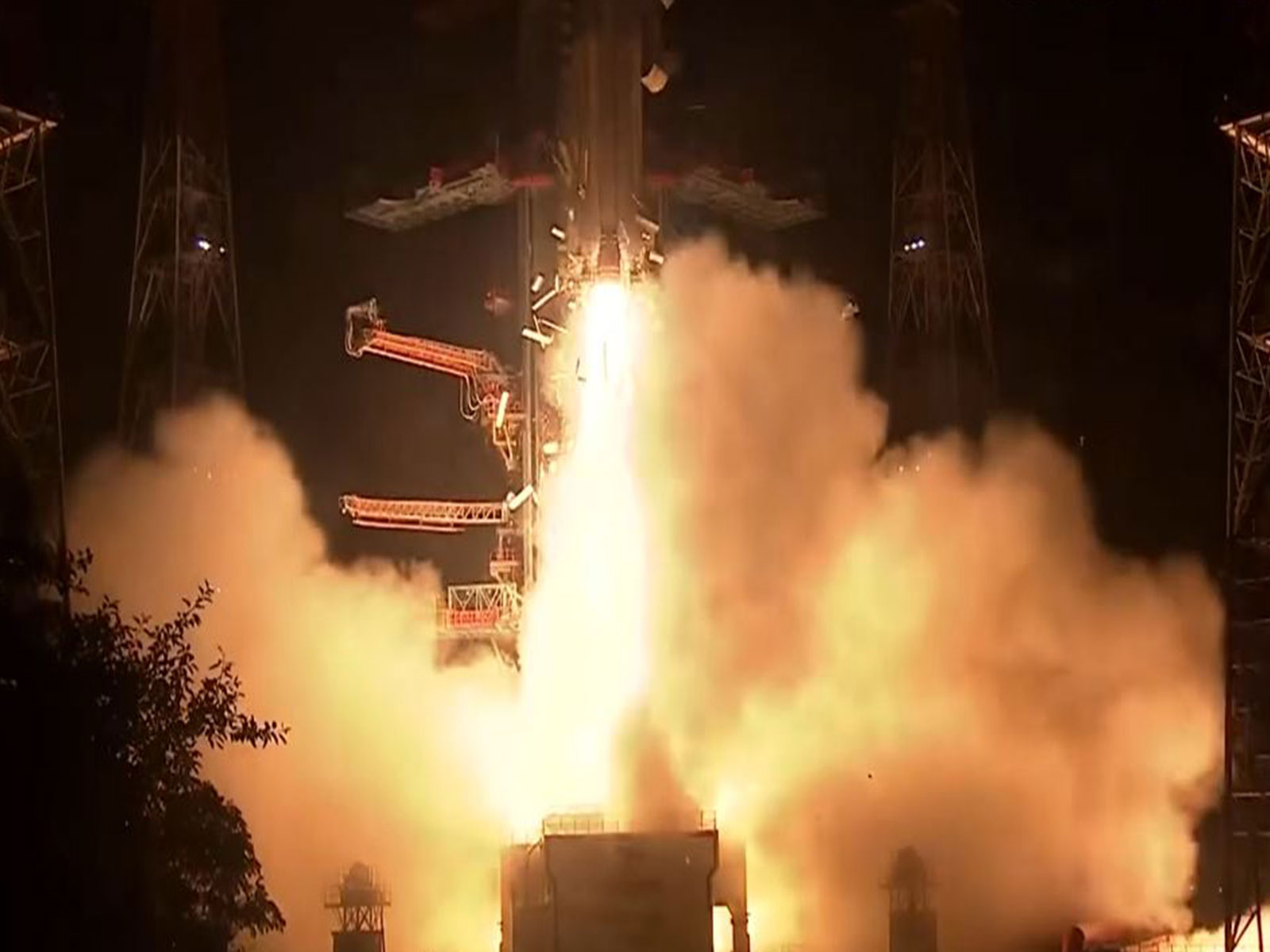
Sriharikota (Andhra Pradesh) [India], September 4 (ANI): The Indian Space Research Organisation (ISRO) successfully deployed the EOS-05 Earth observation satellite from the Satish Dhawan Space Centre in Sriharikota on Friday, marking another major milestone in India’s space programme.
The launch took place from the Second Launch Pad at the Satish Dhawan Space Centre, SHAR. The launch was carried on a GSLV-F17 rocket which is the 19th flight of India’s Geosynchronous Satellite Launch Vehicle (GSLV) as it EOS-05 towards a Sub-Geosynchronous Transfer Orbit (Sub-GTO).
Praising the ISRO and scientists involved in the mission, Minister of State in Department of Space, Jitendra Singh wrote on X, “Another giant leap for India in Space! Kudos to Team @isro on the successful launch of GSLV-F17/EOS-05. EOS-05 is a state-of-the-art Earth Observation satellite and India’s first imaging satellite from Geosynchronous Orbit, enabling advanced imaging across visible, infrared, multi-spectral and hyperspectral bands. With the visionary leadership of PM Shri @narendramodi Ji, India’s space capabilities continue to scale new heights, strengthening our position as a global space power.”
The mission attracted considerable public interest, with students, teachers and space enthusiasts gathering at Sriharikota to witness the launch. Despite rain, people remained at the launch-viewing area, eager to watch the rocket lift off.
EOS-05 is a state-of-the-art Earth observation spacecraft and is significant for being India’s first imaging satellite intended for placement in a geosynchronous orbit. From such an orbit, the satellite is designed to provide repeated observations of large areas of the Earth and provide information related to weather, agricultural updates, among others.
The spacecraft was carried by GSLV-F17, whose payload fairing has a 4-metre-diameter ogive composite configuration. The vehicle’s mission is to place EOS-05 into a Sub-GTO, following which the satellite is expected to reach its operational orbit.
The mission is also an important flight for the GSLV programme, which is designed to launch heavier spacecraft towards geosynchronous orbits. The previous GSLV mission, GSLV-F16, successfully launched the NASA-ISRO Synthetic Aperture Radar (NISAR) satellite in July 2025.
With the successful launch of GSLV-F17, ISRO has once again demonstrated the capabilities of its GSLV platform while advancing India’s Earth observation programme. (ANI)
Related reading