New Delhi [India], August 6 (ANI): The Union Government is likely to take up the Foreign Contribution (Regulation) Amendment Bill, 2026, for discussion in Parliament on August 12, even as Opposition protests continue to disrupt proceedings during the Monsoon Session.
The development comes amid objections raised by Christian groups and minority organisations against the proposed legislation, with a delegation meeting Union Home Minister Amit Shah on Thursday to submit their concerns and seek changes in the Bill.
Mizoram Chief Minister Lalduhoma also met Shah to formally present regional concerns and recommendations regarding the legislation. He was accompanied by a delegation comprising Reverend John Raldosanga, Chairman of the Mizoram Kohhran Hruaitu Committee (MKHC), and Reverend Lalhmangaiha, General Secretary of the Council of Churches in Mizoram (CCM).
According to sources, the Christian representatives demanded that the Bill either be withdrawn or referred to a Joint Parliamentary Committee (JPC) for further scrutiny.
Following the meeting, Lalduhoma said he had raised six issues with Shah and was assured that the proposed amendments would not have retrospective effect.
“The only thing that is very clearly mentioned to us is that it’s not going to be retrospective. That assurance was given to us, and the rest of the points will be given a paragraph-wise comment by him, and he (Amit Shah) is going to start the discussion on the 12th of this month in Parliament,” Lalduhoma said.
Meanwhile, a high-level delegation representing Christian denominations, minority forums, and charitable institutions across India met with Union Minister of Home Affairs Amit Shah in Parliament on Thursday to formally register their staunch opposition to the Foreign Contribution (Regulation) Amendment Bill, 2026.
The meeting concluded following the submission of a detailed representation and clause-wise analysis spearheaded by the Joint Action Forum on Minorities, led by Senior Advocate and DMK MP P Wilson.
The comprehensive representation presented to the Home Minister highlighted that while the delegation accepted the legitimate regulation of foreign funds as a state function, the 2026 Amendment Bill–introduced in the Lok Sabha on March 25, 2026–shifts from standard regulation into a confiscatory regime that threatens the very survival of charitable, educational, and medical institutions.
The delegation formally pressed for three primary remedial actions: Complete withdrawal of the FCRA Amendment Bill, 2026, or its referral alongside a comprehensive review of the Principal FCRA Act of 2010 to a Joint Parliamentary Committee (JPC), complete repeal of Section 15 of the Principal FCRA Act, 2010, to eliminate the principle of asset vesting from the statutory framework and ensuring that administrative or technical delays in certificate renewals do not trigger automatic cessation, provisional vesting, and the permanent absorption of community and religious assets into the Consolidated Fund of India.
The representation submitted at North Block and deliberated during the parliamentary interaction featured prominent leaders, clergy, and institutional heads from across the country.
The memorandum detailed how the proposed legislation impacts religious minorities and civil society. The delegation pointed out that under new provisions like Section 14B and Chapter IIIA, bureaucratic delays on the FCRA Online Portal or minor technical non-compliances could result in automatic certificate cessation, instantly triggering the provisional and permanent vesting of assets in a state-notified “Designated Authority”.
Institutions built largely through domestic contributions, local community donations, and CSR funds face whole-asset confiscation even if only a fraction of their funding originated from foreign grants.
The memorandum argued that the Bill infringes upon fundamental rights guaranteed under Articles 14, 19, 21, 25, 26, 29, 30, and 300A of the Constitution, particularly affecting minority-run educational institutions, hospitals, orphanages, and places of worship.
The Foreign Contribution (Regulation) Amendment Bill, 2026 was reintroduced in the Lok Sabha during the Monsoon Session. The Bill seeks to amend the Foreign Contribution (Regulation) Act, 2010, with the stated objective of enhancing transparency and accountability in the regulation of foreign contributions.
The proposed legislation provides that an organisation’s FCRA registration will cease upon expiry, non-renewal or refusal of renewal by the government. It also provides for the creation of a designated authority to oversee the vesting, supervision, management and disposal of foreign contributions and related assets.
Congress and other Opposition parties have opposed the bill outright. Congress MP Chamala Kiran Kumar Reddy accused the government of steamrolling dissent using its numbers in the House.
“They don’t need anybody. They don’t need the opposition’s voice. They don’t need people’s voice in this country. They can pass any bill because they have numbers in the House,” he said, tying the bill’s opposition to the party’s other central demand: “I request that this be discussed properly. Our demand is that Amit Shah should come to the Parliament and answer about the incident that happened on 20th July at Jantar Mantar… Until then, we are going to continue our protest.”
As it happened, the Rajya Sabha itself saw the standoff as Leader of the Opposition Mallikarjun Kharge renewed his demand that Shah make a statement on the police action against student protesters at the July 20 Jantar Mantar protest, criticising Rijiju’s earlier remarks and invoking former minister Arun Jaitley’s view that disruption is itself part of parliamentary democracy.
“We only raise genuine questions concerning the country and its 140 crore people. We are asking the Home Minister and the Prime Minister to come to the House. We request the Chair to direct the Home Minister to come and give a statement. We are ready to discuss it. In this very House, Arun Jaitley ji himself said that disruption is a part of Parliamentary Democracy. You can raise any questions that are relevant to the proceedings. But here, when we are asking genuine questions, they are escaping,” Kharge later posted on X.
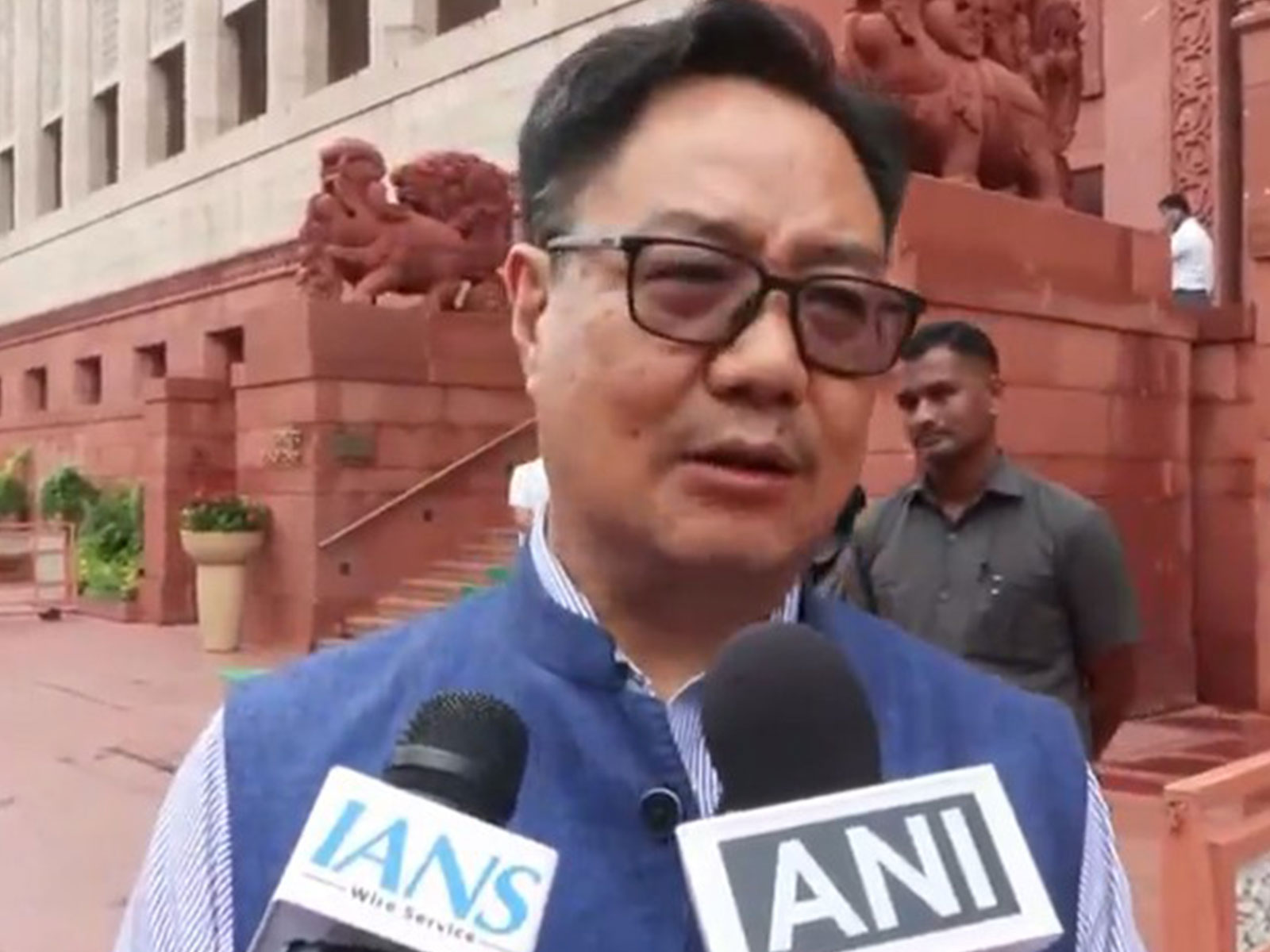
Union Parliamentary Affairs Minister Kiren Rijiju opposed the demand, saying the Leader of Opposition in the Rajya Sabha could only make a request and not direct the Chair.
“The leader of the opposition did not quote any rule, cannot give direction to the Chair, only make requests, cannot dictate. New Congress members not learning anything because their leadership not giving them a chance,” Rijiju said.
At that point, Rajya Sabha Chairman CP Radhakrishnan intervened, asking Rijiju to relay the Opposition’s “sentiment” to the Home Minister rather than dismiss it outright.
“Now I request you to consider his request. Kharge requested the presence of the Home Minister in the House. You represent him. As a parliamentary affairs minister, you can echo the sentiments to the Home Minister,” the Chair said.
Later, Rijiju clarified that the Chairman’s remarks were a suggestion and not a direction.
“Somebody told me that the Chairman had passed a direction… no, no, it’s not a direction, it’s a suggestion,” said Rijiju outside Parliament.
CPI MP P Sandosh Kumar termed the development a victory for the Opposition.
“It’s a huge victory for the entire opposition. We were continuously demanding that Amit Shah should come and make a statement on the 20th July lathi charge… Now, finally, the Chair directed Rijiju to convey the feelings of the opposition to the Home Minister… We are eagerly waiting for that reply,” he said.
Despite repeated disruptions, Parliament completed some legislative business on Thursday.
Parliament on Thursday passed the Appropriation (No. 3) Bill, 2026, which authorises the appropriation of money from the Consolidated Fund of India to regularise excess expenditure of Rs 54,067.46 crore incurred during the financial year ended March 31, 2023, beyond the amounts originally approved by Parliament.
The excess expenditure relates to two heads – repayment of debt amounting to Rs 53,871.01 crore and capital expenditure of Rs 196.45 crore under the Ministry of Railways.
The Bill, which had earlier been passed by the Lok Sabha, was passed by the Rajya Sabha on Thursday. Replying to the discussion on the Bill in the Rajya Sabha, Union Finance Minister Nirmala Sitharaman said bringing such legislation before Parliament is a normal constitutional process whenever excess expenditure requires approval.
“Government of India has a practice of coming to the House because it has to get the appropriation cleared by the House whenever these excess demands happen,” Sitharaman said.
She noted that similar appropriation Bills had been brought before Parliament earlier as well, citing approvals sought in 2022 for excess expenditure related to the 2019-20 Budget, in 2023 for the 2020-21 Budget and in 2025 for the 2021-22 Budget. She said the present Bill similarly seeks Parliament’s approval for excess expenditure relating to the 2022-23 financial year.
Separately, the Lok Sabha on Thursday passed the ‘Taxation and Other Laws (Amendment) Bill, 2026 ‘, which seeks to amend the Payment and Settlement Systems Act, 2007, Income-tax Act, 2025, and Finance Act, 2026.
The Bill, moved by Finance Minister Nirmala Sitharaman for passing, was approved by voice vote without discussion amid protests by opposition members over their demands related to police action against protestors on July 20.
It proposes a series of tax changes aimed at boosting investment, supporting manufacturing, providing tax certainty and will replace the Income-tax (Amendment) Ordinance, 2026. (ANI)
Related reading