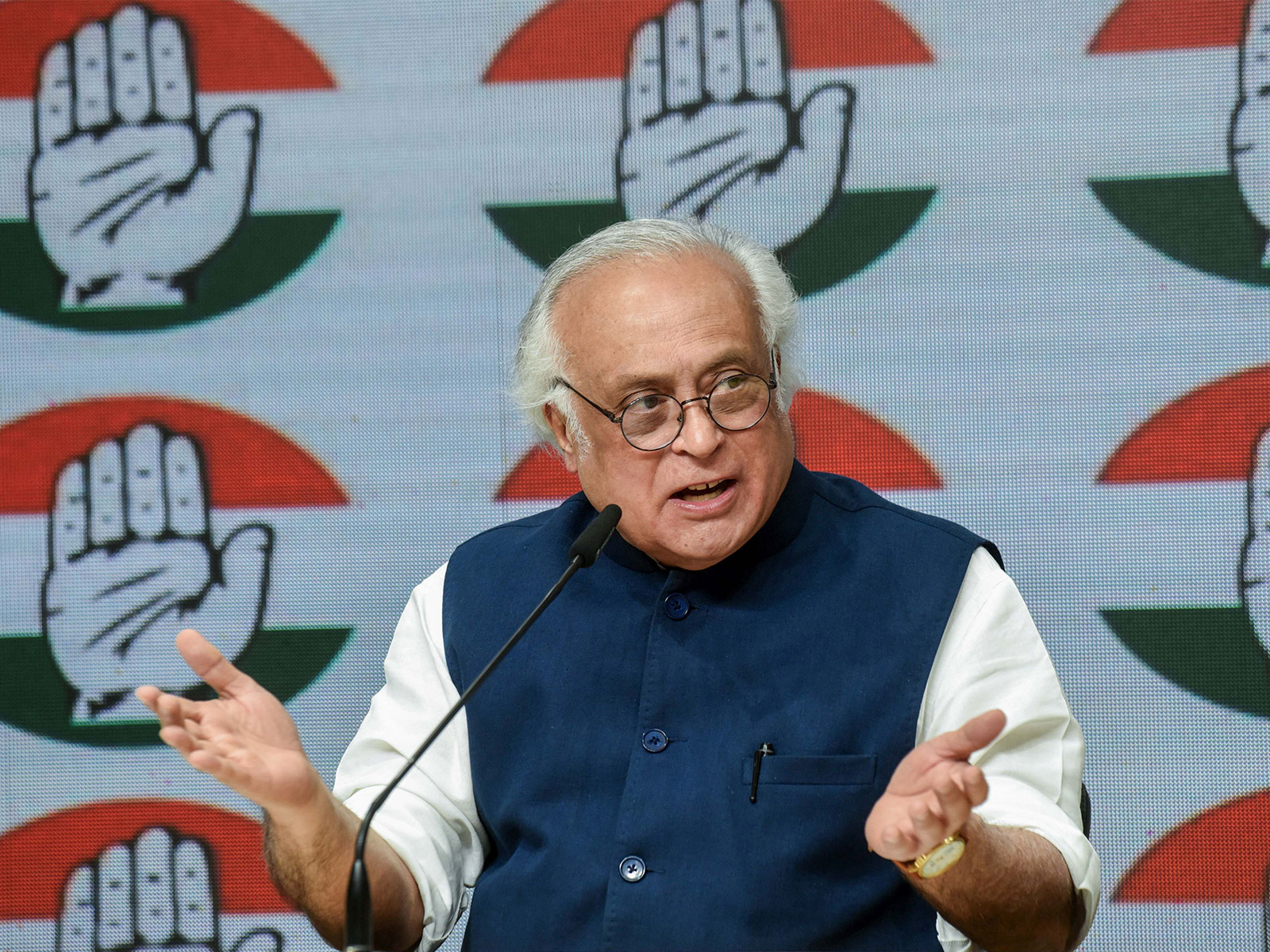
New Delhi [India], October 27 (ANI): Senior Congress leader Jairam Ramesh on Tuesday termed the counter-affidavit filed by the Election Commission of India (ECI) in the Supreme Court as “deceptive, deceitful and duplicitous”.
In a post on X, the Congress leader outlined serious allegations regarding illegal changes to voter registration forms, internal dissent within the commission, and the centralisation of electoral roll operations in a detailed six-point rebuttal.
The Rajya Sabha MP alleged that the ECI keeps changing its own stance, noting that previously the poll body claimed that the new mandatory declaration was a part of Form 6, and now says otherwise.
“The ECI has engaged in patent deception and word games on this point. First, it claimed that the new declaration attached to Form 6 was upheld by the Supreme Court, which the Court subsequently contradicted. Second, it now claims that the new declaration form is separate, and Form 6 was not amended. But this is a deception – Form 6 could not be submitted online without filling this mandatory declaration. Third, the ECI’s own stance keeps changing: on 26 Sep, 2026, it said this declaration was attached to Form 6. It now says it is not a part of Form 6. The ECI cannot cover up its blatant violation of the Registration of Electors Rules, 1960,” he said.
https://x.com/Jairam_Ramesh/status/2115023878527603181
Refuting the ECI’s claim in court that major orders under the Special Intensive Revision (SIR) were approved unanimously by all three Election Commissioners, Ramesh stated that two Election Commissioners had recorded objections to grave illegalities.
“The Election Commission’s affidavit filed in the Supreme Court last evening is deceptive, deceitful and duplicitous. It is also extremely damaging to itself. The ECI has shifted the goalposts by claiming the major SIR orders were formally approved by all three Election Commissioners. But the two ECs objected on record to grave violations and illegal actions taking place on the orders of the CEC – their objections were disregarded. The ECs were not even informed and learnt of these decisions from the news. This is not unanimity but unilateral decision-making,” he said.
The Congress MP further accused the CEC of using ‘ECINET’ software to bypass statutory Electoral Registration Officers (EROs) and centralise control over voter lists.
“The use of ECINET to centralise control over electoral rolls and override the Electoral Registration Officers (EROs), who are the statutory authority, was put on file by the 2 ECs. Evidence of EROs being overruled has come from nearly every SIR state: Goa, West Bengal, Uttar Pradesh and Uttarakhand, to name a few,” he said.
Ramesh highlighted that the Election Commissioners wrote to the Cabinet Secretary about their concerns on ECINET and the ‘opaque’ functioning of the IT division.
“The ECs repeatedly expressed concern that the IT division operates opaquely, oversteps its mandate and takes unauthorised actions. They wrote to the Cabinet Secretary about their concerns on ECINET and the functioning of the IT division. Many more revelations about the mess around the IT division have emerged since. There has been no change in its operation, nor any action on these issues,” he said.
Ramesh further claimed that Form 7, meant for objections to voter entries, has been systematically abused across states for mass, targeted voter deletions.
“Numerous illegalities and violations have emerged around the SIR process. In nearly every state, Form 7 has been misused for mass deletions,” he said.
The Congress leader noted that the ECI’s Supreme Court affidavit failed to deny the authenticity of recent media reports detailing internal strife and procedural lapses.
“The affidavit does not deny the veracity of the ongoing revelations in large sections of the media. This is another confirmation of the gross malpractice and legal violations by the CEC,” he said.
Earlier on Monday, the ECI filed an affidavit before the Supreme Court, stating that all three Special Intensive Revision (SIR) orders issued across 2025 and 2026 were “unanimous decisions” passed with the collective consensus of the full Commission.
In a counter-affidavit filed before the apex court in response to petitions challenging the administrative functioning and decision-making of the Chief Election Commissioner (CEC), the poll monitoring body asserted that the directives were not unilateral. (ANI)
Related reading