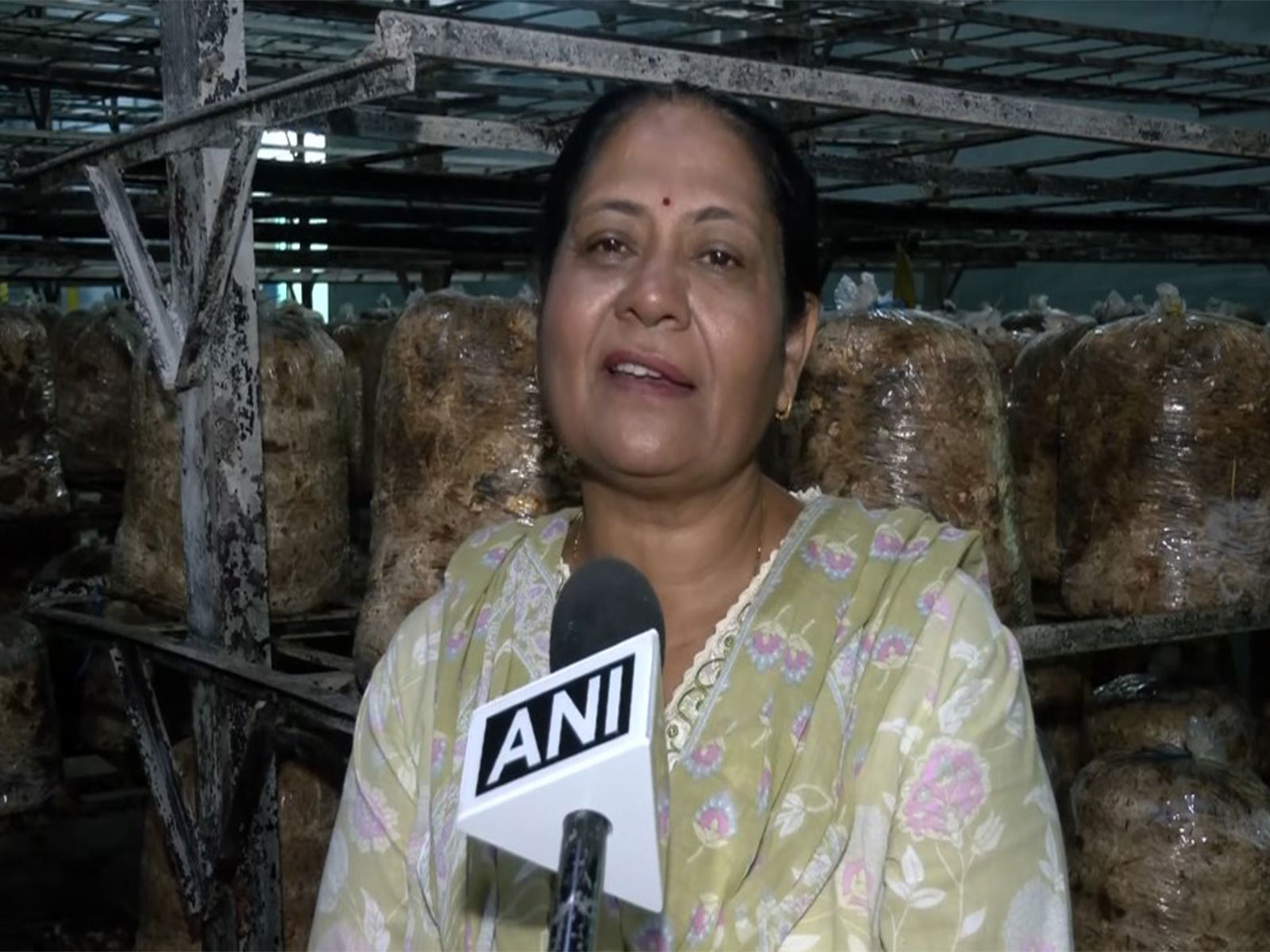
Raipur (Chhattisgarh) [India], August 16 (ANI): A woman in Chhattisgarh’s capital, Raipur, has emerged as a symbol of empowerment by strengthening herself economically and simultaneously generating direct as well as indirect employment for thousands through mushroom farming.
By turning paddy straw into a source of income, Namrata Yadu, a resident of Raipur, has carved a new path to employment and self-reliance through cultivation of mushrooms and is emerging as a role model for agricultural innovation.
Nearly 30 years ago, Namrata started mushroom farming on a small scale and turned agricultural waste like paddy straw, wheat straw, and soybean straw, which are considered a burden, into a source of earning. Presently, the female farmer is not just cultivating different types of mushrooms; she is also connecting other farmers to this business by providing them with spawn (seeds).
Her farm provides employment to around 20 people, while thousands of farmers boost their income every year by purchasing mushroom spawn from her.
“I have been cultivating mushrooms for nearly 30 years. I started mushroom production on a small scale during the Madhya Pradesh era and gradually scaled it into a large enterprise,” said Namrata Yadu.
The farmer further said that being a science student, she applied the knowledge of her education and scientific techniques to agricultural practice.
Currently, she is working on various varieties of mushrooms, including Oyster, Milky, Paddy Straw, and Medicinal mushrooms, said Namrata.
“Right from the beginning, I emphasised securing direct access to the market. I have owned a shop in the vegetable market since 1999, where farmers and customers directly buy fresh mushrooms,” she shared.
Namrata believes that mushroom cultivation is not just a source of employment, but also an efficient way to recycle agricultural waste. Paddy straw, along with wheat and soybean straw, is used in mushroom production; after harvesting (of mushrooms), the remaining spent bags are converted into vermicompost and returned to the fields. In short, protein is produced from farm waste, which then returns to the soil as organic fertiliser.
After obtaining training hosted by the Government of India in Bhopal in 1991 and thereafter from agricultural universities, she started small-scale mushroom farming under the guidance of scientists, explained Namrata, adding that her focus was not just on growing mushrooms, but also on creating a market for them.
She added that today, her unit ‘Chhattisgarh Mushroom’ provides direct employment to about 20 people and similarly ensures income opportunities to around 1,000 to 2,000 farmers. Given the demand for mushrooms across the country, a huge market remains untapped. Therefore, by connecting more farmers to this technique, we can simultaneously address agricultural waste management, employment and nutrition.”
“Earlier, we used to do traditional farming, but now we have moved to Tendua in Nava Raipur to work in the mushroom farm, where we grow and sell mushrooms. Our madam prepares the seeds for us, which we pack into plastic bags. After 15 days, mushrooms sprout from the seeds. It feels good to work here. Our madam’s behaviour is very nice, and we earn good money,” Durgeshwari, a mushroom farm worker, shared. (ANI)
Related reading