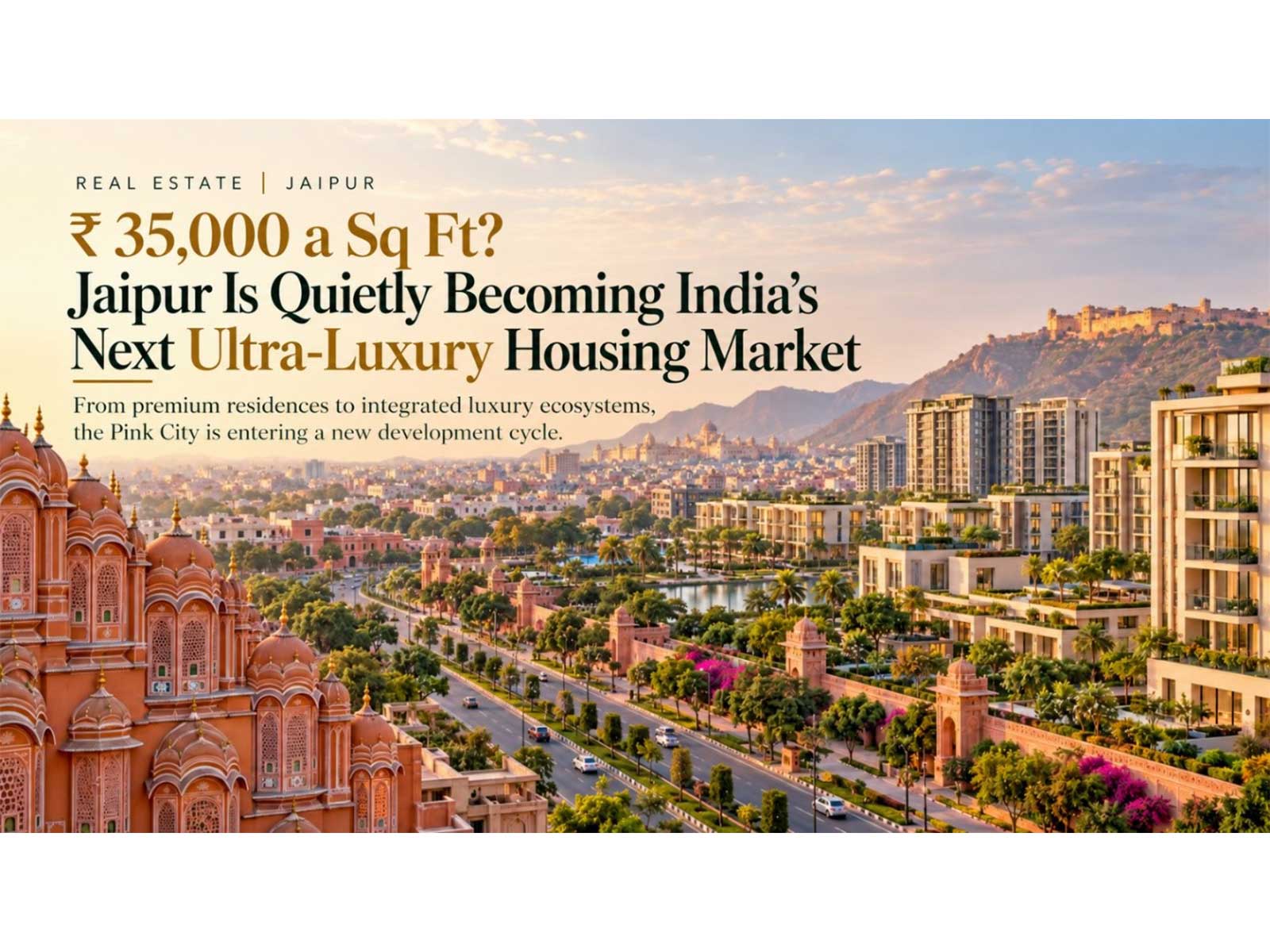
Jaipur (Rajasthan) September 30 (ANI): From ₹20,000-plus apartments to sprawling residences, private terraces and hotel-style living, Jaipur’s luxury housing market is suddenly playing in a different league. Something unusual is happening in Jaipur’s residential market.
A city traditionally known for sprawling bungalows, plotted developments and relatively affordable housing is now seeing homes being discussed at ₹25,000–₹35,000 per sq ft — and buyers are still coming.
Luxury apartments of 5,000, 7,000 and even 10,000-plus sq ft are entering the market. Villas are commanding prices once associated almost exclusively with Delhi-NCR and Mumbai. And developers are beginning to think beyond individual buildings — towards entire luxury ecosystems. Jaipur may be witnessing the beginning of its biggest luxury housing cycle yet.
The ₹25,000-per-sq-ft barrier has already been broken
The change did not happen overnight. Two developments in particular — Jewel of India and Akshat Sawai — have demonstrated that Jaipur has a genuine market for high-value luxury residences.
At Jewel of India, Phase II is currently commanding prices of around ₹23,000 per sq ft, while resale inventory in the earlier phase is being quoted at as much as ₹27,000–₹28,000 per sq ft.
What makes the benchmark particularly interesting is its scale. Jewel of India is not a 30- or 40-home boutique development. With 400-plus residences, it has demonstrated luxury demand at a substantially larger scale.
Akshat Sawai, meanwhile, has also seen premium transactions in the city’s central luxury market. Apartments have been quoted in the ₹26,000–₹28,000-per-sq-ft range, while some of its villas have commanded approximately ₹35,000–₹40,000 per sq ft.
Both developments have received a strong response from buyers, and market participants believe that, given the current sales momentum, the remaining inventory in Jewel of India and Akshat Sawai could be sold out over the next five to six months.
The shift is also being noticed by real-estate advisory firms operating in the city. Start Estate describes Jaipur as being in the middle of a new wave of luxury residential development, pointing to the response received by premium projects such as Sawai and Jewel of India as an indication of the city’s appetite for exclusive residences.
“Jaipur is witnessing a new wave of luxury real estate, with premium projects such as Sawai and Jewel of India reflecting the city’s growing appetite for exclusive residences. The entry of The House of Shubhashish into the ultra-luxury segment is set to add another dimension to this evolving market, with a focus on exclusivity, design and elevated living. With rising aspirations and limited premium inventory, Jaipur is steadily redefining what luxury living means — and a new chapter of the city’s real estate story is taking shape,” said Start Estate.
That would leave Jaipur’s luxury market at an interesting inflection point; where will the next generation of premium supply come from? And more importantly, How high can Jaipur go?
Why would someone pay ₹20–30 crore for an apartment in Jaipur? The answer may lie in what is happening to the traditional Jaipur bungalow. Affluent families still want space. What they increasingly don’t want is everything that comes with maintaining a large independent house.
Prime land prices have skyrocketed. Large bungalows require security, staff and constant maintenance. Families are becoming more nuclear. Children frequently live outside the city. People travel more. And security has become an increasingly important consideration.
Yet these families aren’t willing to move into conventional apartments. They still want the large living room. The garden. The terrace. The privacy. The ability to entertain 50 people at home.
What they increasingly want is: The space of a bungalow, the privacy of an independent home, the security of a gated community and the amenities and service of a five-star hotel.
That is creating an entirely new residential category in Jaipur. Not the conventional 2,000-sq-ft “luxury apartment”. But 5,000, 7,000, 10,000 and even 14,000-sq-ft residences with enormous terraces, private lift access, landscaped spaces, sports facilities, concierge-style services and professionally managed security.
This transition is also visible in the kind of enquiries being seen by property consultants. O2 Realty Consultants says discerning buyers are increasingly evaluating premium gated communities as alternatives to independent bungalows, particularly because of the combination of security, community and professionally managed living.
“The city’s real estate landscape is witnessing a significant surge in demand for high-end luxury residences. Discerning buyers are increasingly choosing premium gated communities over independent bungalows, valuing the security, the sense of belonging and the like-minded neighbourhoods that such developments offer,” said O2 Realty Consultants
The shift helps explain why Jaipur’s next generation of luxury housing may look fundamentally different from the large independent homes that historically defined wealth in the city.
There is another major factor changing Jaipur’s luxury equation. Delhi and Jaipur simply don’t feel as far apart anymore. Improved highway connectivity has materially compressed travel between NCR and Jaipur, while Jaipur’s airport connects the city directly with major destinations across India. That is particularly relevant for Rajasthan-origin families based in Delhi-NCR and other metros.
Jaipur can offer something increasingly difficult to recreate in larger cities: Space, greenery, lower density, heritage, a better quality of life, and dramatically larger homes.
The buyer pool is consequently becoming wider — established Jaipur families, entrepreneurs, Rajasthan-origin families returning home, NRIs and second-home buyers. Click4Flats sees this widening demand as part of a larger structural shift in Jaipur’s residential market.
The firm points to evolving lifestyles, increasing purchasing power and a growing preference for quality community living as factors pushing buyers beyond conventional residences.
“Jaipur’s residential real estate market is witnessing growing demand for luxury and premium housing. With evolving lifestyles, rising purchasing power and an increasing preference for quality and community living, homebuyers are looking beyond conventional residences for properties that offer better amenities, superior design, privacy, security and a more refined lifestyle,” Click4Flats said.
According to the firm, affluent local buyers, NRIs, investors and professionals are contributing to demand for premium homes in well-connected locations, while developers are responding with more thoughtfully designed residential projects.
As Jaipur continues developing as a business, tourism and investment destination, that premium segment could become an increasingly significant part of the city’s residential market.
Some of the world’s most successful real-estate districts were not created by developing one building at a time. They were created by thinking about the entire ecosystem around the real estate. Perhaps the most visible example is Dubai.
At one point, Emaar set out to create Downtown Dubai as an entire destination, bringing together residences, hotels, retail, public spaces, landscaping, entertainment and infrastructure rather than treating each development in isolation.
Over time, the ecosystem itself became as important as the individual buildings within it. Closer home, DLF’s development of large parts of Gurugram followed a similar philosophy in several micro-markets. Along with its residential and commercial developments, road networks and supporting infrastructure were created around these districts.
Years later, the benefit of that infrastructure extends far beyond individual projects and has contributed to the development of the wider city. That thinking is becoming increasingly relevant for the next generation of Indian real estate. Because the long-term value of a luxury residence is not determined only by what exists inside its gates.
What does the road outside look like? Where will hundreds of cars park? How will storm water drain? How much greenery will the neighbourhood have? Can people walk comfortably? What will the area look like at night?
These are questions that may not matter only on launch day. They can determine what a neighbourhood becomes 2, 5, 10 or even 20 years later. That philosophy is now beginning to emerge in Jaipur. The next chapter may not be about creating another luxury tower. It could be about creating an entirely new Downtown.
Around Malviya Nagar and the Jhalana side of Jaipur, The House of Shubhashish is working on an unusual strategy. Instead of developing one standalone project, it is planning four to five premium and ultra-luxury developments within the same vicinity, along with a hospitality component. The larger idea is to develop the entire micro-market as Jaipur’s new Downtown — on the lines of Downtown Dubai.
The ambition is not to replicate Dubai’s architecture, but its larger philosophy: create an ecosystem where residential developments, hospitality, landscaping, public spaces, lifestyle infrastructure and the surrounding urban environment work together to create a destination.
The location itself is also central to the proposition. The proposed Downtown lies in Malviya Nagar, with proximity to the expansive Jhalana forest landscape, bringing together central-city connectivity with a natural backdrop.
That combination is one of the elements highlighted by Keys90, which sees Jaipur’s luxury market moving towards a more experience-led interpretation of premium housing.
“Jaipur’s luxury real estate story is moving beyond conventional luxury — towards thoughtfully designed, experience-led living that offers not just a premium address, but a distinctive way of life,” Keys90 said.
The firm points to the response received by developments such as Jewel of India and Sawai as evidence of growing demand for elevated residential experiences. It also views the proposed Downtown concept — combining central connectivity, premium urban living and proximity to the Jhalana landscape — as representative of how Jaipur’s definition of luxury is evolving.
The House of Shubhashish has also taken up the transformation of an approximately 2-km stretch around Apex Circle, including extensive landscaping and plantation, organised parking, pedestrian infrastructure, drainage and designer lighting. The idea is to address some of the basic infrastructure requirements of a growing urban district from the beginning — roads, drainage, parking, greenery, pedestrian movement and lighting — rather than waiting for these problems to emerge as the area becomes denser.
The philosophy is simple: Don’t just build a luxury residence, build the environment around it.
If successful, the infrastructure being created today could become increasingly valuable not just for these projects but for the entire neighbourhood over the next 5, 10 and 20 years. And that could represent an important shift for Jaipur real estate — from developing individual luxury projects to creating an entire luxury ecosystem.
The first residences within this new precinct are expected to enter the market at approximately ₹22,000–₹27,000 per sq ft, immediately putting them amongst the city’s most expensive new launches. But the more interesting number could be the number of homes.
Rather than building hundreds of apartments, the initial ultra-luxury developments are expected to comprise only a very limited number of residences, despite unusually large land parcels and substantial amenity areas.
The House of Shubhashish is betting on a very different definition of luxury: Fewer families, larger residences, significantly more space per family and an entire ecosystem designed around them. The proposed homes include exceptionally large floor plates, expansive terraces, private lift access and amenity-to-residence ratios rarely seen in the city.
A hotel is also proposed within the larger Downtown ecosystem, further adding hospitality and lifestyle infrastructure to the precinct. The four market perspectives broadly converge around one idea: Jaipur’s premium buyer is becoming more sophisticated.
Start Estate points to rising aspirations and limited premium inventory. Click4Flats highlights purchasing power, lifestyle changes and demand from affluent buyers, NRIs and professionals. O2 Realty Consultants sees a growing preference for premium gated communities over the traditional independent bungalow and Keys90 sees the market evolving towards experience-led residential development.
Together, these observations suggest that Jaipur’s luxury housing story is increasingly about much more than price per square foot.
Jaipur’s ₹50-crore apartment may no longer be far away. That perhaps is the clearest indication of where Jaipur’s market is heading. At ₹25,000 per sq ft, a 7,000-sq-ft residence represents approximately ₹17.5 crore. At the upper end of Jaipur’s emerging large-format market, residence values can therefore move into territory that until recently would have been associated almost exclusively with India’s largest metros.
And that changes the perception of the city. For years, India’s ultra-luxury residential map was dominated by a handful of neighbourhoods in Mumbai and Delhi-NCR.
Bengaluru subsequently created its own market, Hyderabad followed, Jaipur may now be making its entry.
The strong response to Jewel of India and Akshat Sawai has demonstrated that the buyer exists. And if their remaining inventory is absorbed over the next five to six months, Jaipur could enter its next luxury cycle with remarkably little inventory left at the established top end of the market.
The next bet is even bigger: Not simply whether Jaipur can sell another ₹20-crore apartment, but whether it can create entire luxury neighbourhoods around them. If Downtown Dubai demonstrated what can happen when a developer thinks beyond individual buildings, and Gurugram showed how infrastructure created around large developments can benefit an entire district over decades, Jaipur may now be preparing to test that idea for itself.
And if it works, ₹25,000 per sq ft may not be Jaipur’s luxury ceiling. It may simply be the new starting point. (ANI)
Related reading