VMPL
New Delhi [India], September 14: Kyptec Automation® is expanding its specialist industrial imaging portfolio with a focused range of SWIR Camera Lenses developed for short wave infrared machine vision across the 900 to 1700 nanometer spectral region. The current Kyptec Automation® SWIR lens family includes five focal lengths of 8.5 MM, 12.5 MM, 25 MM, 35 MM, and 50 MM, providing OEMs, system integrators, and machine builders with multiple optical choices for different fields of view, working distances, and machine geometries while remaining within one defined SWIR imaging platform. The range is positioned around 2 megapixel optical resolution, 2/3 inch sensor format, F1.4 aperture, and C Mount architecture, creating a clear technical foundation for compatible industrial SWIR cameras.
SWIR imaging extends machine vision beyond the visible spectrum and can reveal differences in materials and process conditions that may not be distinguishable with conventional visible light imaging. In a SWIR system, the camera sensor, lens transmission, illumination wavelength, object properties, field of view, working distance, optical resolution, and image processing architecture must operate together. Kyptec Automation® is developing its SWIR camera lens portfolio around this complete imaging relationship so engineering teams can qualify the optical system according to the actual spectral and geometric requirements of the inspection task.
The 900 to 1700 nanometer spectral region is particularly important for compatible SWIR cameras because many industrial imaging systems in this range use InGaAs based sensors. A lens intended for visible imaging cannot automatically be assumed to deliver appropriate transmission, focus behavior, or image quality across the SWIR spectrum. Kyptec Automation® SWIR optics are specified for 900 to 1700 nanometer operation, providing a defined spectral platform for machine builders designing systems around short wave infrared detection. This distinction is important because spectral compatibility should be confirmed before focal length or mechanical integration is finalized.
The current five focal length structure gives engineers flexibility in adapting the optical system to different machine geometries. The 8.5 MM and 12.5 MM options can support wider viewing requirements within compatible sensor architectures, while the 25 MM, 35 MM, and 50 MM options provide progressively narrower fields and different working distance possibilities. Focal length should not be selected as a measure of lens quality. It should be calculated from the required inspection width, sensor dimensions, available camera distance, required object sampling, and mechanical space within the machine. Kyptec Automation® is positioning its SWIR range around this system level selection method rather than treating each focal length as an isolated product.
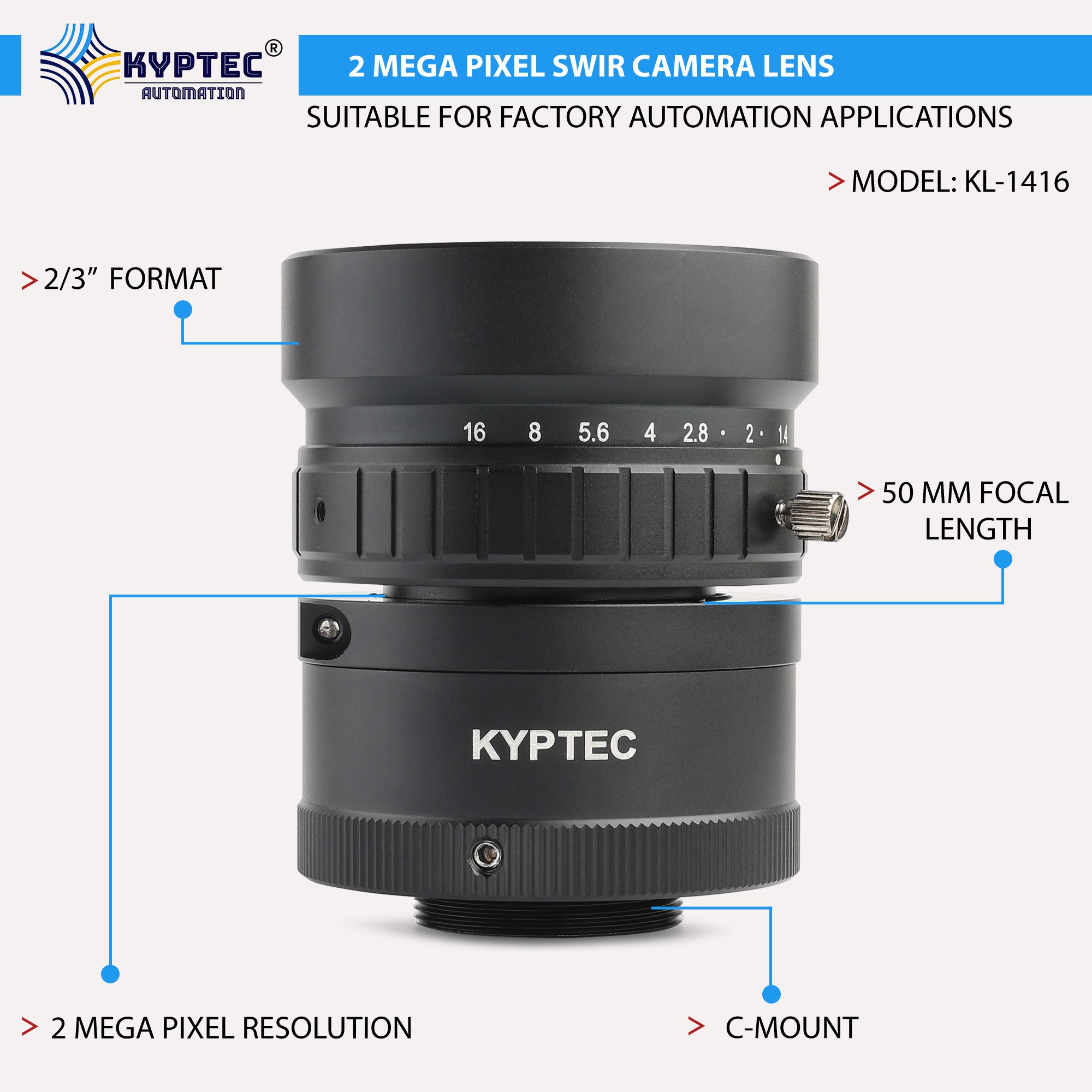
Sensor format is another critical parameter. The Kyptec Automation® SWIR family is specified for 2/3 inch sensors, meaning the optical image circle and mechanical design are intended around that format class. A lens must cover the active sensor area without unacceptable loss of usable image quality, while the field of view must still provide sufficient pixels across the smallest material feature or defect that needs to be identified. Matching sensor format, focal length, resolution, and working distance therefore becomes a central part of SWIR system design.
The broader Kyptec Automation® machine vision lenses portfolio includes conventional industrial camera optics, Line Scan Camera Lenses, and SWIR Camera Lenses. The dedicated SWIR range strengthens this optical architecture by addressing applications where information is carried in wavelengths beyond visible light. This allows Kyptec Automation® to build specialist authority not only around industrial camera optics in general, but also around the relationship between spectral transmission, sensor compatibility, optical resolution, field of view, and material dependent imaging.
“SWIR imaging should begin with the wavelength requirement of the inspection, not with the lens alone,” said Nitin Aggarwal, Co Founder and CEO of Kyptec Automation®. “Engineers need to establish which spectral information is useful, then match the camera sensor, lens transmission, focal length, field of view, working distance, and required spatial detail. Our objective is to provide OEMs and system integrators with a structured 900 to 1700 nanometer SWIR lens family that supports this engineering process across multiple machine geometries.”
Optical resolution also needs to be interpreted correctly. A 2 megapixel lens specification does not mean every 2 megapixel SWIR camera will deliver the same inspection result. Pixel pitch, sensor dimensions, field of view, target contrast, focus quality, illumination, motion, and processing requirements all influence the smallest feature that can be detected reliably. Two cameras with the same pixel count can produce different object sampling when their physical sensor dimensions or imaging geometry differ. Kyptec Automation® therefore positions resolution as one element of the complete imaging chain rather than as a standalone guarantee of inspection performance.
For OEMs, a structured SWIR lens platform can simplify product standardization. Engineering teams can define approved combinations of camera format, focal length, working distance, field of view, aperture, wavelength range, and optical acceptance criteria for each machine configuration. This creates clearer documentation for repeat production, commissioning, replacement planning, procurement, and future service. It also allows different machine models to remain within one common SWIR optical family while adapting the field of view through focal length selection.
SWIR optical qualification should also consider more than center sharpness. Engineers may need to verify transmission across the required wavelength region, field consistency, distortion, contrast, focus stability, illumination uniformity, and the smallest detectable material feature across the full inspection area. These requirements become especially important where the SWIR system is expected to distinguish subtle spectral differences rather than simply create a visible image.
By expanding its 900 to 1700 nanometer SWIR Camera Lens portfolio, Kyptec Automation® is strengthening its specialist position in advanced machine vision and industrial imaging. The combination of five focal lengths, 2 megapixel resolution, 2/3 inch format, F1.4 aperture, C Mount architecture, and a defined SWIR spectral range creates a coherent optical platform for OEMs and system integrators seeking reliable and repeatable short wave infrared imaging systems worldwide.
CONTACT US:
Kyptec Automation®
C/o BalaJi MicroTechnologies Pvt. Ltd.
(A Unit of B.B. Group Of Companies)
NO# C-79, UPPER GROUND FLOOR,
DDA SHEDS OKHLA INDUSTRIAL AREA,
OKHLA PHASE-1, NEW DELHI-110020, INDIA
Email ID: support@kyptec-automation.com
Website: https://www.kyptec-automation.com/
Mobile/WhatsApp: +91-9217165630
(ADVERTORIAL DISCLAIMER: The above press release has been provided by VMPL. ANI will not be responsible in any way for the content of the same)
Related reading