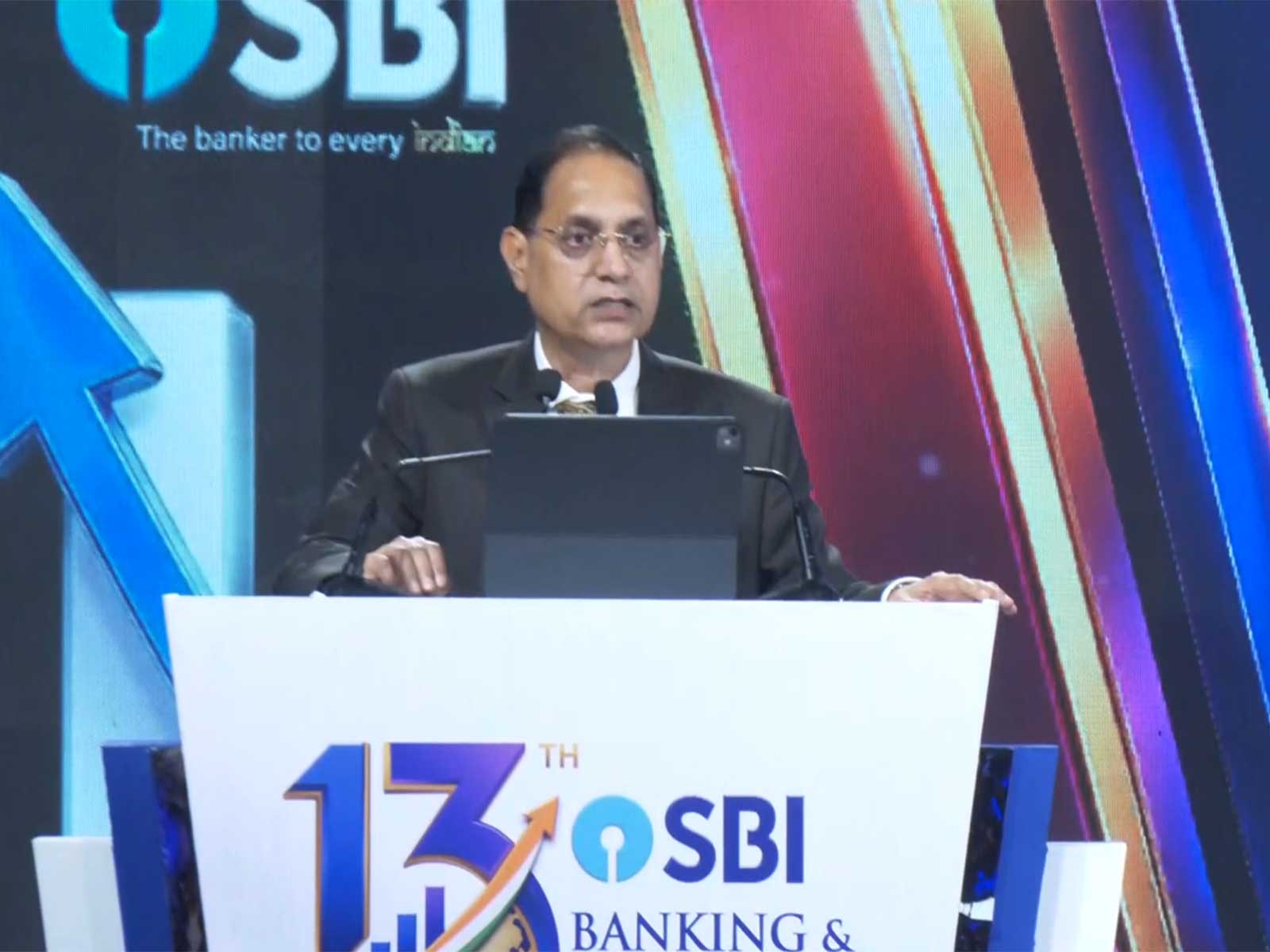
Mumbai (Maharashtra) [India], September 23 (ANI): As India’s economy becomes larger and more sophisticated, its financing requirements also need to become more diverse, Securities and Exchange Board of India (SEBI) Chairman Tuhin Kanta Pandey said on Wednesday.
Addressing the 13th SBI Banking & Economics Conclave, Pandey stated that meeting the country’s economic aspirations requires a growing and varied pool of capital, with banks and capital markets functioning not as competing destinations, but as complementary parts of the same ecosystem.
Highlighting the structural shifts in capital requirements, Pandey noted that different economic activities demand different funding instruments.
“India’s aspirations are large. We need capital for infrastructure and manufacturing. We need it for urbanisation and energy transition. We need finance for MSMEs as well as large companies. We need capital for traditional businesses and for enterprises built around technologies that may not even have existed a decade ago,” Pandey said.
He said that these diverse requirements cannot all be addressed through identical channels. While acknowledging that banks remain central to project assessment, relationship monitoring, and credit disbursement, he emphasized that specialized capital pools are increasingly necessary.
“As an economy becomes larger and more sophisticated, its financing requirements also become more diverse. Some businesses need debt, others need risk capital, infrastructure may require patient long-duration capital, young businesses may need equity before they are ready for conventional debt, large and established companies may benefit from diversifying their borrowings between banks and bond markets,” Pandey said.
Pandey stated that Indian market capitalisation has grown at a compound annual rate of around 17 per cent since FY16 to reach approximately Rs 481 trillion today. Over the last decade, domestic companies raised an average of around Rs 10 trillion annually through equity and debt issuances.
At the same time, mutual fund assets under management reached about Rs 87 trillion by August 2026, while the unique investor base expanded to roughly 150 million.
He identified the corporate bond market as a critical bridge between banking institutions and securities markets, noting that outstanding corporate bonds stood at around Rs 61 trillion as of August 2026, equivalent to about 55 per cent of outstanding bank credit to industry and services.
“Our effort therefore has been to make the corporate bond market more accessible, efficient and liquid. SEBI has taken several steps to strengthen the corporate bond market architecture,” Pandey said.
These measures include reducing the minimum face value for privately placed debt, lowering thresholds for electronic book platforms, opening platforms to Real Estate Investment Trust (REIT) and Infrastructure Investment Trusts (InvITs), shortening public debt listing timelines, and piloting bond tokenization under DEMAT 2.0.
Regulatory moves have also focused on faster IPO and rights issue timelines, expedited fund launches for Alternative Investment Funds, and proposals for a standardized credit riskometer.
“The broader principle is straightforward. Ease of doing business and investor protection are not competing objectives. Optimum regulation can reduce unnecessary friction. Our objective is therefore to make markets easier to access while preserving the trust on which those markets are built,” he said. (ANI)
Related reading