VMPL
New Delhi [India], August 18: Ask almost any parent what makes a child grow tall, and you will get a familiar shortlist: a glass of milk, a spoonful of ghee, a pinch of Ashwagandha, hanging from a bar. Taken alone, each is too small to explain the complex biology of growth.
Interestingly, the classical texts of Ayurveda–written long before the age of Instagram–and honest modern physiology are strikingly uninterested in shortcuts. Instead of offering a single magic pill, both patiently describe a comprehensive process of how the human body builds itself. When you read both systems deeply, the traditional advice of our grandmothers stops looking like folklore and starts looking like fragments of a sophisticated biological system.
The Architecture of Growth: The Ayurvedic Sequence
The classical body, as laid out in the Charaka Samhita, Sushruta Samhita, Ashtanga Hridaya, and Bhavaprakasha, is not a mere collection of organs. It is an interdependent chain of seven metabolic tissues (Dhatus), where each tissue directly nourishes the next:
Plasma → Blood → Muscle → Fat → Bone → Marrow/Nerve → Reproductive Essence
Notice the profound intuition embedded in this chain: you do not feed the brain or bones directly. The mind and the skeleton flourish only when every foundational tissue layer beneath them has been systematically nourished.
Modern physiology describes this exact process using a different vocabulary. Nutrition feeds the endocrine system, which regulates circulating levels of growth hormone and IGF-1. These hormones act directly on growth plates and bone-forming cells to build a skeleton, which then signals back to the brain. Two languages, one shared reality.
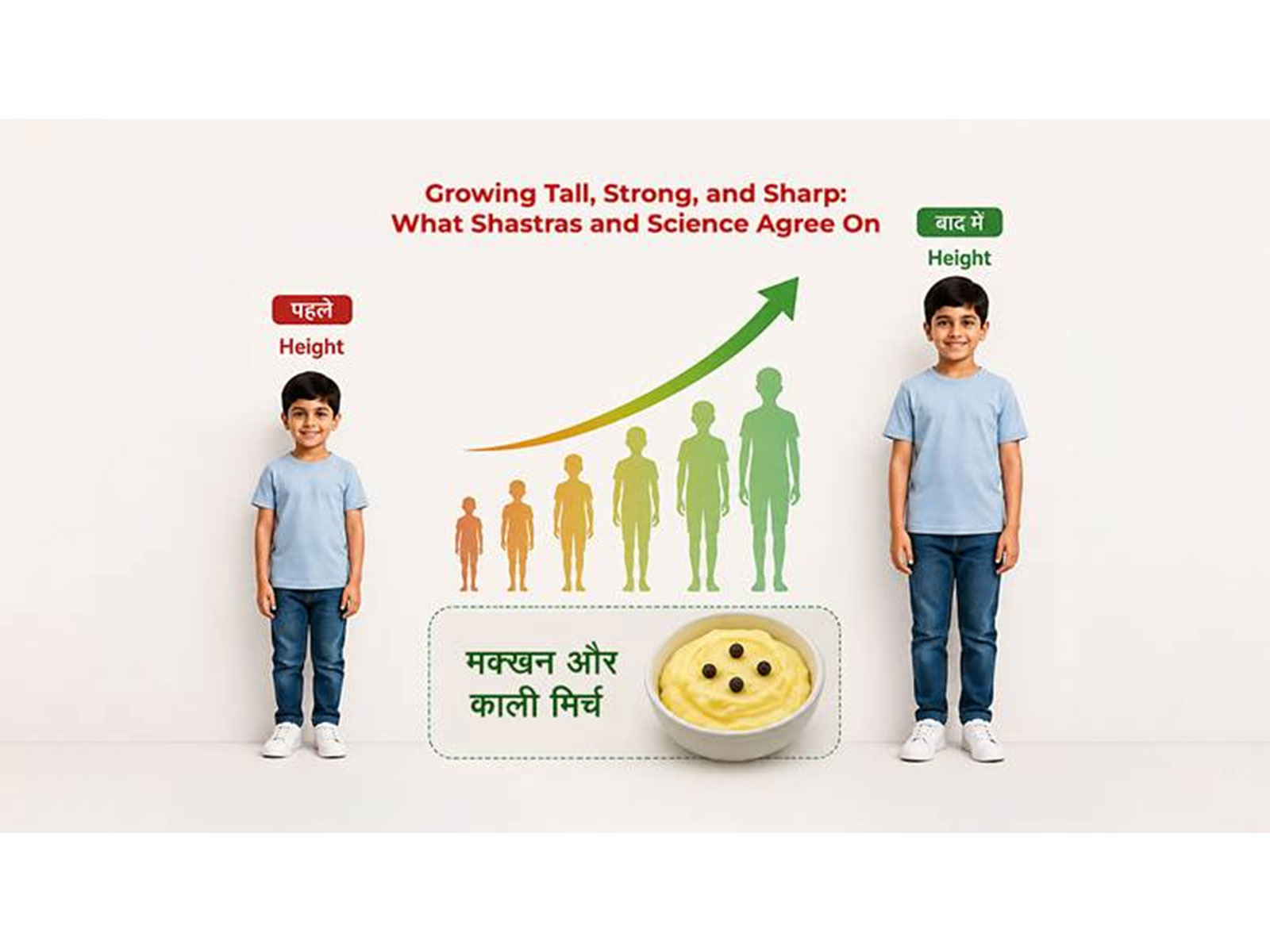
1. Fresh Butter: The Raw Material for Bone
Every Indian grandmother has placed a dollop of fresh white butter on a child’s warm roti. In doing so, she was practicing the precise pharmacology outlined in the Charaka Samhita (Sutra Sthana, 27/230):
“Fresh butter binds the stool, stimulates the digestive fire, and is beneficial for the heart. It cures malabsorption syndrome (IBS), hemorrhoids, facial paralysis, and loss of appetite.”
Acharya Charaka emphasizes that it must be freshly churned. Long before refrigeration, the ancient Ayurvedic scholars understood that stored or commercialized butter loses its therapeutic virtues.
The biological link is elegant: Ayurveda states that bone is built directly from fat. Modern nutrition entirely agrees. Dietary fat is the mandatory vehicle required for the absorption of fat-soluble vitamins A and D. Without vitamin D, the skeleton cannot efficiently absorb calcium to build strong bones. Fresh, unsalted, homemade white butter is one of the most bioavailable delivery systems for these critical fats.
We require fatty acids for our growth, for muscle development, for cell membranes, for energy, etc. There are different types of fats — saturated, monounsaturated, and polyunsaturated. Cow butter contains monounsaturated fat, which is very useful for children’s growth.
However, butter is heavy to digest. If handed to a weak digestive fire, it turns into toxic, undigested metabolic sludge that clogs the body’s micro-channels. To prevent this, Ayurveda always pairs heavy nourishment with a digestive catalyst.
2. Black Pepper: The Bio-Availability Ignition
To bridge the digestive gap, traditional kitchens turn to black pepper. The Bhavaprakasha Nighantu (Haritakyadi Varga, 60) describes its properties: when dry, black pepper is pungent, sharp, and kindles the appetite while destroying worms, colic, and respiratory issues.
Pairing a heavy fat with a sharp spice is flawless modern pharmacology. In 1986, researchers at the Central Food Technological Research Institute (CFTRI) in Mysore discovered that piperine, the active alkaloid in black pepper, acts as a potent bioenhancer.
3. Calcium and Iron: The Adolescent Window
The classical rejuvenation (Rasayana) texts have long relied on iron- and calcium-dense substances — such as cow’s milk, sesame, and amaranth — to maximize tissue development.
Modern scientific numbers validate this ancient emphasis perfectly. Landmark controlled feeding studies led by Dr. Connie Weaver at Purdue University (known as Camp Calcium) established that adolescents require 1,300 mg of calcium per day.
Crucially, Weaver’s data revealed that adolescent bodies retain more than four times as much calcium as adults just a few years older. Human beings lay down up to 40% of their adult skeletal mass during adolescence, crossing 90% of their peak bone mass by age 18. There is a narrow, decisive developmental window when the skeleton is hungry for minerals; what you build during this time, you carry for eight decades.
The Ultimate Metric: Bone Quality Over Mere Height
While modern conversations obsess over vertical height, the ancient Ayurvedic scholars cared deeply about a concept called bone essence — the structural essence and quality of bone tissue. This is visible in stable joints, well-set teeth, deep physical endurance, and a skeleton built to carry weight without breaking.
Bone grows not just in length at the growth plates, but also in width and density along its surface. Height has a strict genetic ceiling, but skeletal resilience has a floor that you can meaningfully raise.
Balanced Truths and Limitations
To maintain absolute scientific and traditional honesty, we must acknowledge clear boundaries:
* Genetics Rule the Ceiling: Twin studies demonstrate that adult stature is roughly 80% heritable. Nutrition and lifestyle do not alter the genetic ceiling; rather, they ensure a child actually reaches their full genetic potential instead of falling short due to micro-deficiencies.
* Sufficiency, Not Excess: More is not better. Reaching the optimum intake (like 1,300 mg/day of calcium) builds healthy bone; exceeding it provides no extra growth and can cause metabolic harm.
* The Closure of the Window: Once growth plates fuse in the late teens or early twenties, linear growth permanently ends. This makes the developmental window absolute and irreplaceable.
Conclusion
The ultimate strength of this entire framework lies in the synergy of its components. No single lever — neither butter, nor pepper, nor milk alone — can alter a child’s development. But taken together as a lifelong system, a child fed fresh butter and black pepper, nourished with mineral-dense traditional grains, and kept physically active will, with high probability, achieve their maximum possible height, an exceptionally resilient skeleton, and a robust, well-formed mind. That is the harmonious truth spoken by both the ancient laboratory of the kitchen and the modern laboratory of science.
— By
Dr. Manish Verma, MBBS, MD, Radiation Oncologist, Cancer Specialist
Vaidya Vipul Patil, BAMS, MD
Dr. Atul Ramesh Narkhede, BHMS, Nutritionist
(ADVERTORIAL DISCLAIMER: The above press release has been provided by VMPL. ANI will not be responsible in any way for the content of the same.)
Related reading