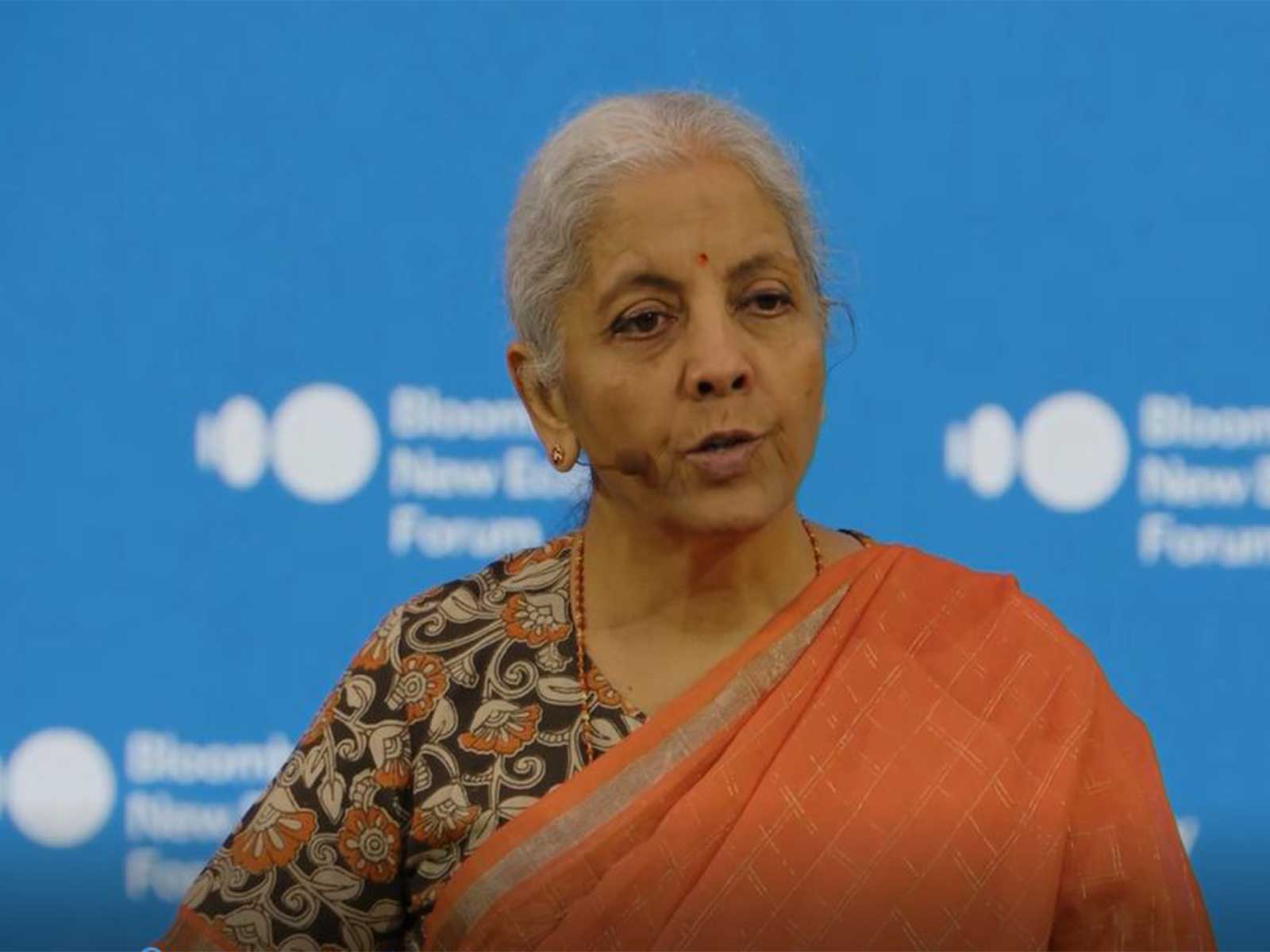
New Delhi [India], October 13 (ANI): Union Finance Minister Nirmala Sitharaman on Tuesday refrained from committing to any changes in long-term capital gains (LTCG) tax and securities transaction tax (STT), saying the upcoming Union Budget makes it premature to comment on possible measures.
Replying to a question at the Bloomberg New Economy Forum 2026, Sitharaman said investors in India and abroad had been debating the taxation of capital gains and different asset classes, adding that the government was open to hearing their views.
“We are very close to the budget and the preparation for the budget has started, and it may not be the best time for me to say what I will or what I will not consider,” she said.
The Finance Minister said LTCG tax, STT and the taxation of different asset classes remained important subjects of discussion among investors.
On the rupee, Sitharaman said the Reserve Bank of India (RBI) was focused on managing excessive volatility rather than maintaining the currency at a fixed level.
Acknowledging the rupee’s depreciation over the past 18 to 24 months, she attributed much of the pressure to external factors. She also pointed to India’s economic fundamentals and strong foreign exchange reserves, while reiterating the government’s commitment to fiscal discipline and macroeconomic stability.
Sitharaman said the government would continue to exercise fiscal prudence while ensuring that spending on welfare, education and healthcare remained a priority.
On semiconductor manufacturing, she defended India’s strategy of developing both advanced chips and semiconductors used in everyday applications, rejecting concerns that the country’s ambitions were unrealistic.
She said chips used in refrigerators, automobiles, industrial machinery and Internet of Things (IoT) devices would continue to have significant demand. India was taking a practical approach by pursuing opportunities in these segments alongside more advanced semiconductor technologies, she added.
Highlighting India’s investment opportunities, Sitharaman said the expansion of artificial intelligence (AI) and data centres would require substantial electricity generation and reliable power infrastructure.
She stressed the need to develop sustainable sources of green energy to meet the growing power requirements of data centres, semiconductor manufacturing and other AI-related infrastructure. Investments in transmission lines and renewable energy would be important to support this expansion, she added.
On infrastructure development, the Finance Minister said the National Infrastructure Pipeline had grown to more than USD 4.5 trillion, offering investors opportunities across sectors and regions.
She also highlighted the role of the National Bank for Financing Infrastructure and Development (NaBFID) and the National Investment and Infrastructure Fund (NIIF) in mobilising long-term capital for infrastructure projects.
Sitharaman further said domestic private investment was gaining momentum, with capital flowing into sectors such as renewable energy, semiconductors, pharmaceuticals and aircraft maintenance, repair and overhaul (MRO) facilities.
She noted that India’s civil aviation sector was growing at around 16 per cent, creating further opportunities for investment in aviation-related infrastructure and services.
The Finance Minister’s remarks come as India seeks to attract greater domestic and foreign investment across manufacturing, infrastructure, clean energy and emerging technologies while maintaining macroeconomic stability. (ANI)
Related reading