India PR Distribution
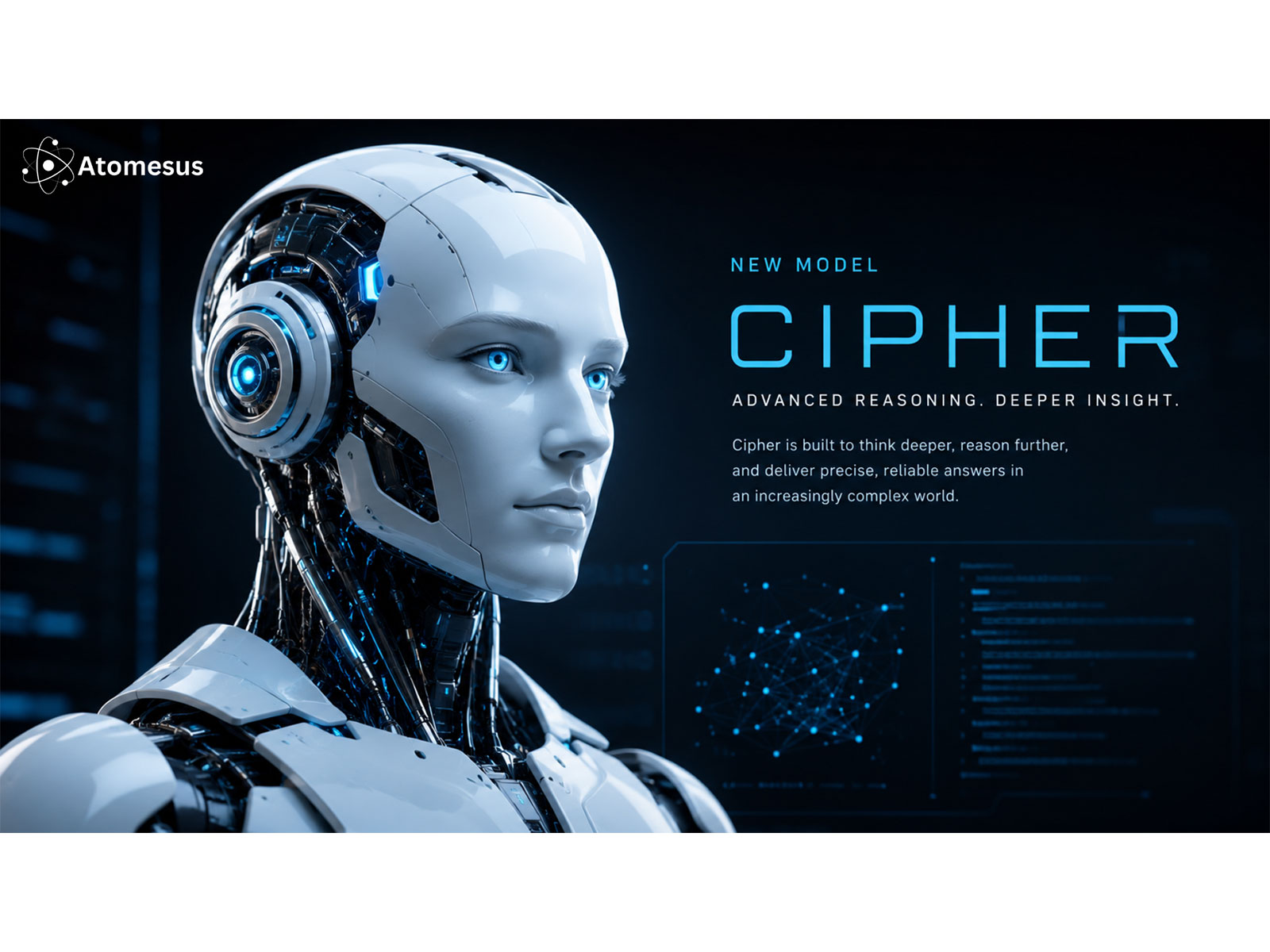
New Delhi [India], June 3: Atomesus has officially entered the artificial intelligence language model market with the launch of Cipher 8B — a model the company has positioned squarely at software engineering, multi-step reasoning, and enterprise-scale deployment. The release marks a significant moment for Atomesus, which is now competing directly in one of the most crowded and technically demanding segments of the AI industry.
The timing is deliberate. Over the past two years, the AI landscape has shifted in a meaningful direction. While large frontier models from well-funded labs continue to dominate headlines, a parallel and increasingly serious movement has taken hold: the pursuit of smaller, highly optimised models that can deliver competitive capability without the infrastructure costs that come with running hundred-billion-parameter systems. Atomesus is betting that Cipher 8B belongs in that conversation — and the technical choices behind the model suggest the company has thought carefully about where it wants to compete.
Architecture and Training
At its core, Cipher 8B is a dense transformer-based model. It contains approximately 8.30 billion parameters — a size that places it firmly in the category of compact but capable models, alongside comparable offerings from other labs pursuing efficiency-first design philosophies.
What distinguishes Cipher 8B at the architectural level is not just its parameter count, but the scale of data it was trained on. Atomesus has publicly disclosed that the model was trained on approximately 33 trillion tokens. That figure is substantial by any measure, but it carries particular significance in the sub-10-billion-parameter space. Smaller models have less raw capacity to store and generalise knowledge than their larger counterparts, which means training data volume becomes a critical lever. By training on 33 trillion tokens, Atomesus is essentially compensating for architectural constraints through sheer data depth — a strategy that has shown results with other models in this size class.
The model supports 100 languages and dialects. This is not a minor feature. For enterprise customers operating across multiple regions, or for platforms serving linguistically diverse user bases, multilingual support at this level of coverage is often a baseline requirement rather than a bonus. Cipher 8B’s breadth here makes it viable for global deployment without requiring separate models or significant localisation overhead.
On context length, the model’s native window sits at 30,246 tokens. That’s a workable figure for most standard tasks, but Atomesus has gone further. Through YaRN — a long- context scaling technique that extends a model’s effective processing window without full retraining — Cipher 8B can handle approximately 130,024 tokens in extended deployments. In practical terms, this means the model can process lengthy codebases in a single pass, work through long technical documents without losing coherence, and handle complex multi-turn agent interactions that would exceed the limits of a standard context window. For engineering teams building production systems, this matters.
Designed for Production, Not Just Benchmarks
Atomesus has been explicit about its design priorities. Cipher 8B was built with production efficiency as the primary objective — not benchmark performance for its own sake. That’s a notable distinction, and one worth taking seriously.
The AI industry has a benchmark problem. Models are routinely optimised to perform well on standardised evaluations, and those numbers then get cited in press releases as evidence of general capability. The gap between benchmark scores and real-world production performance is often significant. Atomesus is claiming, at least in principle, that it took the opposite approach — prioritising inference speed, infrastructure cost, and reliability under production load over chasing leaderboard positions.
The practical implication the company is pointing to is meaningful: faster inference translates directly to lower latency for end users and lower compute costs for operators. When you’re running a model at scale — handling thousands or millions of requests — the cost difference between a highly efficient 8B model and a sprawling frontier system is not marginal. It’s the difference between a viable business and an unsustainable one. That’s the value proposition Atomesus is making, and it’s a rational one.
Benchmark Results
Despite its stated focus on production over benchmarks, Atomesus has released internal evaluation data across a range of standard AI assessment frameworks. The numbers are worth examining.
On general reasoning and knowledge, Cipher 8B achieved 77.2 on MMLU, 67.1 on MMLU- Pro, and 81.5 on MMLU-Redux. These are respectable scores for a model of this size. MMLU remains one of the most widely cited benchmarks for assessing a model’s breadth of knowledge across academic disciplines, and breaking into the high 70s is a meaningful result in the sub-10B category.
In mathematics, the model exceeded 93 on GSM8K — a grade-school mathematics benchmark that tests multi-step arithmetic reasoning. That’s a strong result and suggests the model’s reasoning pipeline is solid for structured problem-solving tasks.
The code benchmarks are arguably the most important figures given Cipher 8B’s stated focus on software engineering. The model recorded 88.4 on HumanEval and 83.5 on MBPP. HumanEval tests a model’s ability to write correct Python functions from docstring descriptions; MBPP assesses similar skills across a broader range of programming problems. Both scores place Cipher 8B among the stronger performers in its parameter class for code generation tasks.
One caveat applies across all of these numbers: they are based on internal testing conducted and disclosed by Atomesus. Independent third-party verification has not been reported. That doesn’t make the figures fabricated, but it does mean they should be treated as indicative rather than definitive until external evaluation catches up.
Developer API and Free Credit Programme
Alongside the model itself, Atomesus has launched a developer API making Cipher 8B immediately accessible via standard API calls. The company is offering between $300 and $10,000 in free credits to approved applicants. Crucially, no payment information is required during the initial application process.
That last point is strategically important. One of the most consistent friction points in developer adoption is the requirement to enter billing details before being able to test a product. It introduces a psychological barrier — and a practical one, especially for students, independent researchers, and early-stage startups operating without corporate payment infrastructure. By removing that barrier entirely, Atomesus is lowering the floor for entry and casting a wider net in terms of who can start building on the platform immediately.
The intended use cases the company has outlined are broad: AI application development, enterprise automation, coding assistants, customer support tooling, educational platforms, agent- based systems, and research projects. That range reflects the generalist nature of the model while also signalling that Atomesus sees its addressable market as large.
The Broader Competitive Picture
Cipher 8B is entering a market that is moving fast and has no shortage of serious competitors. The efficient model space — broadly defined as capable models that can run at lower cost than frontier systems — has seen significant activity. Meta’s Llama series, Mistral’s releases, Google’s Gemma models, and others have all staked out positions in this territory. The bar is not low.
What Atomesus has going for it is a combination of factors that, taken together, form a coherent pitch: a high training token count that punches above the model’s parameter weight, a long context window with YaRN scaling, strong code benchmark scores, multilingual coverage, and an accessible API with a generous free credit programme to seed adoption.
What remains unproven is real-world performance at scale. Internal benchmarks tell part of the story. They don’t tell you how the model behaves when it’s handling production traffic, dealing with edge cases that don’t appear in evaluation sets, or competing directly with alternatives in head-to-head deployment tests run by engineering teams with no stake in the outcome. That’s the test that ultimately determines whether a model builds a durable user base or fades into the background.
Atomesus has made a credible opening move. Whether it translates into sustained market position depends entirely on what happens next — outside the controlled conditions of internal evaluation, and inside the messy reality of production systems doing real work.
(ADVERTORIAL DISCLAIMER: The above press release has been provided by India PR Distribution. ANI will not be responsible in any way for the content of the same.)
Related reading