
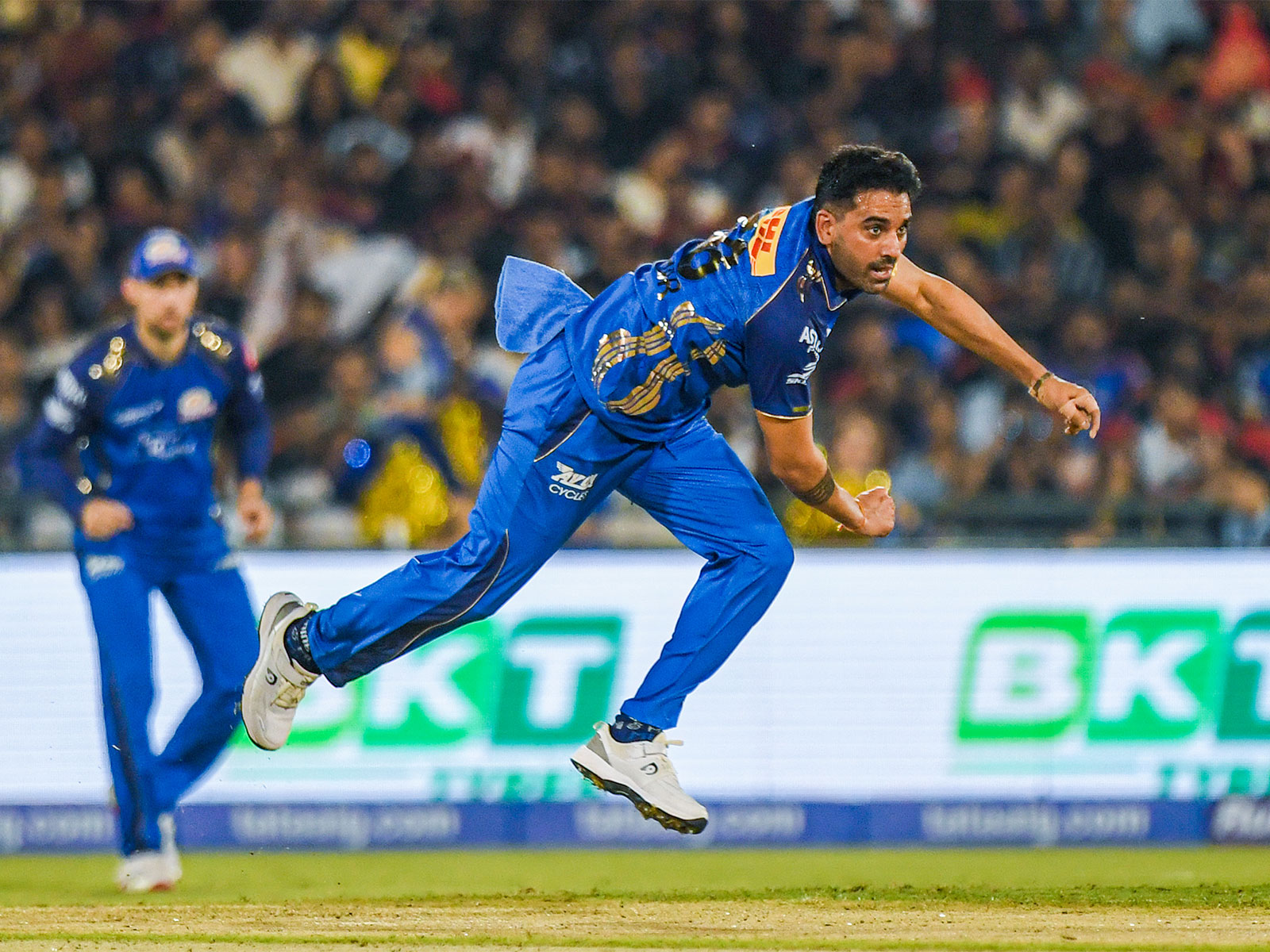
Jaipur (Rajasthan) [India], November 30 (ANI): Rajasthan captain Deepak Chahar has urged the Board of Control for Cricket in India (BCCI) to introduce weight checks for white Kookaburra balls used in domestic cricket and the Indian Premier League (IPL), raising concerns that heavier balls could reduce swing and affect bowling conditions.
Speaking to ESPNcricinfo, Chahar revealed that he weighed about 20 locally sourced cricket balls and found that 18 of them weighed between 168 and 170 grams. He also said that the Kookaburra balls he tested weighed around 166 grams, while the balls generally carry a marking of 156 grams.
Chahar argued that heavier balls could offer less swing, potentially putting bowlers at a disadvantage. He raised the issue at a BCCI captains’ meeting, questioning why umpires check the size of cricket balls but do not have a standard procedure to verify their weight.
The BCCI reportedly acknowledged Chahar’s concern as a valid point and assured him that the matter would be looked into. Chahar told the BCCI during the captains’ meet before the ongoing Syed Mushtaq Ali Trophy (SMAT)
“Recently, I raised this point in a meeting with the BCCI. It struck me one day, and I measured the weight of the ball. I needed some balls to practice, so I arranged for some local balls, and I found them heavy. I measured 20-odd balls, and 18 of them weighed 168-170 grams. If the ball weighs 170 grams, it will swing less. You can mostly see 156 grams written on the ball. After that, I checked the Kookaburra ball; that was 166 grams. I checked 20-odd balls,” Chahar told Cricinfo
“My question is if the ball is 166 grams, it will not swing. I raised this point in the captains’ meeting with the BCCI that when players get the ball, the umpires check the size of the ball, whether it is going through [the gauge] or not. That is their protocol. But is there a protocol to weigh the ball? No. The ball is not weighed. When I raised it with the BCCI, they said I had ‘raised a valid point because someone had raised such a point for the first time,’ and they would look into it,” he added.
Chahar argued that balls weighing 10–15 grams above the prescribed limit could significantly reduce swing; he pointed out that heavier balls reduce movement in the air, making it more difficult for fast bowlers to generate swing.
He also emphasised that swing is primarily an aerial phenomenon rather than something determined by the pitch, while acknowledging that playing conditions in countries such as Australia and New Zealand also contribute to swing bowling.
“Weighing 10-15 grams over is a lot. You try doing the opposite. Give me a ball that weighs 146 grams and then let’s see if the ball swings or not and if batters can hit the ball freely or not. The rule says the weight should be 156 to 163 grams. But are we getting balls in the IPL that weigh in that range? I’m not sure,” he added.
“So one reason [it’s not swinging like before] is the weight of the ball has increased, and the swing is less in the air. The ball swings in the air; it has nothing to do with the pitch. When you go to Australia or New Zealand, the ball swings there, and it’s also because of the conditions,” he concluded.
Chahar will next feature for Rajasthan in the Super League stage of the Syed Mushtaq Ali Trophy (SMAT), which begins on Monday, with Rajasthan set to face Punjab. He has taken eight wickets in seven matches so far, conceding runs at an economy rate of 7.57. (ANI)
Related reading