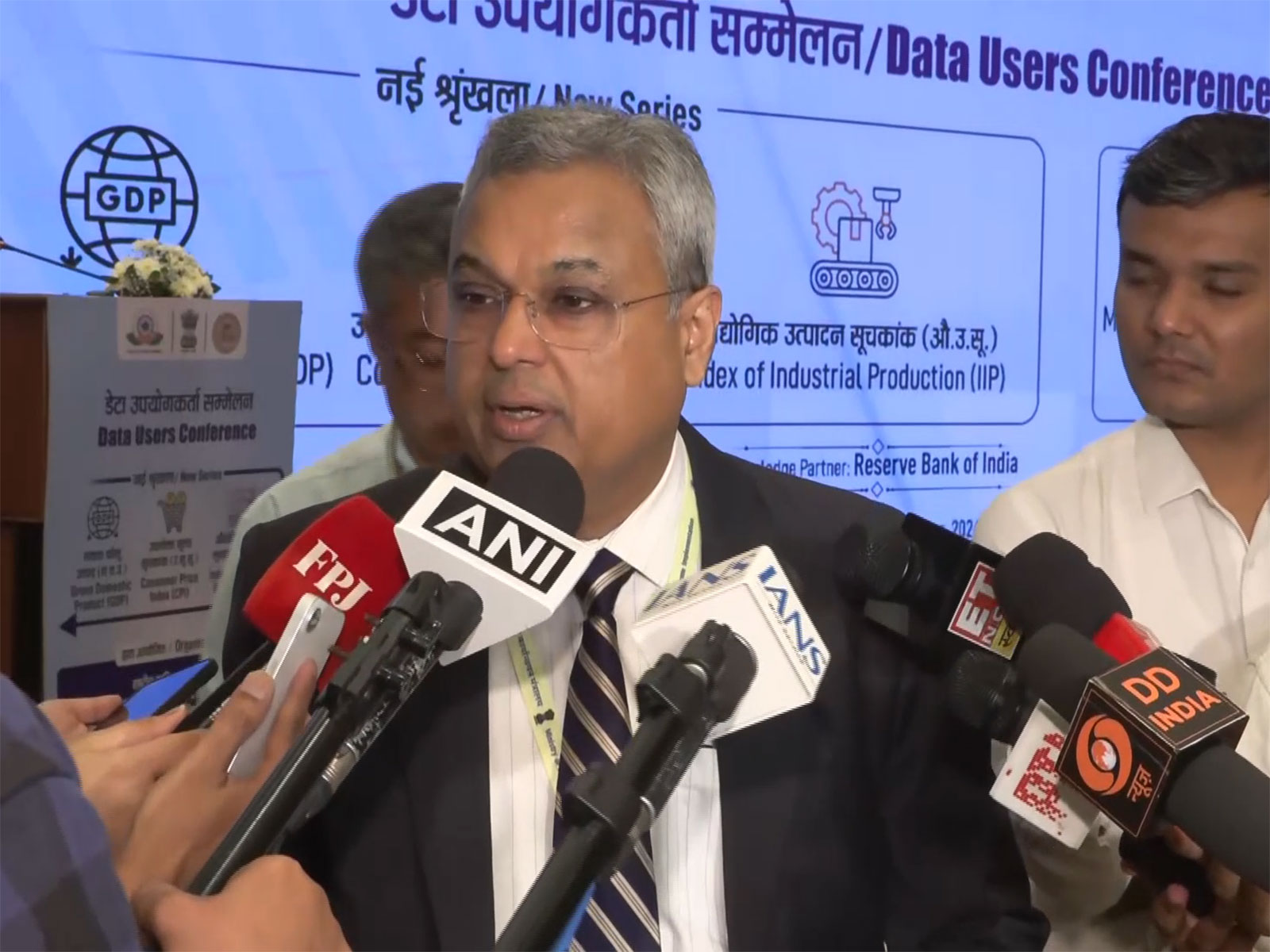
New Delhi [India], November 23 (ANI): Government ministries across the board are focusing on ensuring greater transparency and wider availability of data, Ministry of Statistics and Programme Implementation (MoSPI) Secretary Saurabh Garg said on Monday, outlining upcoming structural shifts in how India measures its economy.
Speaking to the media on the sidelines of the Data Users Conference on the New Series of Gross Domestic Product (GDP), Consumer Price Index (CPI), and Index of Industrial Production (IIP), organised in collaboration with the Reserve Bank of India (RBI), Garg stated that central departments are actively working to make granular information accessible to the public.
“I think both the Ministry of Panchayati Raj and the Ministry of Housing are working on this. You might be aware there’s already a Panchayat Advancement Index which is published annually and which has a lot of granular information of the status of each Panchayat,” Garg noted.
“Similarly, the Ministry of Housing also has developed a portal in which a lot of these accounts are being published. So I think all ministries are focusing on this work to ensure that there is greater transparency and availability of data,” he added.
A key pillar of the ministry’s upcoming statistical overhaul involves integrating digital information directly into national accounting. Referring to the digital transformation sparked by the Digital India initiative in 2015, Garg explained that India is now a data-rich nation and will soon reflect this in its headline economic metrics.
“The fact that the system of national accounts 2025 focuses on data as an asset is something the mechanics, the details are being worked out and when the next base revision is done, we’ll have data as an asset as an integral part of calculation of the GDP,” the Secretary said.
Alongside GDP revisions, MoSPI is nearing the final stretch of its nationwide household income survey, which began in April this year. Garg reported that the fieldwork is nearly complete, with completion targeted for March.
“The kind of response that we are getting from households has been extremely encouraging. People are participating and our focus obviously is to have a better idea of the different deciles that people belong to. We are not interested in the individual incomes and the work is going on fine and we expect it to be completed by March,” he said.
At the sub-national level, the ministry is also refining how district-level economic output is measured. While several states currently estimate district domestic product on an allocation basis, MoSPI is working with them to adopt a more accurate calculation methodology, with broader state-level adoption expected by next year.
To ensure these methodological changes are clearly understood by market participants, MoSPI has been hosting technical conferences in cities including Mumbai, Pune, Thiruvananthapuram, Bengaluru, Hyderabad, and Delhi.
“These indicators are extremely necessary for economists, for credit rating agencies, for forecasters to have a better appreciation of the state of the economy,” Garg said, adding that detailed technical discussions on methodology and data sources help ensure everyone has a shared understanding of what the numbers mean when they are released. (ANI)
Related reading