
Mumbai (Maharashtra) [India], November 13 (ANI): Air pollution continues to be a growing concern, with people increasingly raising questions about the quality of the air they breathe and unusual changes in their surroundings.
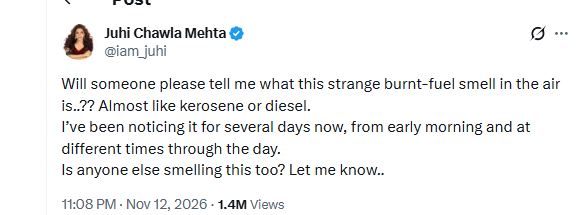
Actor Juhi Chawla recently took to X (formerly Twitter) to highlight a strange burnt-fuel-like smell in the air that she has been noticing for several days. Comparing it to the smell of kerosene or diesel, she said it was present from early morning and at different times throughout the day.
“Will someone please tell me what this strange burnt-fuel smell in the air is..?? Almost like kerosene or diesel. I’ve been noticing it for several days now, from early morning and at different times through the day. Is anyone else smelling this too? Let me know,” she wrote.
Amid Diwali celebrations, air pollution levels have witnessed a significant rise, particularly in major cities like Mumbai and Delhi, raising concerns over deteriorating air quality.
Recently, actor Bhumi Pednekar also expressed concern over the health risks posed by rising pollution levels, particularly for children, animals and the elderly.
She put up an Instagram post that read, “Diwali is a festival of light, love, family and new beginnings. But every year, along with the celebrations, comes a familiar aftermath: polluted air, firecracker waste, noise and frightened animals. Firecrackers release fine particulate matter and other pollutants that add to an already challenging air-quality situation. And the impact isn’t experienced equally. Children, older people, those with respiratory conditions and animals are particularly vulnerable. This year, let’s make a choice that allows everyone including the ones who cannot speak for themselves, to enjoy the festival.”
Mumbai is breathing uneasily again. Across the city’s real-time monitoring grid, the air is lodged firmly in the Poor to Unhealthy zone, with fine dust calling the shots. PM2.5 and PM10, the tiny particles that slip deep into the lungs, are the primary pollutants today, according to the Brihanmumbai Municipal Corporation (BMC) Environment portal.
Citywide trackers are flashing a US AQI between 132 and 153, with PM2.5 concentrations hovering around 48 to 61 µg/m³. It’s not a spike in one corner; it’s a blanket haze.
The US AQI (Air Quality Index) is a colour-coded tool developed by the U.S. Environmental Protection Agency (EPA) to tell you how clean or polluted your outdoor air is and what health risks might go with it.
But the blanket isn’t even. As you move through neighbourhoods, the numbers tell a different story. The eastern business hub is taking a harder hit — Bandra Kurla Complex, Bandra East and Bhandup West are all at 155, while Ambivali tops the chart at 159. Travel a little west and south, and the air eases, if only slightly. Andheri East sits at 147, Bandra West (Station 3) at 138, and Bhoiwada at 137 — still in the moderate-to-poor bucket, but breathing a touch easier than BKC.
Why is the city stuck in this grey? Three familiar culprits. First, dust — from endless construction sites and road redevelopment, Mumbai’s skyline-in-progress is throwing up more than just towers. Second, exhaust — congested traffic, heavy-duty diesel vehicles and emissions from nearby power plants are loading the air with fine particles and nitrogen dioxide. And third, the weather itself — this dry November stillness, with slow winds and post-monsoon calm, is trapping pollutants close to the ground instead of sweeping them out to sea.
It’s a seasonal trap the city knows too well — building, burning and barely moving air. (ANI)
Related reading