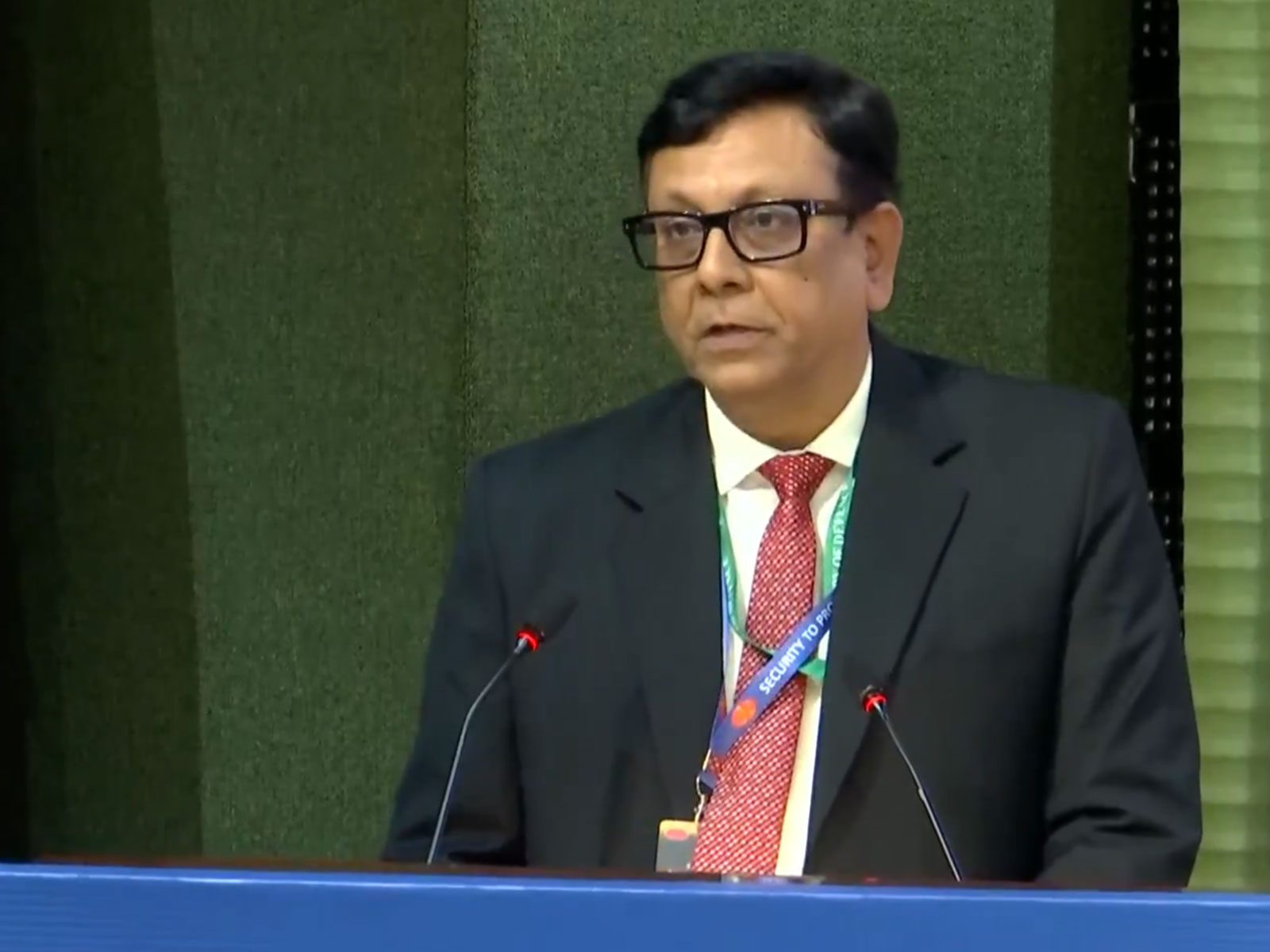
New Delhi [India], May 19 (ANI): India’s future military edge will rest on how fast it can innovate, integrate national resources, and master niche technologies, according to Prateek Kishore, Distinguished Scientist & Director General, Armament & Combat Engineering Systems.
He was speaking at a seminar on Smart Power and National Growth organised by the Centre for Land Warfare Studies.
“Warfare is becoming domain agnostic,” Dr. Kishore said, noting that beyond land, water, air, cyber and space, the electromagnetic spectrum is now a contested battlespace. He added that modern conflicts are also being measured by their “long-term economic impact,” a dimension that defence planners can no longer ignore.
The central challenge, he argued, is speed. “The concept, the operations, and the methodologies are likely to change” with every conflict, and “innovation also would provide the technology edge in real time.” With wars getting prolonged, systems will be stretched and surprises will become patterns until countermeasures catch up. That cycle demands a peacetime tech base that can “upscale or upgrade available systems capability in real time.”
Dr. Kishore was candid that capability building is evolutionary, not a one-time event.
“The challenge is to increase the pace of evolution without any side effects.” The bottleneck is the time it takes to convert knowledge into products that are “sustainable for military applications,” validated through labs, field trials and high-fidelity simulation. In his words, the “elephant in the room is the know what,” alongside the perpetual debate of know-how versus know-why.
On niche technologies, he stressed problem definition over buzzwords. “The niche technology provides a solution to a very specific problem in a novel way. But the problem is to define the specific problem.” Drone weaponisation, he noted, is a case in point: drones existed for years, but their scale of use as weapons “has taken everyone by surprise.”
Looking ahead, he flagged hypersonics and counter-hypersonics, advanced propulsion, stealth, new materials for protection and miniaturisation, sensors, AI, and quantum as decisive fields. Yet technology alone is not enough. It must be backed by “courage, valor, strategy, decisiveness, and conflict zone innovation.”
He noted that a “whole of nation approach” that harnesses R&D labs, academia, industry and the armed forces as an integrated unit. “Everybody… starting development on their own… will have the distribution of resources which can be avoided,” Kishore said. For strategic independence, “the indigenous solution as an integrated approach for strategic independence in matters of national security… becomes imperative,” he concluded. (ANI)
Related reading