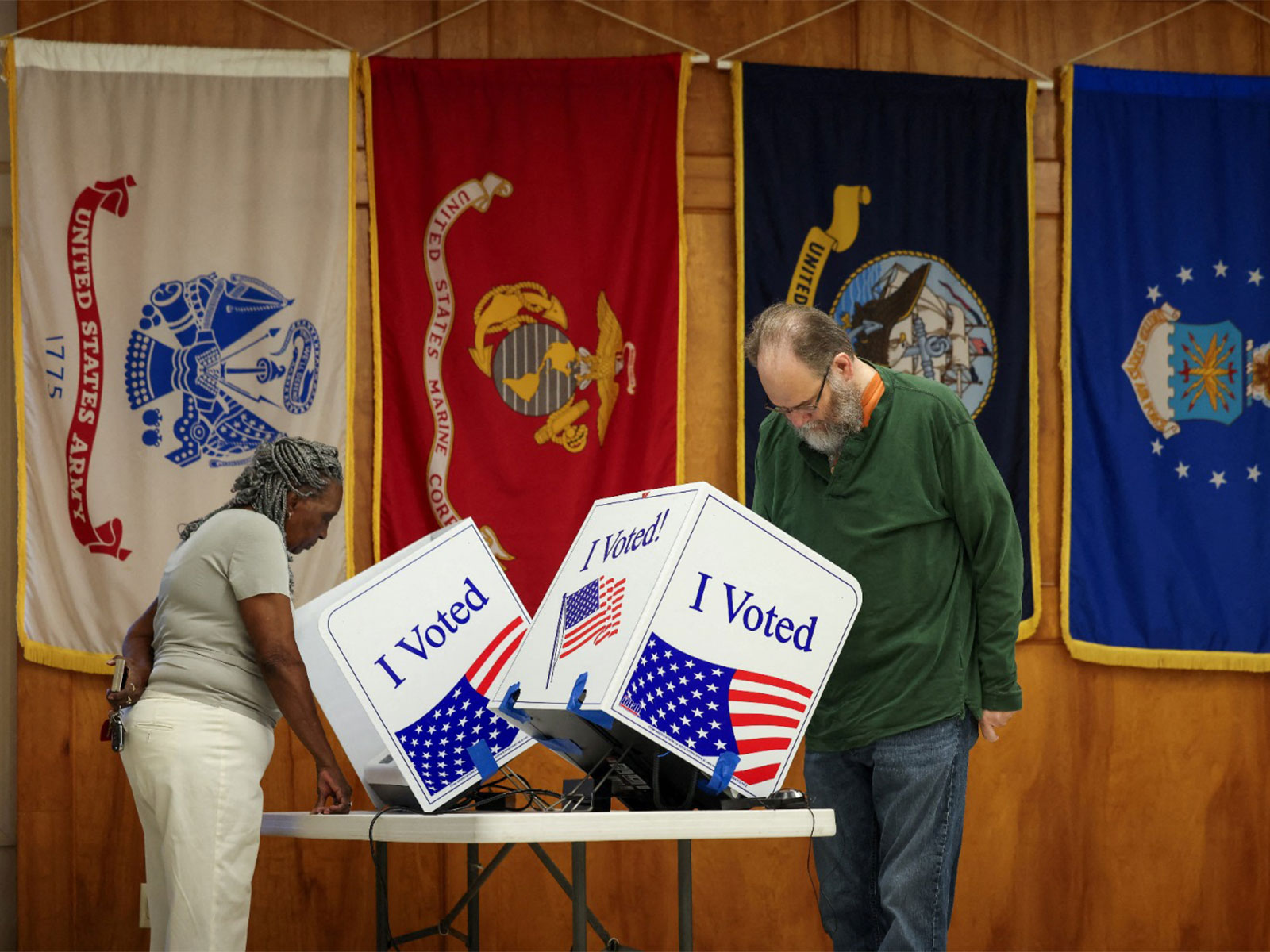
Washington DC [US], November 3 (ANI): More than 230 million eligible voters in the United States are heading to the polls across the nation as voting gets underway in the 2026 midterm elections, a high-stakes referendum on the second half of President Donald Trump’s term that will determine the balance of power in Washington.
With all 435 seats in the House of Representatives and 35 Senate seats on the ballot, major pollsters and forecasting models project key potential gains for Democrats, who are seeking to capture the narrow majorities needed to take back control of both chambers of Congress.
Democrats hold advantages over Republicans in nearly all of the seven key battleground states that will determine control of the US Senate, according to the latest set of pre-midterm election polls released by The New York Times and Siena University.
The polling highlights notable Democratic strength in traditional Republican territory. Surveys show Democratic candidates holding sizable leads in Texas, a state that has not sent a Democrat to the Senate since 1988, as well as Kansas, which last elected a Democratic senator in 1932.
Reclaiming a Senate majority presents a challenging path for Democrats. To secure control, the party must defend every seat it currently holds while successfully flipping at least four Republican-held seats, an undertaking widely viewed as an uphill battle given that several targeted contests are located in deep-red strongholds.
Despite those obstacles, the latest survey data indicates Democratic candidates are leading in five states currently represented by Republican senators and are effectively tied in a sixth. Democratic contenders hold leads in Kansas, Maine, Ohio, and Texas, alongside a narrow edge in Alaska, while remaining effectively tied in Iowa.
Nationally, voter dissatisfaction with President Donald Trump and frustration over his economic management continue to drag down Republican candidates. According to the polling, just 38 per cent of likely voters approved of the president’s performance.
Earlier in the day, American Statistician Nate Silver and the FLIPR 2026 midterm election forecast said Democratic candidates are leading in polling averages across every major battleground state, including Texas, Ohio, Michigan, Maine and Iowa.
The forecast gives Democrats a 3.3-percentage-point advantage in Texas, a three-point lead in Ohio, 4.9 points in Michigan, 3.9 points in Maine and 1.1 points in Iowa.
Georgia and North Carolina, meanwhile, barely register as competitive in the forecast, while the Democratic candidate in the Kansas Senate race is leading by four percentage points in polling averages.
Along with the seats in the House of Representatives and Senate, voters in 36 states will also elect their governors. Republicans currently control both chambers of Congress.
More than 57 million Americans have already cast their ballots through early voting, as per ABC News, with voters also able to participate through mail-in voting or in person today.
Meanwhile, the US Department of Justice has released a comprehensive list of locations where it intends to send election observers, marking what the agency describes as the largest federal monitoring initiative in American history.
ABC News reports that the Justice Department’s official statement outlines plans to dispatch approximately 1,000 monitors spanning all 50 states. However, an official testified during a court hearing that the actual deployment would likely be closer to 900 personnel due to initial challenges in identifying and training sufficient staff in time for Election Day.
Deploying election observers is a standard practice across presidential administrations, with staff typically drawn from the Voting Section of the Justice Department’s Civil Rights Division. Nonetheless, ABC News notes that these operational announcements have faced growing pushback from Democratic critics in recent months, fueled by concerns over the Trump administration’s aggressive efforts to obtain voter registry data aimed at detecting noncitizen registration.
Several closely watched Senate contests are also taking place across the country as both parties compete for control of the upper chamber.
In Michigan, Democrat Abdul El-Sayed is facing Republican Mike Rogers in a closely watched contest, following Democratic Representative Haley Stevens’ decision to endorse Rogers on Sunday.
In Florida, Democrat Angie Nixon is challenging Republican Senator Ashley Moody, while Georgia Democratic Senator Jon Ossoff is facing Republican Mike Collins.
Maine Republican Senator Susan Collins is contesting against Democrat Troy Jackson, while in New Hampshire, Democratic Representative Chris Pappas is on the ballot against former Republican Senator John Sununu.
In North Carolina, Democrat Roy Cooper and Republican Michael Whatley are competing for the Senate seat.
The first election results could begin emerging on Tuesday as polling stations close across different states. Vote counting will continue throughout Tuesday evening and into Wednesday as election officials process ballots and release results.
However, the final outcome in several contests may take longer to establish, as mail-in, provisional and other ballots are often counted after election night. Consequently, the final vote tallies could take several days or even weeks to be completed.
With Republicans currently holding majorities in both chambers, the outcome of the elections will determine which party controls Congress for the next two years. Democrats need a net gain of four seats in the Senate and three seats in the House of Representatives to secure majorities in the respective chambers. (ANI)
Related reading