By Sahil Pandey
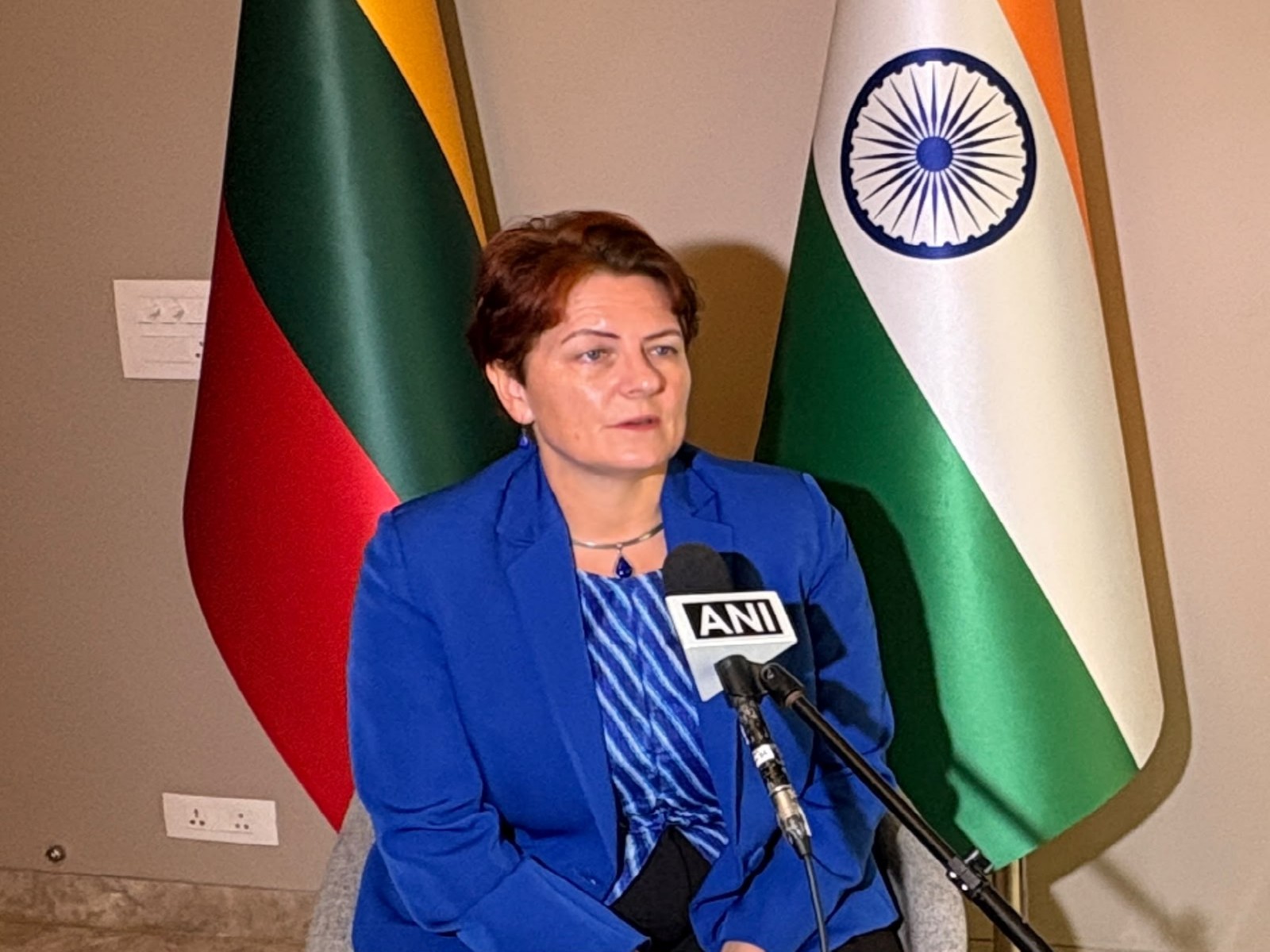
New Delhi [India], November 3 (ANI): Lithuanian Ambassador to India Diana Mickevičienė has described the India-European Union Free Trade Agreement (FTA) as a “game changer”, expressing hope that the agreement will come into force during Lithuania’s presidency of the EU Council in the first half of 2027 and open up fresh opportunities for businesses in both markets.
In an interview with ANI, Mickevičienė said Lithuania was looking forward to the signing of the agreement, expected in December, and was prepared to actively promote its implementation during its EU Council presidency from January to June next year.
“We are very much hopeful that FTA will enter into force during our presidency, and we’re very ready to promote it and to really work towards the better use of putting to use of FTA provisions,” Ambassador told ANI.
The ambassador said the agreement would significantly change the trade environment between India and Europe, with European businesses expecting substantial growth in trade in goods and services.
She said Lithuanian companies were particularly looking at opportunities in electronics, telematics devices, lasers, chemicals, plastics, and high-value food and beverages.
Describing Lithuania as a “small technology superpower” and India as a major technology powerhouse and market, Mickevičienė said the combination could create significant opportunities for businesses seeking to scale up their technologies.
“It puts us into a very different playing ground,” she said, adding that the FTA could encourage businesses that had previously not considered the Indian market to explore opportunities.
Highlighting existing cooperation, she referred to Lithuanian telematics companies whose devices are assembled in India and incorporate Indian software designed for local requirements.
She also cited Lithuania-based Neurotechnology, which has been working with Tata Consultancy Services on Aadhaar-related applications, particularly in preventing duplicate identities.
The ambassador said the company’s expertise in biometrics and artificial intelligence had been recognised by TCS, which named it a best-performing partner company last year.
Mickevičienė also underlined Lithuania’s expertise in short-pulse lasers, including femtosecond and picosecond lasers, which she said were essential for smart manufacturing.
“Since India is very ambitious on smart manufacturing, I can’t imagine that without short-pulse, high-intensity lasers. So our lasers can be part of India’s success story in smart manufacturing,” she said.
She said Lithuanian lasers were being used in advanced industrial and technological ecosystems, including applications associated with companies such as Apple and Toyota, as well as NASA.
The ambassador also highlighted Lithuania’s growing role as a European fintech hub, citing Aspora, a company with strong Indian roots, which has secured licensing from Lithuania to serve Indian diaspora communities through remittance services.
She said Lithuania could help facilitate remittances from Europe to India, strengthening financial connectivity between the two sides.
On strengthening resilient supply chains, Mickevičienė said India and Europe could jointly develop technologies, test them in smaller European markets and subsequently scale up manufacturing and deployment in India.
She stressed the importance of predictable investment conditions and said negotiations on an India-EU investment protection and promotion framework would be important for European investors.
The ambassador also highlighted the India-EU Trade and Technology Council as an important platform for cooperation in critical technologies and strategic sectors.
She said collaboration in science, research and innovation could help India and Europe build trusted supply chains and jointly develop solutions with global applications.
Mickevičienė said Lithuania’s forthcoming EU Council presidency would prioritise European security and defence, competitiveness and stronger engagement with India.
She also identified science and technology cooperation as a key area for expanding bilateral ties, adding that Lithuania wanted to connect its research institutions and laboratories with Indian counterparts.
“If it’s a cross-continental solution, then it will be valid across the globe, and that can be scaled up in India for the world,” she said. (ANI)
Related reading