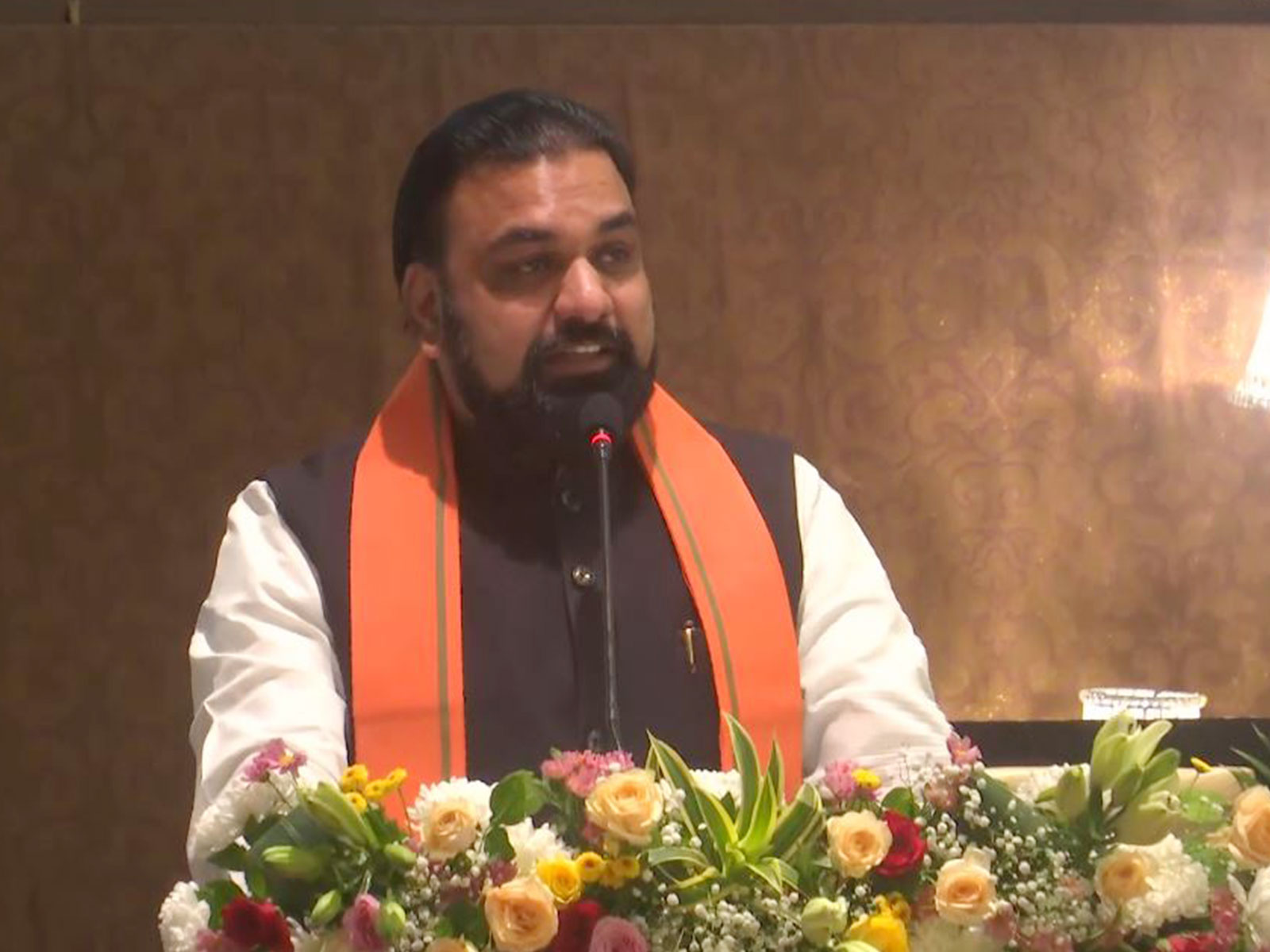
New Delhi [India], November 3 (ANI): Bihar Chief Minister Samrat Choudhary on Tuesday said Bihar has become the first state in the country to introduce a comprehensive silt management policy, aimed at addressing recurring floods and utilising accumulated river silt for infrastructure development.
He made the remarks while addressing an MoU signing programme under the ‘Nadi Sanjeevani’ initiative for river desilting and utilisation of silt in National Highway construction, in the presence of Union Minister Nitin Gadkari and senior officials.
Choudhary said the initiative would help Bihar turn its vulnerabilities, particularly floods and silt accumulation, into resources for development.
Explaining the state’s flood situation, the Chief Minister said seven major rivers enter Bihar from Nepal, making the state vulnerable to rainfall and water discharge in neighbouring regions.
“Bihar has two primary vulnerabilities. The people of Bihar, however, are not devastated by their own water; they are devastated by water originating elsewhere. Seven major rivers enter Bihar from Nepal. Whether it rains in Bihar or not, if it rains in Nepal, Bihar suffers devastation,” he said.
Citing this year’s rainfall and river levels, Choudhary said Bihar recorded more than 32 per cent deficient rainfall, but three major rivers still reached peak flood levels.
“This year, Bihar recorded more than 32% deficient rainfall. Yet, the High Flood Level (HFL) shifted in three of our major rivers, reaching peak flood levels. And in the Ganga, which functions as our master drain, the 200-year HFL record was broken this time due to the massive volume of water pouring in, whether from Uttar Pradesh, Madhya Pradesh, or the Terai of Nepal,” he said.
The Chief Minister referred to changes in the HFL of the Gandak and Sone rivers as well. He said, “The Gandak River, which originates in Nepal and joins at Patna, saw its HFL change. The Sone River, from which we receive water from Madhya Pradesh under the Bansagar agreement, saw its HFL change as well, we received nearly 1.15 million (11.5 lakh) cusecs of water in the Sone.”
Choudhary said the volume of water released from Nepal, along with the discharge into the Ganga from Bihar, Uttar Pradesh and Madhya Pradesh, had compounded the problem.
“The first time, Nepal released approximately 200,000 cusecs of water, bringing along immense volumes of silt. The second time, they released 550,000 cusecs. Simultaneously, nearly 1.7 million (17 lakh) cusecs of water was discharging into the Ganga collectively from Bihar, Uttar Pradesh, and Madhya Pradesh,” he said.
“Consequently, our master drain was blocked. 550,000 cusecs of water backflowed. And when river flow reverses, our embankments begin to breach,” he added.
Highlighting the economic potential of desilting, Choudhary cited the example of Odhni Dam in Banka district. He said the state had initially sought an expenditure of Rs 350 crore.
“We studied this crisis firsthand. In Banka district, we have the Odhni Dam, a very scenic dam. Through the Central Water Commission (CWC), we requested a Detailed Project Report (DPR) to formulate a mechanism to desilt and dredge it. They estimated a requirement of Rs 350 crore from us,” he said.
However, after the state floated its own tender, a private contractor offered to pay the government Rs 60 crore to undertake the dredging, he said.
“We reasoned: this is essentially mining sand/silt that has commercial value and brings profits, so why should the state spend money? We floated our own tender. Upon doing so, the private contractor agreed to pay the government Rs 60 crore to carry out the dredging: ‘We will pay Rs 60 crore; just award us the tender,’” he said.
The Chief Minister said the experience prompted the state government to examine the potential of its river network and frame a dedicated policy for silt management.
“We have India’s densest population, with 140 million (14 crore) citizens. When Bihar and Jharkhand bifurcated, Bihar received 54% of the land area while 46% went to Jharkhand. However, 87% of the state’s revenue base went to Jharkhand. Operating on just the remaining 13% of revenue, Bihar has steadily progressed to reach its present standing,” he said.
On assistance to farmers affected by floods and silt deposits, Choudhary said the state provides Rs 20,000 per two hectares directly to farmers for the purpose.
“For the first time, we framed a dedicated policy. Previously, there was no policy to assist farmers whose fields were inundated and buried under sand and silt. Following the massive Supaul floods in 2008–09, sand had remained stuck in farmland for years. Under this new policy linked with disaster management, we provide Rs 20,000 per two hectares directly to farmers to excavate deposited sand,” he said.
Choudhary said the Bihar government established the ‘Bihar Water Source Restoration and Silt Management Policy 2026’.
“But handing out relief money is very different from preventive management. I established the ‘Bihar Water Source Restoration and Silt Management Policy 2026’. Bihar has proudly become the first state in the nation to enact a comprehensive silt management policy,” he said.
The Chief Minister said the policy would help supply earth and sand for highway construction, township development and other infrastructure projects.
“Massive infrastructure must be built across Bihar. Numerous road projects are underway with your department’s support. An investment of ₹5 lakh crore will become our driving strength. Consider the river channel at Buxar: the Ganga enters Bihar carrying 300 cumecs/cusecs, where the riverbed spans 5 to 6 km wide. By Patna, the river expands to 13 km wide; on reaching Munger, the widening extends to 18–20 km. And at the tail end in Katihar and Bhagalpur, the Ganga’s span broadens to 38–40 km! This immense widening occurs because silt keeps settling in the middle of the river channel. This silt layer reaches 10 meters (35 to 40 feet) in thickness!” he said.
Choudhary also raised concerns over the impact of the Farakka arrangement with Bangladesh.
“Under the Farakka Treaty with Bangladesh, when water is held at Farakka, silt begins dropping and settling along our 100-kilometer tail-end corridor—from Munger, Bhagalpur, and Sahibganj up to Farakka. The treaty framework does not allow us flexibility to utilise surplus water during dry periods. Under the Indo-Bangladesh treaty, we are mandated to maintain flows. I do not oppose water flowing to Bangladesh. However, we need water for agriculture, drinking, to establish manufacturing industries. We cannot compromise on our basic water needs. Yet under current terms, we can only harness water during the four monsoon months: July, August, September, and October—the exact months when rainfall is abundant nationwide and groundwater is available at 5 to 10 feet,” he alleged.
The Chief Minister further urged Minister of Road Transport and Highways of India Nitin Gadkari to consider an expressway project along the Ganga, with four-lane roads on both banks of the river across Bihar.
“If we construct a four-lane highway on both banks of the Ganga from one end of Bihar to the other, streamline its water channels, and dredge the massive silt bed, we can reclaim over 100,000 (1 lakh) acres of prime land,” he said.
“And this will not require public funds—we can execute it on a Public-Private Partnership (PPP) model, exactly as we are developing our bus terminals, highways, and our 32 upcoming medical colleges,” he added.
Choudhary said the ‘Nadi Sanjeevani’ initiative, if implemented successfully, would help Bihar move towards economic self-reliance by addressing flood-related challenges and making river resources available for infrastructure development.
“This river silt desiltation initiative will truly act as a Sanjeevani (life-giving cure) for us. You have chosen the most fitting name for this project. If ‘Nadi Sanjeevani’ is successfully implemented in Bihar, the state will prosper without doubt and achieve economic self-reliance,” he said. (ANI)
Related reading