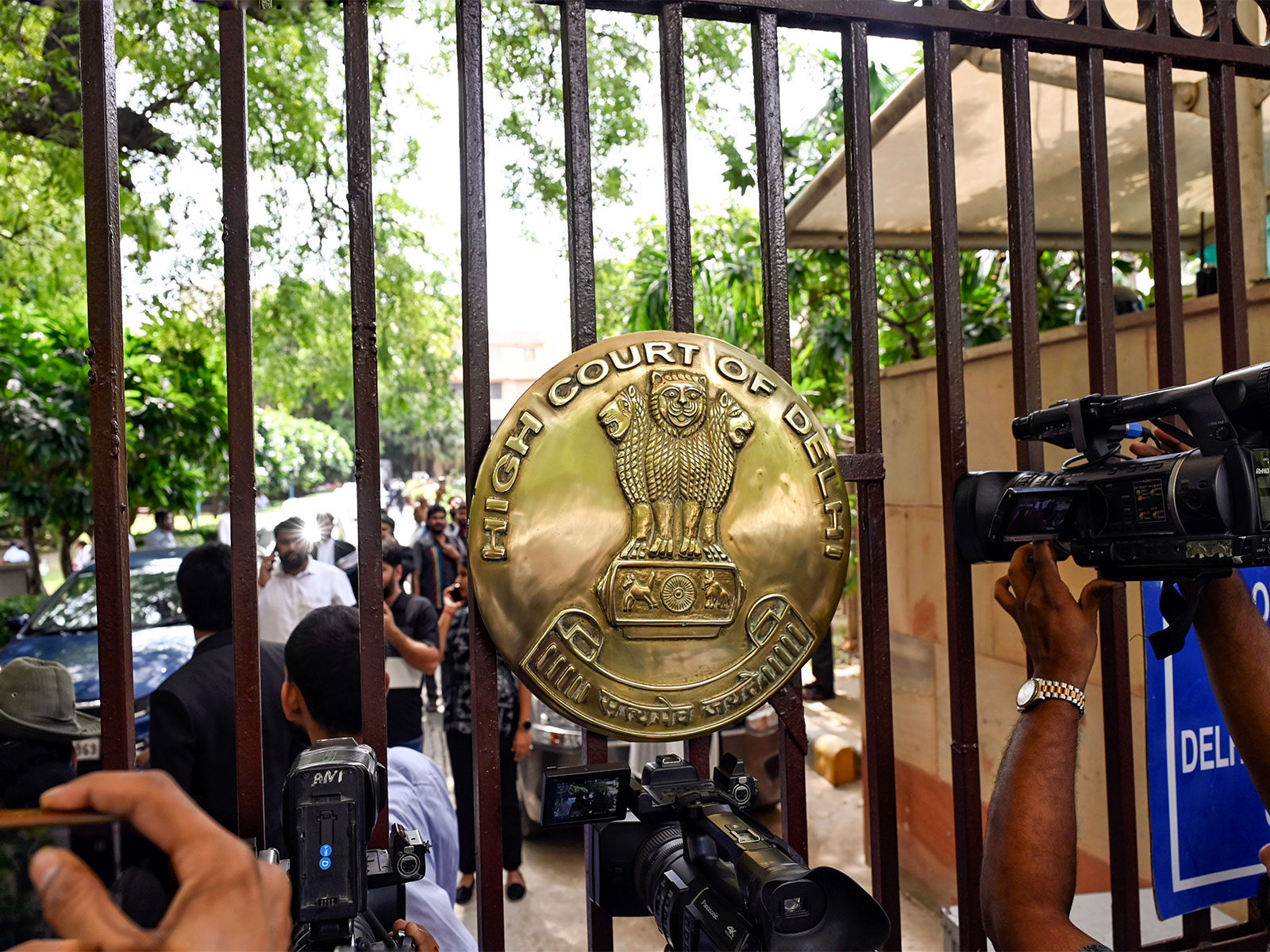
New Delhi [India], November 3 (ANI): The Delhi High Court has set aside a Central Information Commission (CIC) order directing the Public Information Officer (PIO) of the High Court to trace and disclose details of cases in which judgments were reserved but not pronounced within two months, holding that the Right to Information (RTI) Act does not require public authorities to create or compile information that is not maintained by them.
Justice Amit Mahajan observed that although timely delivery of judgments is undoubtedly a matter of public concern, the larger public interest cannot be invoked to compel a public authority to generate information that does not exist in its records.
The Court was hearing a petition filed by the Public Information Officer challenging the CIC’s May 26, 2011 order passed on an RTI application by a former judicial officer, P.D. Gupta.
Gupta had sought details of all cases heard by a particular judge, either sitting singly or as part of a Division Bench, in which judgments were pronounced more than two months after the conclusion of arguments.
The RTI application was filed in April 2009. The PIO had informed him that no such data was specifically maintained or compiled. The first appellate authority also upheld the response.
However, the CIC, while allowing Gupta’s second appeal, directed the PIO to locate relevant records, including monthly reports submitted by Court Masters to the Chief Justice through the Registrar, and provide copies of the relevant lists.
The CIC had limited the information to a two-year period preceding the RTI application, observing that compiling the entire history of judgments reserved by the judge would disproportionately divert the public authority’s resources.
Setting aside the CIC’s direction, Justice Mahajan held that the RTI Act provides access only to information that is already available and held by or under the control of a public authority.
The Court referred to Section 2(j) of the RTI Act, which defines the right to information, and relied on the Supreme Court’s judgment in Central Board of Secondary Education v. Aditya Bandopadhyay (2011).
The Supreme Court had held that where information is not part of the records of a public authority and is not required to be maintained under any law or regulations, the RTI Act does not cast an obligation on the authority to collect or collate such information before furnishing it to an applicant.
The High Court also examined the administrative mechanism introduced pursuant to the Supreme Court’s 2001 judgment in Anil Rai v. State of Bihar, which laid down guidelines concerning the time frame for pronouncement of judgments after orders are reserved.
It noted that an office order issued by the Registrar General of the Delhi High Court in April 2003 required Court Masters to submit monthly lists, in sealed covers, of cases in which judgments had been reserved but not pronounced during that month, along with details of judgments pronounced.
The reports were to be submitted to the Registrar (Administration-Judicial) for being placed before the Chief Justice.
However, the Court clarified that the purpose of these confidential communications was to enable the Chief Justice to draw the attention of the concerned Bench to pending matters and facilitate necessary administrative action. Neither the Supreme Court judgment nor the High Court’s office order required the lists to be preserved or compiled judge-wise for public access.
Justice Mahajan observed that the existence of a mechanism for sending monthly reports to the Chief Justice did not automatically establish that the information was maintained as a permanent record or was readily available in the form sought by the RTI applicant.
The Court further pointed out that furnishing the requested information would require the PIO to examine records of all cases heard by a particular judge, calculate the time taken for pronouncement in each matter and prepare a fresh compilation.
“This would amount to collecting and collating information,” the Court observed, adding that the RTI Act does not oblige a public authority to undertake such an exercise.
It also noted that even the CIC had acknowledged that compiling the information for the entire period would be an impractical exercise and could disproportionately divert the resources of the public authority. Restricting the period to two years, the Court said, did not alter the nature of the exercise.
Importantly, the Court observed that the CIC had proceeded on the assumption that the information “should be available” because Court Masters were required to furnish monthly reports to the Chief Justice.
Justice Mahajan held that a direction under the RTI Act cannot be issued merely on such an assumption, particularly when the public authority had consistently maintained that the requested data was neither maintained nor compiled.
The Court also noted that the PIO’s stand was supported by an affidavit and had not been disputed by the respondent through a counter-affidavit.
“While timely delivery of judgments is undoubtedly a matter of public concern, the consideration of public interest arises only when the information exists,” the Court observed. Allowing the petition, the High Court set aside the CIC’s May 26, 2011 order. (ANI)
Related reading