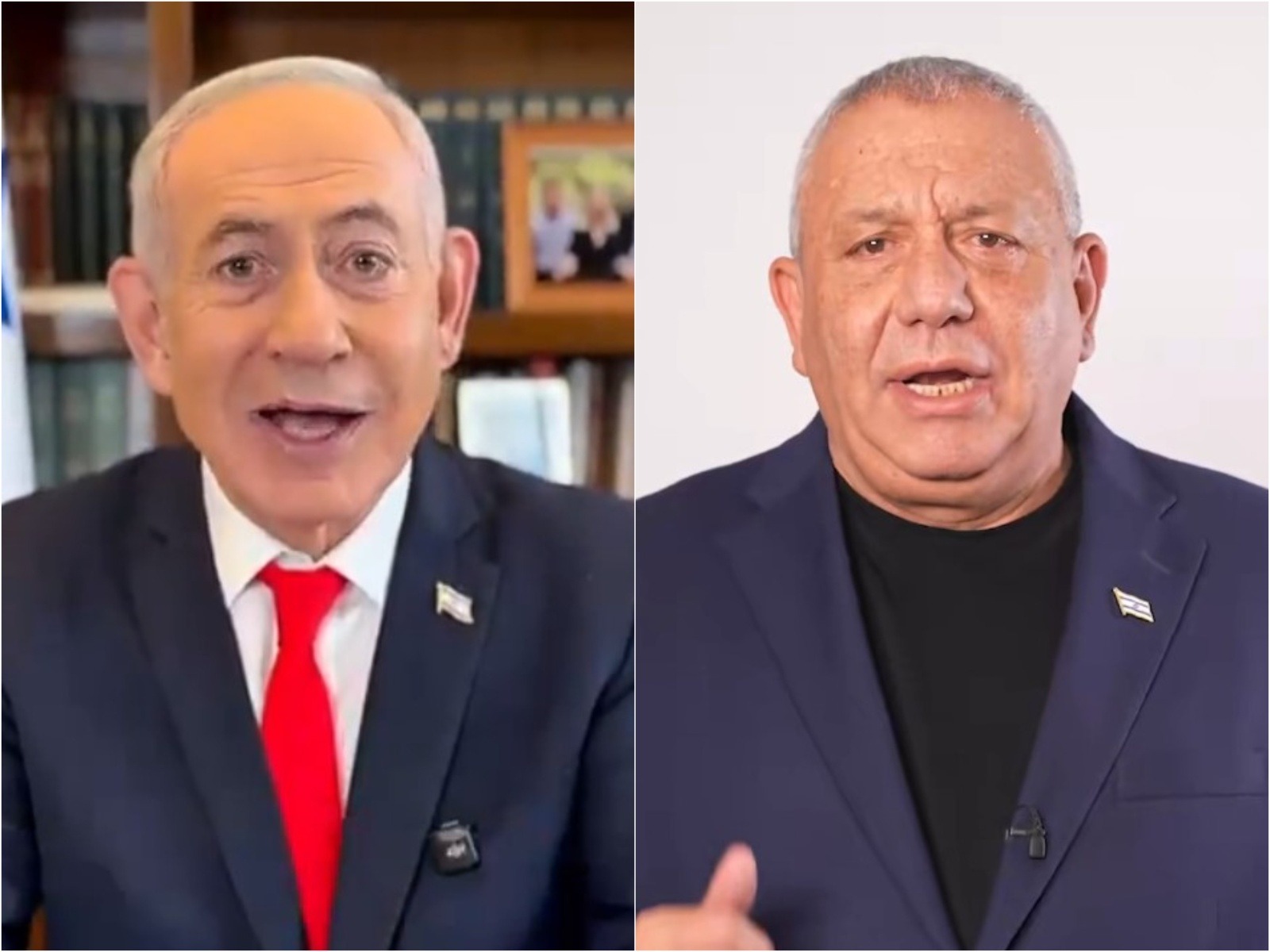
Jerusalem [Israel], October 26 (ANI): A day before citizens head to the “fateful” polls in what is widely regarded as a watershed moment for the nation, incumbent Prime Minister Benjamin Netanyahu and his chief rival, former military chief Gadi Eisenkot, have released intense, final video messages to rally voters.
Against a backdrop of profound regional tension, both leaders pulled no punches as they made their ultimate pitches to the Israeli electorate.
On one hand, Netanyahu rallied Russian-speaking Israelis using security assurances and promising to eliminate the Iranian threat alongside US President Donald Trump. On the other hand, Eisenkot warned voters against election-sabotaging disinformation, assuring legal action and urging voter vigilance ahead of the polls.
Directly addressing former residents of the Soviet Union, Prime Minister Netanyahu began his final plea by honouring the diaspora community, praising their foundational contributions across high-tech, industry, and academia, and highlighting his appointment of Major General Roman Gofman as Director of the Mossad as a testament to their representation and national pride.
“I meet you at every crossroads of Israeli society: in high-tech, in industry, in security, in academia,” Netanyahu stated in a video message shared on X.
Addressing his appointment of Gofman, he added, “He possesses deep intelligence, he possesses creativity, he possesses initiative, he possesses resourcefulness, and he possesses patriotism second to none. He is the best fit, and that is why he is there. He represents you, he represents all of us, and I believe he brings pride to all of us.”
Shifting his focus to the ballot box, Netanyahu urged voters to select the Likud party (Machal), launching a blistering critique against political rival Avigdor Lieberman. He accused Lieberman of crossing ideological lines and endangering the country.
“It would be a mistake to vote for Avigdor Lieberman, because Lieberman aligned himself with the Muslim Brotherhood. He formed a government in which he acted as the banker for Mansour Abbas of the Muslim Brotherhood, transferring billions to him — billions of your money, taxpayer money — to organisations supporting Hamas and to individuals who claim Hamas is a charitable organisation,” Netanyahu said.
Netanyahu also warned against Lieberman’s recent defence proposals, declaring, “Furthermore, he has completely lost his mind. A few days ago, he stated that a Jordanian army, an Arab army, should be brought into the heart of the country to guard us in Judea and Samaria. That is an enormous danger.”
Invoking international backing and framing the election as a clear choice for regional defence, Netanyahu concluded with a direct call to action alongside US President Donald Trump, who has endorsed the Israeli Prime Minister several times ahead of the elections.
“You want a strong right-wing government led by me, working alongside Donald Trump, who once again called on you today to vote for me, saying: ‘Together, he and I will eliminate the Iranian threat once and for all.’ So for the sake of Israel’s security, the future of your children and grandchildren, and the future of our country — vote Machal,” he stated.
https://x.com/netanyahu/status/2114711776650559678
On the opposing side, Yashar party leader Gadi Eisenkot used his final pre-election address to sound the alarm over a massive wave of dirty tricks, warning voters that malicious actors are attempting to subvert the democratic process in a “fateful 24-hour window.”
“We are in a fateful 24-hour window for the State of Israel,” Eisenkot warned the public in a video message shared on X. “Starting yesterday, a malicious disinformation campaign has been underway against Yashar. Fake text messages and fabricated voice recordings are being disseminated to the general public in my name and in the name of the party. Be aware: this will only escalate.”
Eisenkot cautioned that manipulation attempts would peak before the final ballot is cast, assuring voters that his legal teams are aggressively intervening.
“Until the polls close tomorrow, we will witness further attempts to improperly, cleverly, criminally, and maliciously influence the elections. Fake videos will be circulated, and false statements will be attributed to me — statements I never made,” Eisenkot said.
Underscoring Israel’s commitment to the rule of law, Eisenkot framed the cyber and disinformation onslaught as a direct assault on the democratic aspirations of the public:
“The State of Israel is a nation of laws, and we will not allow anyone to turn Israel into a third-world country. My campaign’s legal team is taking action before the Central Elections Committee against every such attempt. I say unequivocally: They are trying to sabotage change. I repeat: they are trying to sabotage the change that the citizens of Israel want,” he said.
Urging absolute vigilance, family discussions, and unity among political partners to resist wedges driven by opponents, Eisenkot issued a final rallying cry, calling for the public to discourage attempts to “drive a wedge between us.”
“This is the time for each of you to remain vigilant: Talk to your families, talk to your grandparents. I also call upon my partners: Do not cooperate with attempts to drive a wedge between us. This is a calculated effort aimed at harming everyone who seeks change. This is the time to show responsibility and vigilance. We will stand as a fortified wall against any attempt to disrupt the elections.”
https://x.com/gadi_eisenkot/status/2114677412004868152
In another post, Eisenkot wrote, “Change is on the way, and behind it are millions of Israelis who are saying in a clear voice – there is only one way to ensure the change! The “Way” slip is a double victory. We must have Yesh Atid! And Eizenkot will be great by a wide margin! Rotem and Asi! Courage and public integrity – this is Israeli leadership. I thank you for the support and love. Tomorrow we vote “Way” at the ballot box.”
As voting locations across the country prepare to seal their final logistical steps with polls scheduled to take place tomorrow, the starkly contrasting messages from Netanyahu and Eisenkot underscore the high stakes of a race that could reshape Israel’s political future and security posture for years to come.
For incumbent Benjamin Netanyahu, the narrative is simple: a projection that only he can keep the Iranian threat at bay especially with his endorsement from US President Trump. Netanyahu’s coalition comprises his own Likud Party, Finance Minister Bezalel Smotrich’s pro-settler Religious Zionism, and National Security Minister Itamar Ben-Gvir’s far-right party Jewish Power.
His closest rival is the former military chief Gadi Eisenkot, who has projected himself as a security hawk with an image of a political outsider.
The others include the alliance led by former Prime Ministers Naftali Bennett and Yair Lapid, former defence minister Avigdor Lieberman and a four-party coalition with a significant representation of the Arab minority in Israel headed by Yair Golan.
Meanwhile, residents across different age groups have expressed hopes for peace, political change and national unity, as the country faces the impact of prolonged conflict and continuing regional tensions.
Speaking to ANI, first-time voter Nave said Israel needed to reach agreements with other countries and Hamas in the Gaza Strip after three years of war, stressing that the prolonged conflict had significantly affected young people.
“My expectation from the government is that after three years of war, we need to get some agreements with the other countries and with Hamas in the Gaza Strip, and we need to get some peace and quiet because these three years of war have affected us very much as young people and as first-time voters,” Nave said.
Speaking about the expectations among his peers, Nave said most of his friends wanted a change in government, although some members of his family continued to support incumbent Prime Minister Benjamin Netanyahu.
“My circles, my friends, most of them think we need a change. Some, like my family, vote for the government we have now, still vote for Netanyahu, but most of our friends that are my age are voting for change,” he told ANI.
Another resident, Gideon Ros, expressed dissatisfaction with the prevailing situation in Israel, saying that repeated violence and conflict had made it difficult for people to live peacefully.
On women’s participation in political decision-making, Sharda said women should have a greater role in shaping decisions, stressing that the issue was relevant globally and not limited to Israel.
“I don’t think that the women suffer, but we need to be more. How do we say it? More involved in the decision like all women in the world, not particularly in Israel, and this is what I have to say,” she said.
Israel uses a party-list proportional representation system. Under this system, voters cast their ballots for lists of candidates, and each list receives a number of seats in the Knesset proportional to its share of the vote. Israel has an electoral threshold: only lists that receive at least 3.25% of the valid votes participate in the allocation of Knesset seats. The Knesset is made up of 120 Members.
After the elections, the President of the State, in this case Isaac Herzog, assigns the task of forming a government to a Member of the Knesset who may then present the government they have formed to the Knesset. For the government to be established, it must win a plurality in a “vote of confidence” held in the Knesset. To date, all governments formed in Israel have been coalition governments.
According to Jerusalem Post, the four latest election surveys, which closed on October 23, show that Gadi Eisenkot’s Yashar party leads Netanyahu’s Likud, but neither of the two major political blocs has enough seats to secure a majority in the 120-seat Knesset.
The battle lines are drawn firmly: consummate political survivor Bibi Netanyahu versus a former Military Chief in a no-holds-barred contest. The victory of either could well reshape not just the politics of Israel but also the situation in West Asia. (ANI)
Related reading