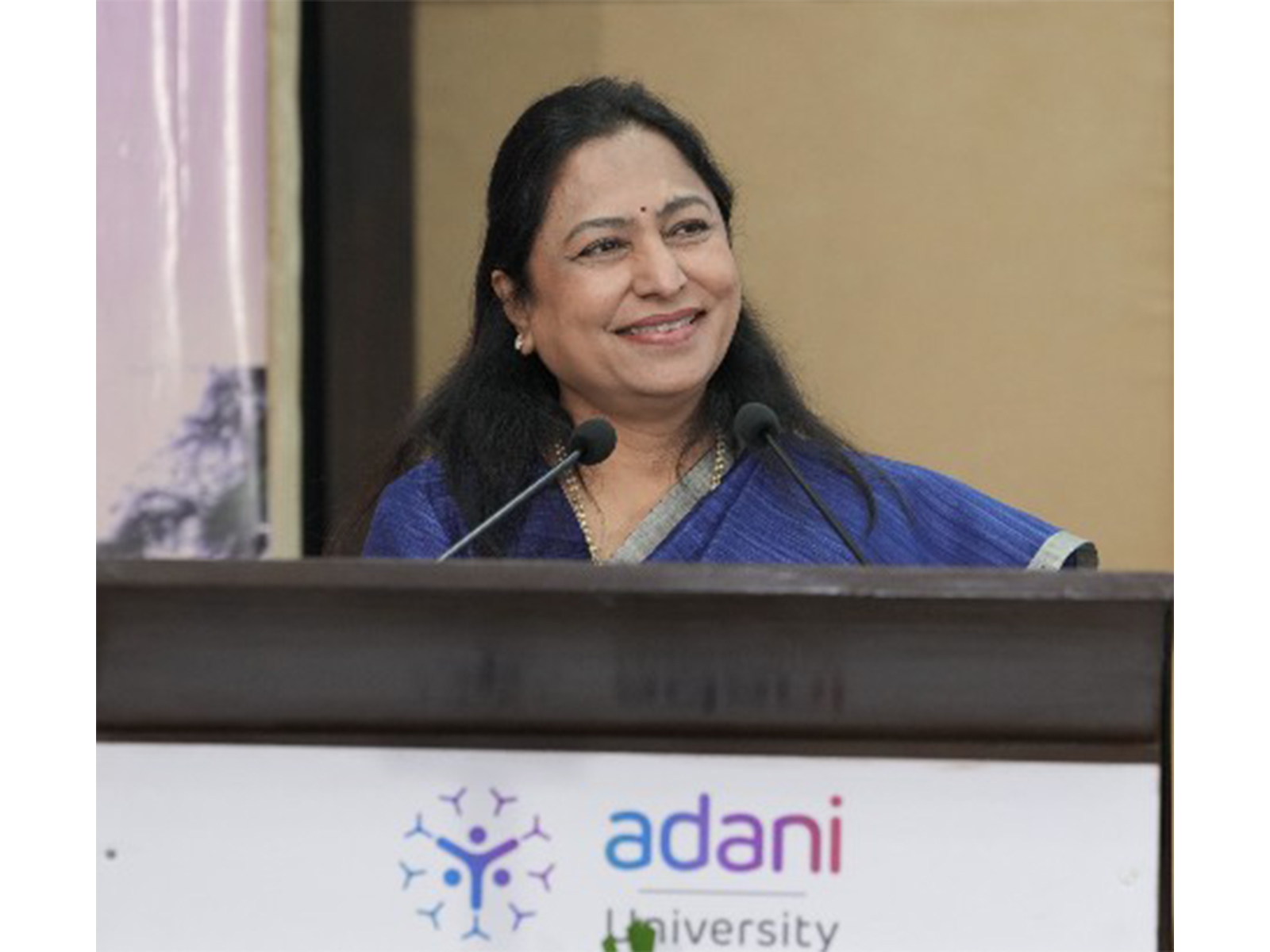
New Delhi [India], October 24 (ANI): Priti Adani, President of Adani University, has called for stronger industry-academia collaboration to develop skilled talent for India’s semiconductor ecosystem, saying technological progress will depend on “how wisely we develop and use human intelligence,” as the university plans to build expertise in chip design, manufacturing and packaging at its global campus in Ahmedabad, according to a company statement.
Addressing the Conclave on Hardware, Innovation, Processing and Semiconductor Technologies (CHIPS) 2026, Adani emphasised that building a strong semiconductor industry requires not only advanced manufacturing facilities but also a skilled workforce capable of designing, developing and improving complex technologies.
“The true measure of our technological progress will not be how intelligent our machines become. It will be how wisely we develop and use human intelligence to build a better future,” Adani said.
The release noted that India’s semiconductor ambitions extend beyond chip fabrication to developing capabilities in design, manufacturing and packaging, supported by the India Semiconductor Mission and ongoing projects at Dholera and Sanand, which are strengthening Gujarat’s position in the sector.
“India has already given the world remarkable technology talent. Now we have an opportunity to deepen what we can design, develop and manufacture, here at home, while working with partners across the world,” she said.
Meanwhile, the rapid growth of artificial intelligence (AI) is driving demand for advanced semiconductor chips, data centres and reliable power infrastructure.
Apart from this, Adani University is planning to build expertise in semiconductor design, manufacturing and packaging at its upcoming multidisciplinary global campus in Ahmedabad.
The university is proposing specialised programmes for young engineers, executive education for industry professionals and faculty development initiatives, aimed at aligning academic research and training with industry requirements.
“As we develop our new world-class, multidisciplinary global campus in Ahmedabad, our ambition is to bring education, research and industry together to solve real challenges. We plan to build capabilities in semiconductor design, manufacturing and packaging, connecting academic knowledge with practical innovation,” she added.
CHIPS 2026 was organised in collaboration with IIT Mandi, the VLSI Society of India, a professional body promoting Very Large-Scale Integration (VLSI) technology and its applications, and law firm Cyril Amarchand Mangaldas.
The event brought together representatives from the Gujarat State Electronics Mission, semiconductor companies and academic institutions, with discussions focusing on aligning research and technical education with industry requirements. (ANI)
Related reading