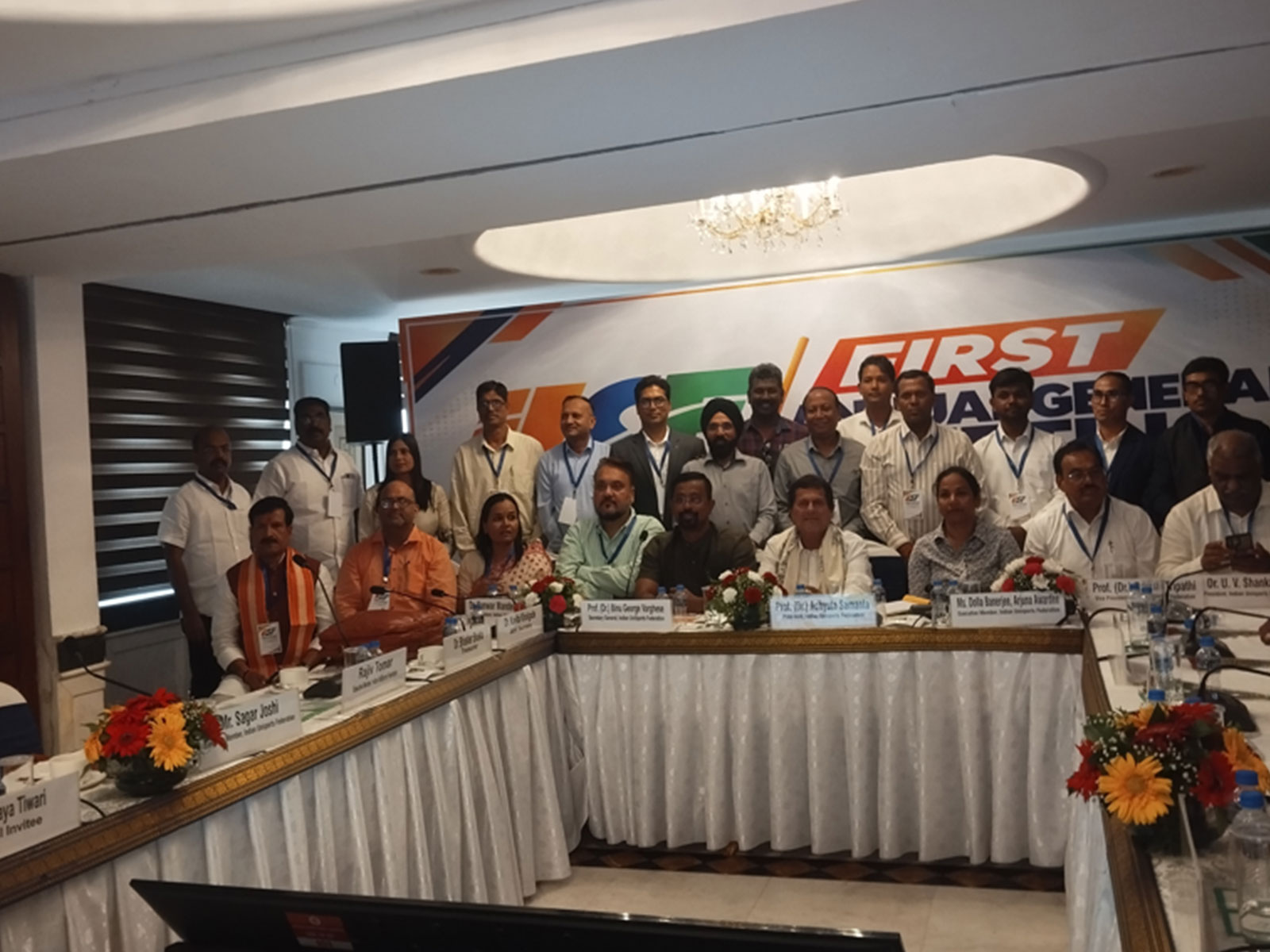
New Delhi [India], October 12 (ANI): Prof. Achyuta Samanta, educationist, social worker and Founder of KIIT and KISS, has been unanimously elected the first president of the Indian UniSport Federation (IUSF) at the federation’s first Annual General Meeting held in New Delhi on Sunday, according to a press release.
The formation of IUSF marks an important step towards strengthening university-level sport in India through a more coordinated, inclusive and athlete-centred framework.
The federation has been established with the approval of the Ministry of Youth Affairs and Sports with the objective of bringing universities onto a common platform and supporting the identification, development, training and progression of sporting talent. Representatives of 27 state and regional university sports associations were listed as present at the meeting, reflecting broad participation from across the country.
Accepting the responsibility, Prof. Samanta expressed his gratitude to the Ministry of Youth Affairs and Sports, the government of India, universities, athletes, sports administrators and all members who have joined hands with IUSF. He said that university sport must offer every talented athlete a fair opportunity to compete and progress, irrespective of background or institution. He also emphasised that the federation would work collaboratively with members and stakeholders to build a stronger future for university sport in India.
The federation will work towards realising Prime Minister Narendra Modi’s vision of developing sport in the country and further strengthening India’s position on the global sporting map. Prof. Samanta expressed his gratitude to the Union Minister of Youth Affairs and Sports, Mansukh Mandaviya, for approving the federation.
Addressing concerns raised by universities around membership and registration fees, support for host institutions and athletes, access to financial information, and the selection of sports officials and committees, Samanta stressed the importance of transparent, evidence-based decision-making. The federation’s stated priorities include clear rules, accountable governance and accessible information on how decisions are made and how funds are used.
As part of its proposed commitments, IUSF has outlined a uniform annual subscription of Rs 50,000 for government and private institutions. There will be no individual participation fee for players. Any participation fees collected from state governments, state sports federations, or universities will be utilised and shared for the benefit and welfare of players. Assistance to universities would be guided by clear criteria, including sporting performance and demonstrated need.
The federation’s proposed athlete-focused measures include greater access to quality coaching, sports science, nutrition, injury prevention and rehabilitation; education and financial assistance for leading athletes; and efforts to reduce participation costs. IUSF also plans to encourage university leagues and regular competitions, create fair pathways to events such as the Khelo India Games, and strengthen the university-athlete pipeline in support of India’s ambitions for the 2030 Commonwealth Games and the 2036 Olympic Games.
Fair competition and selection will be another priority. The proposed measures include publishing eligibility rules, selection criteria and competition calendars in advance; using independent, sport-specific selection panels; providing clear appeal procedures; and establishing independent grievance redressal mechanisms at competitions. The federation has also identified publication of audited annual accounts, sports-related expenditure and the use of membership and registration fees as important elements of transparent governance.
IUSF also intends to build stronger relationships with the International University Sports Federation (FISU) and other international university sports bodies, increase international competition opportunities for Indian university athletes, and develop the capacity to host major sporting events to international standards.
Speaking about the experience of KIIT and KISS, Samanta highlighted the importance of combining education with sporting opportunity, quality coaching, competition, and athlete care. KIIT and KISS athletes have represented India at the Olympics, Asian Games, Commonwealth Games and World University Games. KIIT has served as India’s nodal university for the World University Games since Napoli 2019 and has supported the Indian contingent and athlete participation.
At the 2025 FISU World University Games, 40 KIIT athletes formed India’s largest university contingent, while India won six medals. At the 2025 Khelo India University Games, KIIT finished seventh among 222 universities, winning 21 medals and setting three Games records. KIIT and KISS together provide more than 30 sports facilities, specialist coaching, sports science, nutrition, rehabilitation and medical support. Through KISS, thousands of Indigenous students, including girls, access sporting pathways alongside education, accommodation and essential support. The campuses also host national and international competitions and make facilities available to more than 150,000 athletes each year.
The leadership team listed in the meeting documents includes Prof. Rajesh Tripathi, U. V. Shankar, Prof. Kalpana Sharma and Kanwar Mandeep Singh as Vice Presidents; Binu George Varghese as Secretary General; Bhasker Shukla as Treasurer; Kavita Kholgade and Kaukab Azeem as Joint Secretaries; and V. Mahadevan, Aminul Haq, Arjuna Awardee Dolla Banerjee, Sagar Joshi, Padma Shri Anju Bobby George and Rajiv Tomar as Executive Members.
The first Annual General Meeting concluded with an invitation to all member associations and universities to contribute ideas and participate actively in strengthening the federation’s governance and programmes. IUSF aims to be judged by the opportunities it creates for athletes, the fairness of its decisions and the support it extends to universities.
Through collective effort, IUSF seeks to build a stronger and more accessible university sports ecosystem, identify and nurture talent across the country, and provide India’s young athletes with a stronger platform to grow, compete internationally and bring glory to the nation. (ANI)
Related reading