New Delhi [India], October 9 (ANI): The world around Abhijeet Mandal is changing fast. Machines are getting smarter, artificial intelligence is taking over more corners of everyday life, and technology can now create images in seconds.
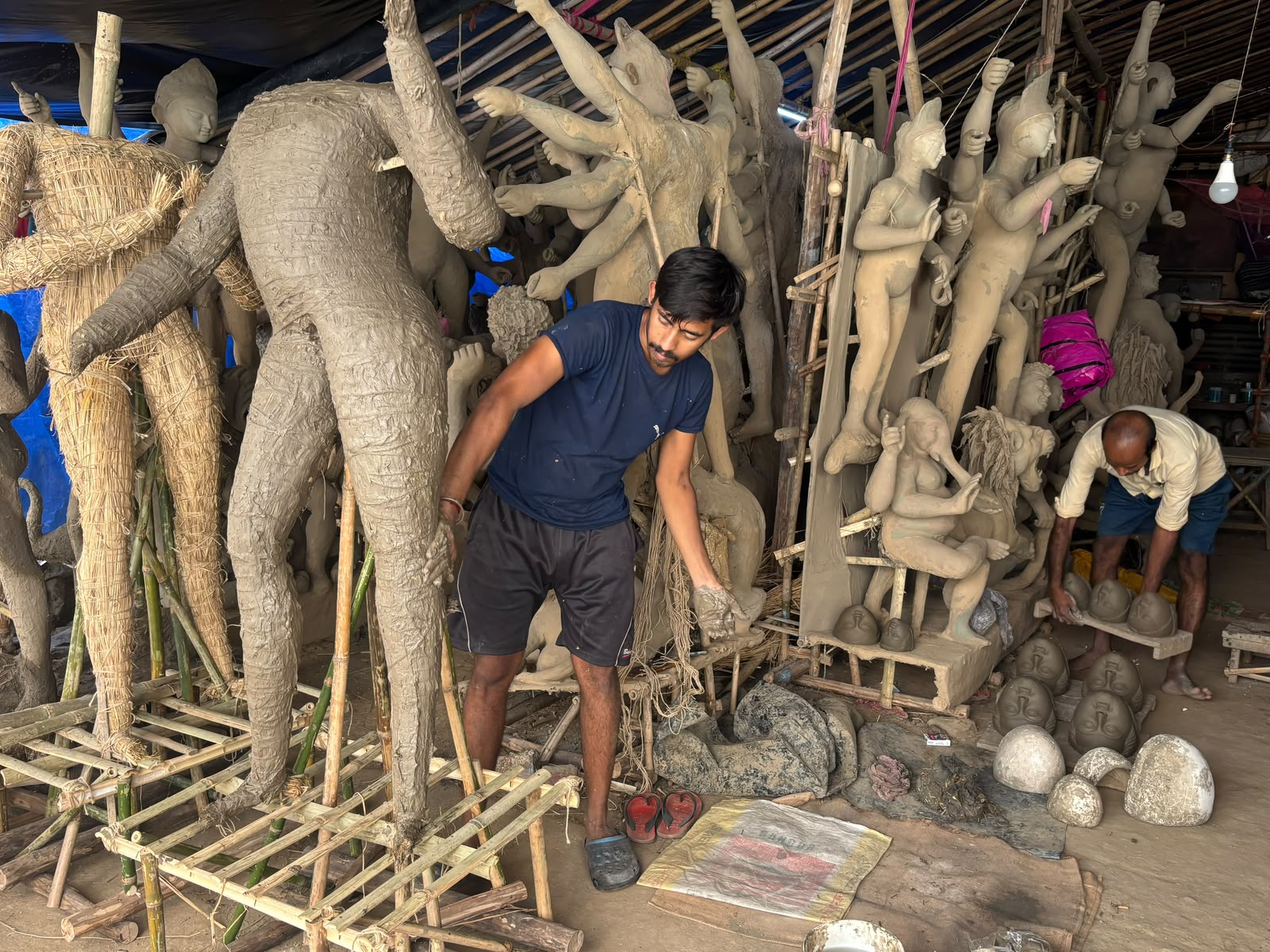
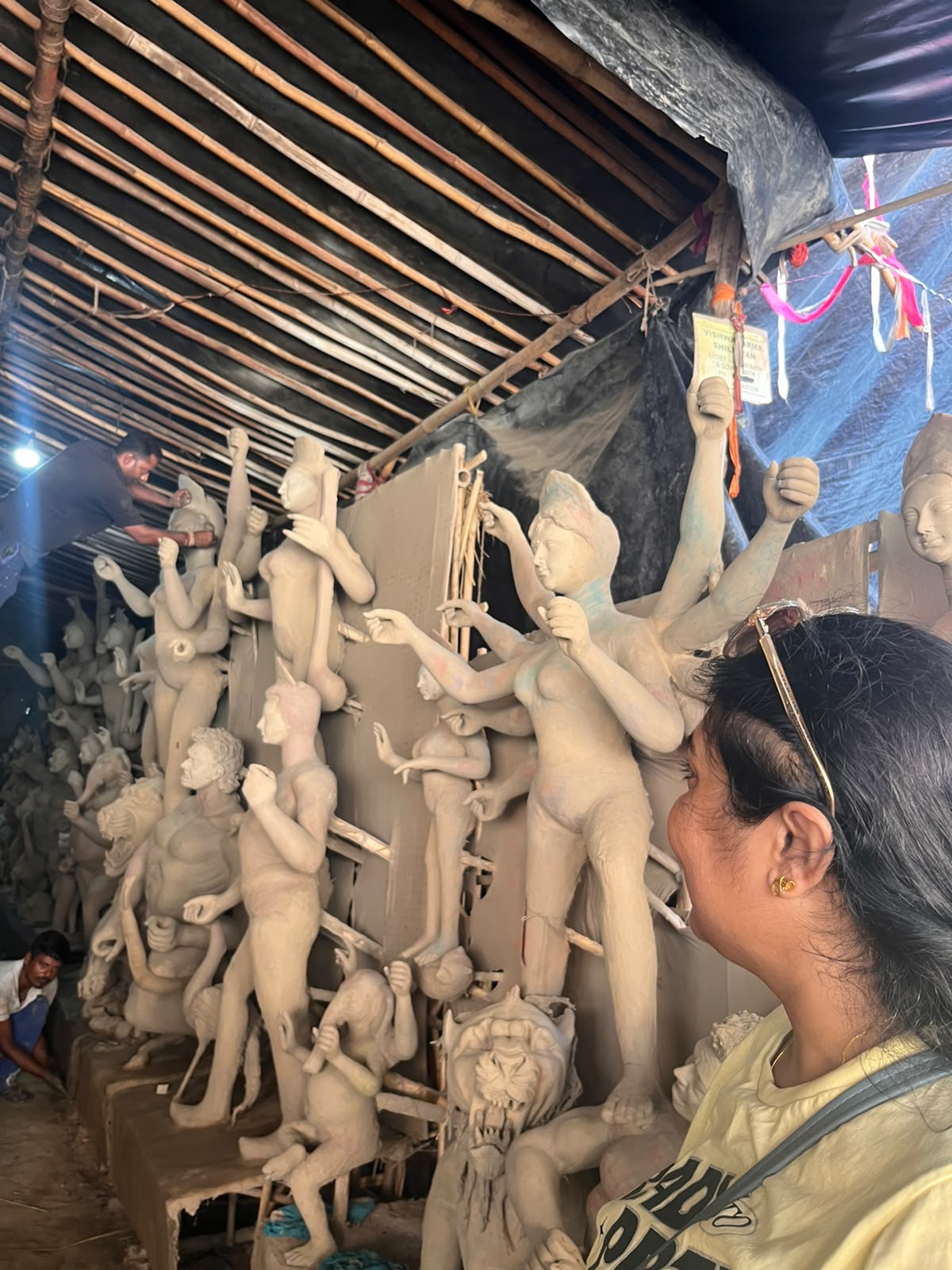
But in one corner of CR Park, 32-year-old Mandal is still working the old-fashioned way — with his hands, a lump of clay and an eye trained to get the proportions of Goddess Durga just right.
“AI can make many things today, but can it make this?” he asks, looking at the idol taking shape in front of him. For Mandal, the answer is in the details — the face of Durga, the posture of Mahishasura, the expressions, the proportions and the patience required to bring an idol to life.
The question is particularly relevant here. With barely a fortnight to go for Durga Puja, CR Park’s Kali Bari is turning into a giant workshop, where bamboo, cloth, clay and colour are coming together ahead of the festival. And many of the hands doing the work have travelled from West Bengal, leaving their homes during the festive season for a simple reason: Delhi pays better.
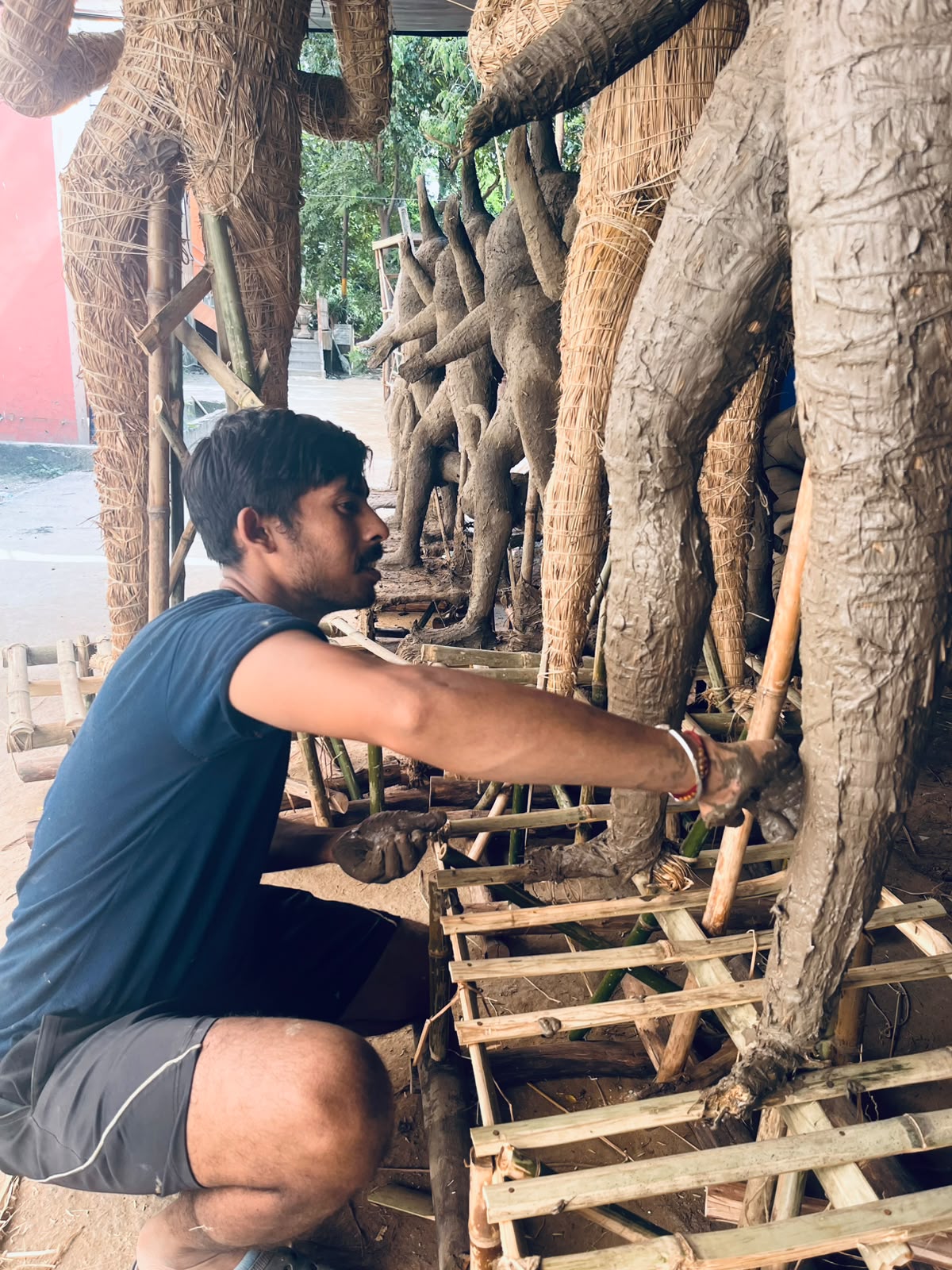
Mandal came to Delhi from Kalighat in August. He will spend nearly three months here, making not just Durga but the entire family — Saraswati, Lakshmi, Ganesh and Kartik, along with their vahanas.
He is among at least 30 artisans who have come from different parts of West Bengal for the season.
Back home, Mandal said, an artisan can earn around Rs 10,000-12,000 a month, despite the long hours, intricate detailing and nights spent finishing idols. In Delhi, that figure can rise to around Rs 15,000-16,000.
It may not seem like a dramatic difference, but for artisans who live by seasonal work, that extra income is reason enough to leave home when the rest of Bengal is preparing to celebrate.
“When people say we come here for ‘handsome money’, it doesn’t mean we become rich. It means we get a little extra for the work we do,” Mandal said, explaining why he makes the journey every year.
There is an irony to the timing. While millions prepare to welcome Durga, the people who make the goddess often have to leave their own homes to do so.
Mandal’s fingers are busy as he speaks. He dips a piece of cloth in liquid clay and carefully places it over the idol’s structure, adding another layer to the figure.
The technique is slow. There is no shortcut.
“An idol can be made anywhere, but this particular craft comes from Bengal and has been passed down through generations. You need patience, practice and an understanding of how the face and body have to be shaped. You cannot learn all of that from a machine,” he said.
For Mandal, the craft is also a family inheritance. He did not get much formal education because of financial difficulties. His father was an idol maker, and he eventually followed him into the profession.
He does not romanticise the work. It is physically demanding and financially uncertain. But he also believes that its value lies precisely in the human touch that machines cannot replicate.
“Machines can copy a design, but an artisan understands the idol while making it. The hands know how much clay to use, where to add a little more and where to remove it. That is what gives the idol its expression,” he said.
As Mandal and the other artisans work, CR Park residents keep dropping in to watch the preparations. Some click pictures. Others stand around discussing the design of the pandal. For many, watching the festival being built is almost as important as attending it once it is ready.
Among them are sisters Soma and Rimi Roy, both in their early 30s, who grew up in the lanes of CR Park.
For the sisters, Durga Puja is not something that arrives suddenly on the calendar. It begins taking shape weeks in advance — in the bamboo structures, the paint, the idols and, increasingly, in the involvement of younger members of the community.
Rimi points towards a wooden arch being prepared above the idols. To her, it is not merely decorative.
She explains that the arch represents the coming together of Durga and her children during their annual visit to their maternal home. According to the tradition passed down by elders, an image of Lord Shiva is placed above Durga, symbolising his permission for Uma to make the journey. The idols of her children are made separately and then brought together beneath the arch.
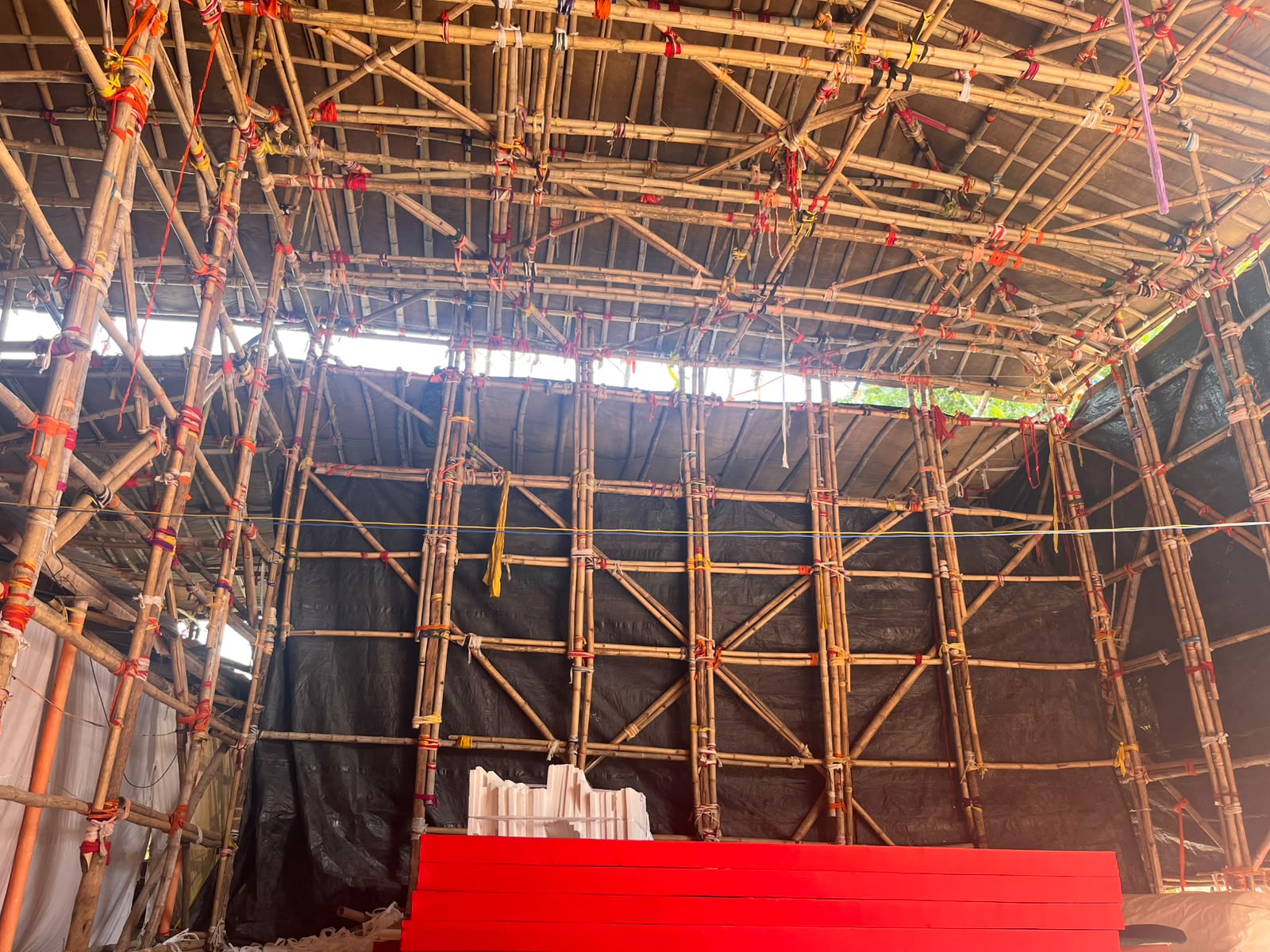
“It is not just an arch for us. It brings everyone together — Durga, her children and the story of her coming home. These are things we learnt from our elders, and now the younger generation is seeing and understanding them too,” Rimi said.
That younger generation is not merely watching.
Soma’s children are among those helping with the interiors and exterior decorations of the pandal. Around them, other young residents are also pitching in, turning up to paint, decorate, photograph and simply spend time around the artisans.
For Soma, that participation matters because it gives children a chance to experience the festival before the lights come on and the crowds arrive.
“The children are not just coming here to see the pandal. They are helping make it. That is how the connection with the festival continues,” she said.
A little away from the idol-making area, another piece of Bengal’s cultural memory is taking shape on a much smaller canvas.
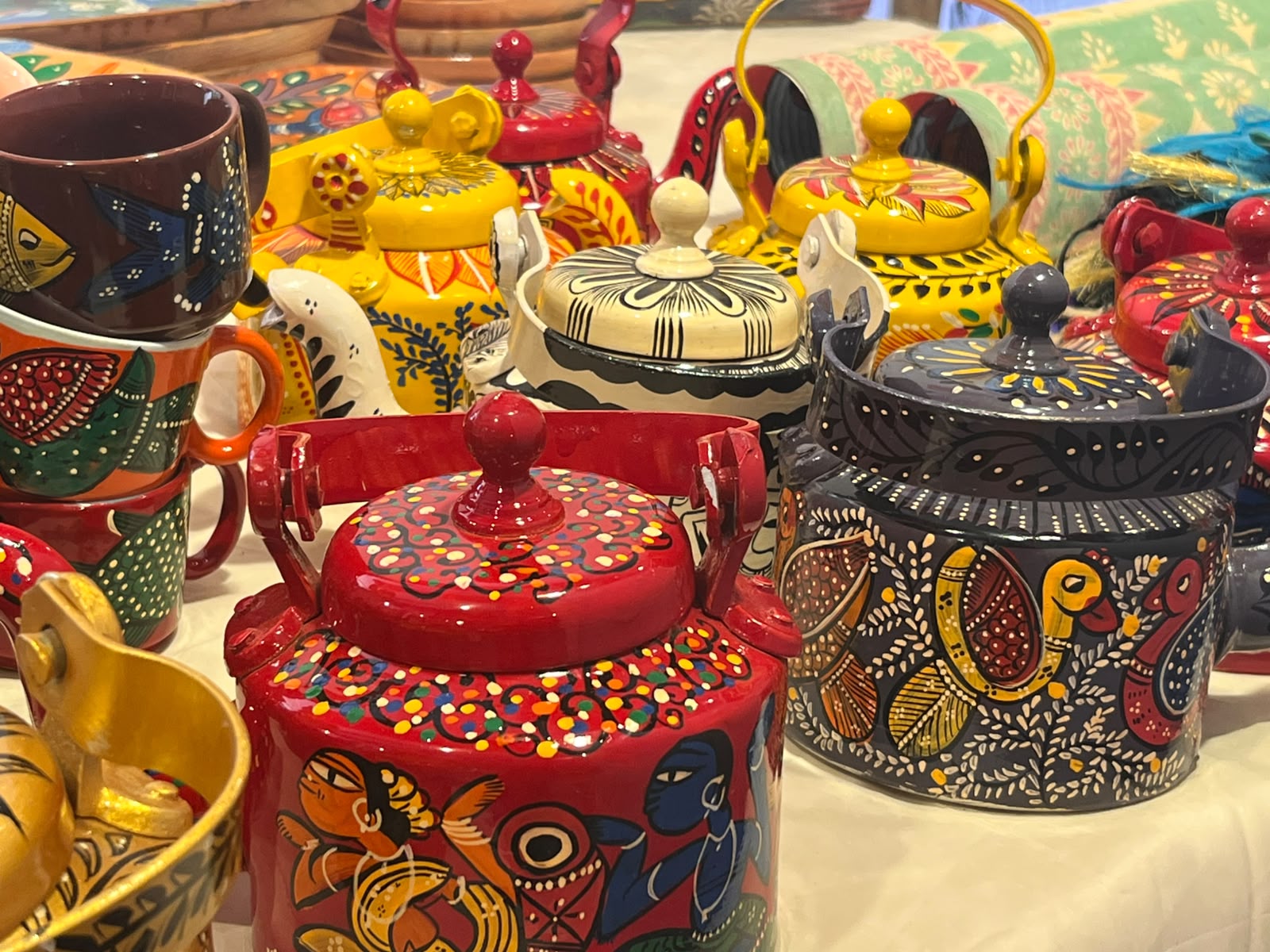
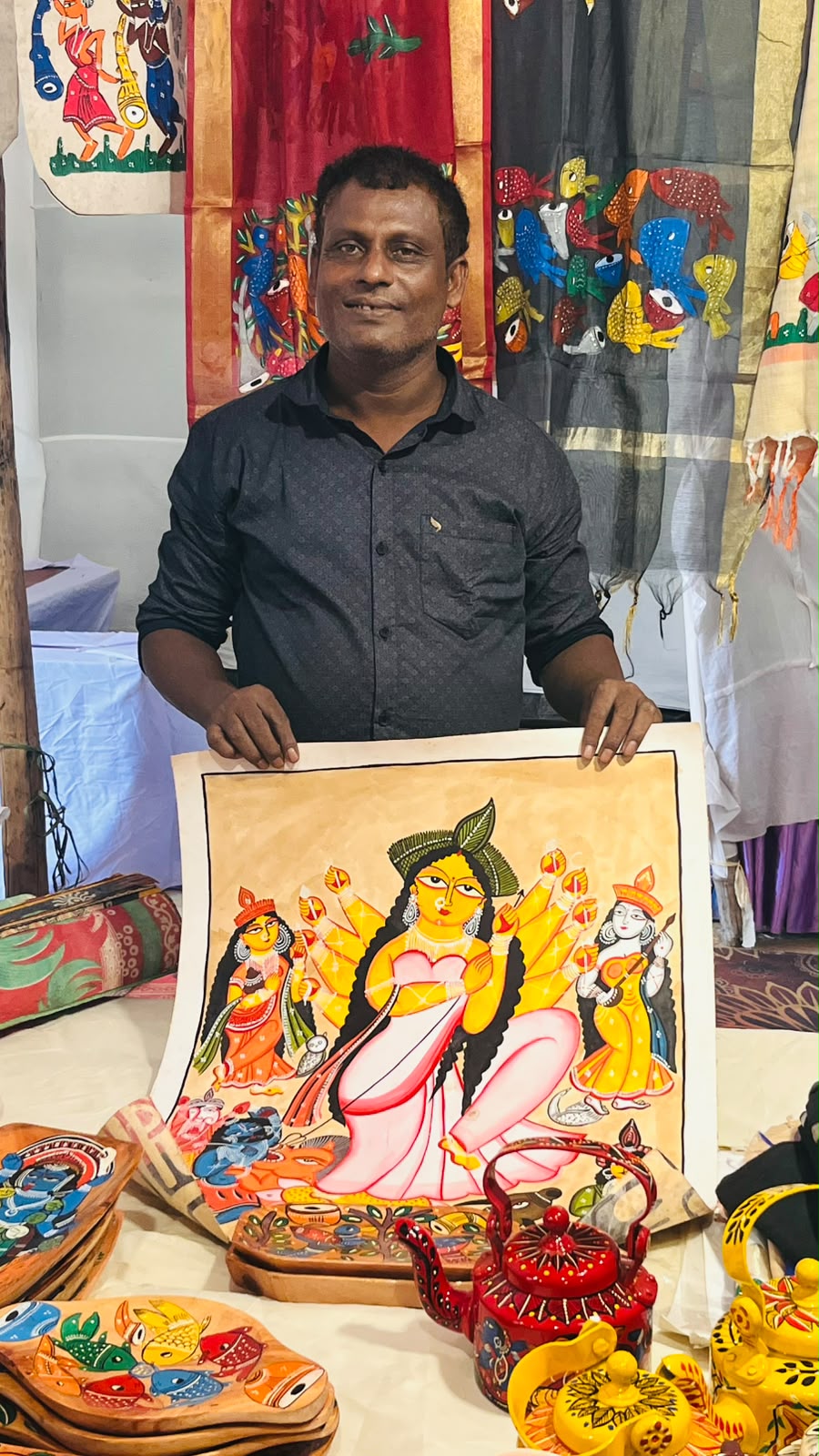
Folk artist Bapi Ghosh, 54, has brought Pattachitra and Kalighat-style paintings from West Bengal’s Medinipur district to the Puja stalls at CR Park Kali Bari.
His paintings tell stories — some mythological, some humorous, some rooted in everyday life. There are episodes from the Ramayana, stories about the beginning of Durga Puja, tribal dances and communities, and even the whimsical tale of fish getting married.
Traditionally, the paintings were never meant to be silent objects hanging on a wall. The Chitrakar would carry them from village to village, unfolding the images while singing the stories they depicted.
“When there was no television or cinema, we would go from house to house with these paintings and sing the stories. People would give us rice or money in return,” Ghosh said.
Today, the same stories travel differently. His paintings have reached Delhi, Pune, Jaipur and Ajmer, while some works depicting Mahishasura Mardini have travelled as far as the US.
Yet the journey of the art has remained a family affair.
Ghosh learnt the craft from his father, who had learnt it from the previous generation. Now, he hopes his daughter, currently in Class 12, will take it forward.
“My grandfather was uneducated, my father studied, I studied, and now my daughter is in Class 12. Every generation is moving forward, but the art is moving with us,” he said.
That perhaps captures the larger story unfolding in CR Park this Puja season.
For the artisans from Bengal, Delhi offers a few extra thousand rupees — enough to make leaving home worthwhile. For the Bengali community, their arrival brings with it something money cannot quite measure: the hands, techniques, stories and traditions that make the festival feel like home.
And for a new generation growing up in Delhi, the festival is becoming something they do, rather than something they simply inherit.
The bamboo will eventually be covered. The clay idols will be painted. The lights will come on. The crowds will arrive.
But before Durga Puja becomes a spectacle, it is being built quietly — one bamboo joint, one layer of clay, one brushstroke and one human hand at a time. (ANI)
Related reading